Sign In Start Free Trial
Account

Add to playlist

Create a Playlist

Modal Close icon
You need to login to use this feature.
  • Book Overview & Buying Artificial Intelligence and Machine Learning Fundamentals
  • Table Of Contents Toc
Artificial Intelligence and Machine Learning Fundamentals

Artificial Intelligence and Machine Learning Fundamentals

By : Nagy
4.3 (110)
close
close
Artificial Intelligence and Machine Learning Fundamentals

Artificial Intelligence and Machine Learning Fundamentals

4.3 (110)
By: Nagy

Overview of this book

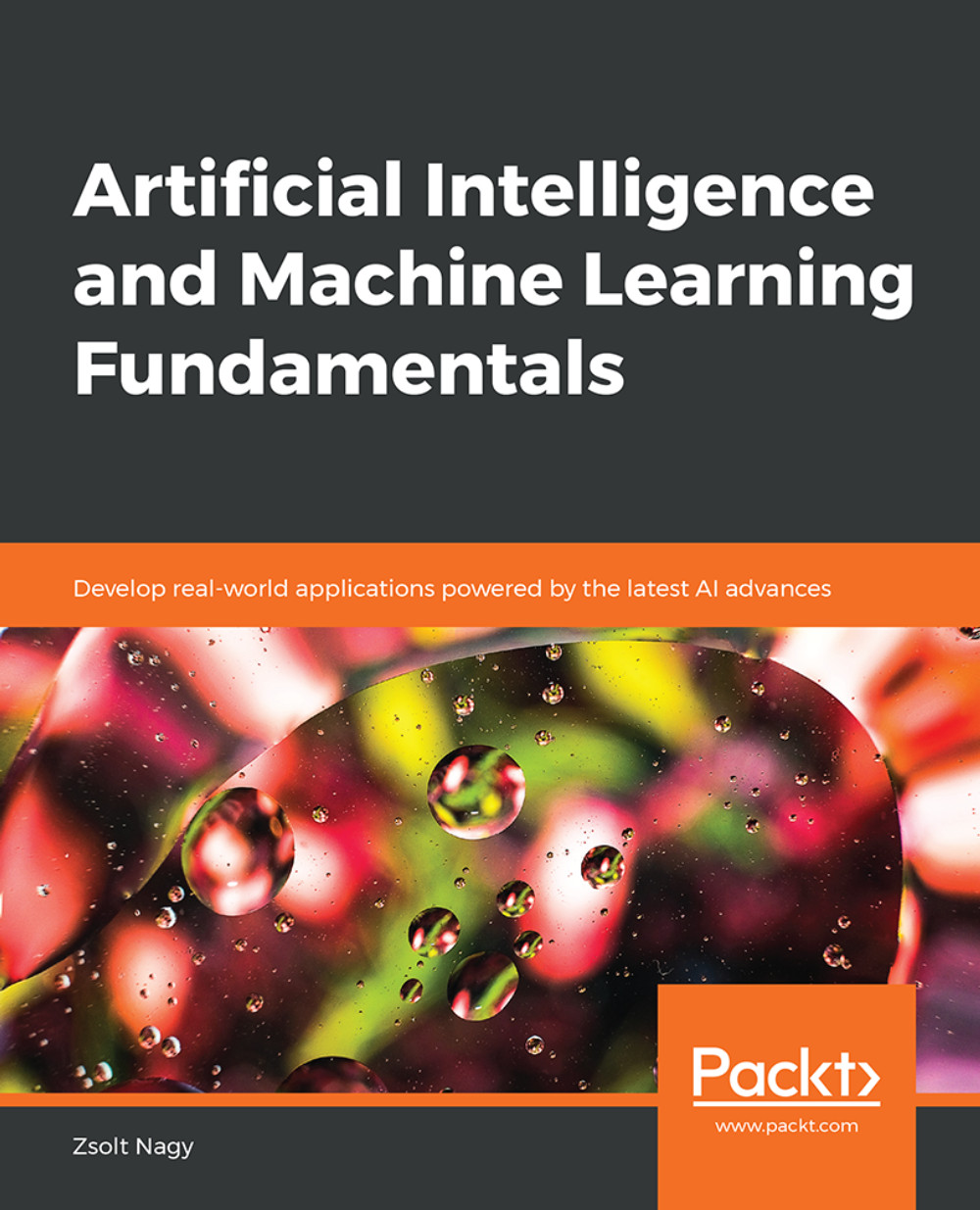
Machine learning and neural networks are pillars on which you can build intelligent applications. Artificial Intelligence and Machine Learning Fundamentals begins by introducing you to Python and discussing AI search algorithms. You will cover in-depth mathematical topics, such as regression and classification, illustrated by Python examples. As you make your way through the book, you will progress to advanced AI techniques and concepts, and work on real-life datasets to form decision trees and clusters. You will be introduced to neural networks, a powerful tool based on Moore's law. By the end of this book, you will be confident when it comes to building your own AI applications with your newly acquired skills!
Table of Contents (9 chapters)
close
close

The Fundamentals of Classification


While regression focuses on creating a model that best fits our data to predict the future, classification is all about creating a model that separates our data into separate classes.

Assuming that you have some data belonging to separate classes, classification helps you predict the class a new data point belongs to. A classifier is a model that determines the label value belonging to any data point in the domain. Suppose you have a set of points, P = {p1, p2, p3, ..., pm}, and another set of points, Q = {q1, q2, q3, ..., qn}. You treat these points as members of different classes. For simplicity, we could imagine that P contains credit-worthy individuals, and Q contains individuals that are risky in terms of their credit repayment tendencies.

You can divide the state space so that all points in P are on one cluster of the state space, and then disjoint from the state space cluster containing all points in Q. Once you find these bounded spaces, called clusters...

CONTINUE READING
83
Tech Concepts
36
Programming languages
73
Tech Tools
Icon Unlimited access to the largest independent learning library in tech of over 8,000 expert-authored tech books and videos.
Icon Innovative learning tools, including AI book assistants, code context explainers, and text-to-speech.
Icon 50+ new titles added per month and exclusive early access to books as they are being written.
Artificial Intelligence and Machine Learning Fundamentals
notes
bookmark Notes and Bookmarks search Search in title playlist Add to playlist font-size Font size

Change the font size

margin-width Margin width

Change margin width

day-mode Day/Sepia/Night Modes

Change background colour

Close icon Search
Country selected

Close icon Your notes and bookmarks

Confirmation

Modal Close icon
claim successful

Buy this book with your credits?

Modal Close icon
Are you sure you want to buy this book with one of your credits?
Close
YES, BUY

Submit Your Feedback

Modal Close icon
Modal Close icon
Modal Close icon