Sign In Start Free Trial
Account

Add to playlist

Create a Playlist

Modal Close icon
You need to login to use this feature.
  • Book Overview & Buying Artificial Intelligence and Machine Learning Fundamentals
  • Table Of Contents Toc
Artificial Intelligence and Machine Learning Fundamentals

Artificial Intelligence and Machine Learning Fundamentals

By : Nagy
4.3 (110)
close
close
Artificial Intelligence and Machine Learning Fundamentals

Artificial Intelligence and Machine Learning Fundamentals

4.3 (110)
By: Nagy

Overview of this book

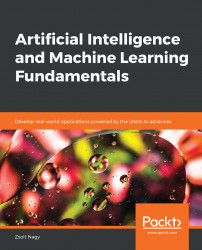
Machine learning and neural networks are pillars on which you can build intelligent applications. Artificial Intelligence and Machine Learning Fundamentals begins by introducing you to Python and discussing AI search algorithms. You will cover in-depth mathematical topics, such as regression and classification, illustrated by Python examples. As you make your way through the book, you will progress to advanced AI techniques and concepts, and work on real-life datasets to form decision trees and clusters. You will be introduced to neural networks, a powerful tool based on Moore's law. By the end of this book, you will be confident when it comes to building your own AI applications with your newly acquired skills!
Table of Contents (9 chapters)
close
close

AI Tools and Learning Models

In the previous sections, we discovered the fundamentals of artificial intelligence. One of the core tasks for artificial intelligence is learning.

Intelligent Agents

When solving AI problems, we create an actor in the environment that can gather data from its surroundings and influence its surroundings. This actor is called an intelligent agent.

An intelligent agent:

  • Is autonomous
  • Observes its surroundings through sensors
  • Acts in its environment using actuators
  • Directs its activities toward achieving goals

Agents may also learn and have access to a knowledge base.

We can think of an agent as a function that maps perceptions to actions. If the agent has an internal knowledge base, perceptions, actions, and reactions may alter the knowledge base as well.

Actions may be rewarded or punished. Setting up a correct goal and implementing a carrot and stick situation helps the agent learn. If goals are set up correctly, agents have a chance of beating the often more complex human brain. This is because the number one goal of the human brain is survival, regardless of the game we are playing. An agent's number one motive is reaching the goal itself. Therefore, intelligent agents do not get embarrassed when making a random move without any knowledge.

Classification and Prediction

Different goals require different processes. Let's explore the two most popular types of AI reasoning: classification and prediction.

Classification is a process for figuring out how an object can be defined in terms of another object. For instance, a father is a male who has one or more children. If Jane is a parent of a child and Jane is female, then Jane is a mother. Also, Jane is a human, a mammal, and a living organism. We know that Jane has a nationality as well as a date of birth.

Prediction is the process of predicting things, based on patterns and probabilities. For instance, if a customer in a standard supermarket buys organic milk, the same customer is more likely to buy organic yoghurt than the average customer.

Learning Models

The process of AI learning can be done in a supervised or unsupervised way. Supervised learning is based on labeled data and inferring functions from training data. Linear regression is one example. Unsupervised learning is based on unlabeled data and often works on cluster analysis.

CONTINUE READING
83
Tech Concepts
36
Programming languages
73
Tech Tools
Icon Unlimited access to the largest independent learning library in tech of over 8,000 expert-authored tech books and videos.
Icon Innovative learning tools, including AI book assistants, code context explainers, and text-to-speech.
Icon 50+ new titles added per month and exclusive early access to books as they are being written.
Artificial Intelligence and Machine Learning Fundamentals
notes
bookmark Notes and Bookmarks search Search in title playlist Add to playlist font-size Font size

Change the font size

margin-width Margin width

Change margin width

day-mode Day/Sepia/Night Modes

Change background colour

Close icon Search
Country selected

Close icon Your notes and bookmarks

Confirmation

Modal Close icon
claim successful

Buy this book with your credits?

Modal Close icon
Are you sure you want to buy this book with one of your credits?
Close
YES, BUY

Submit Your Feedback

Modal Close icon
Modal Close icon
Modal Close icon