Sign In Start Free Trial
Account

Add to playlist

Create a Playlist

Modal Close icon
You need to login to use this feature.
  • Book Overview & Buying Principles of Data Science
  • Table Of Contents Toc
Principles of Data Science

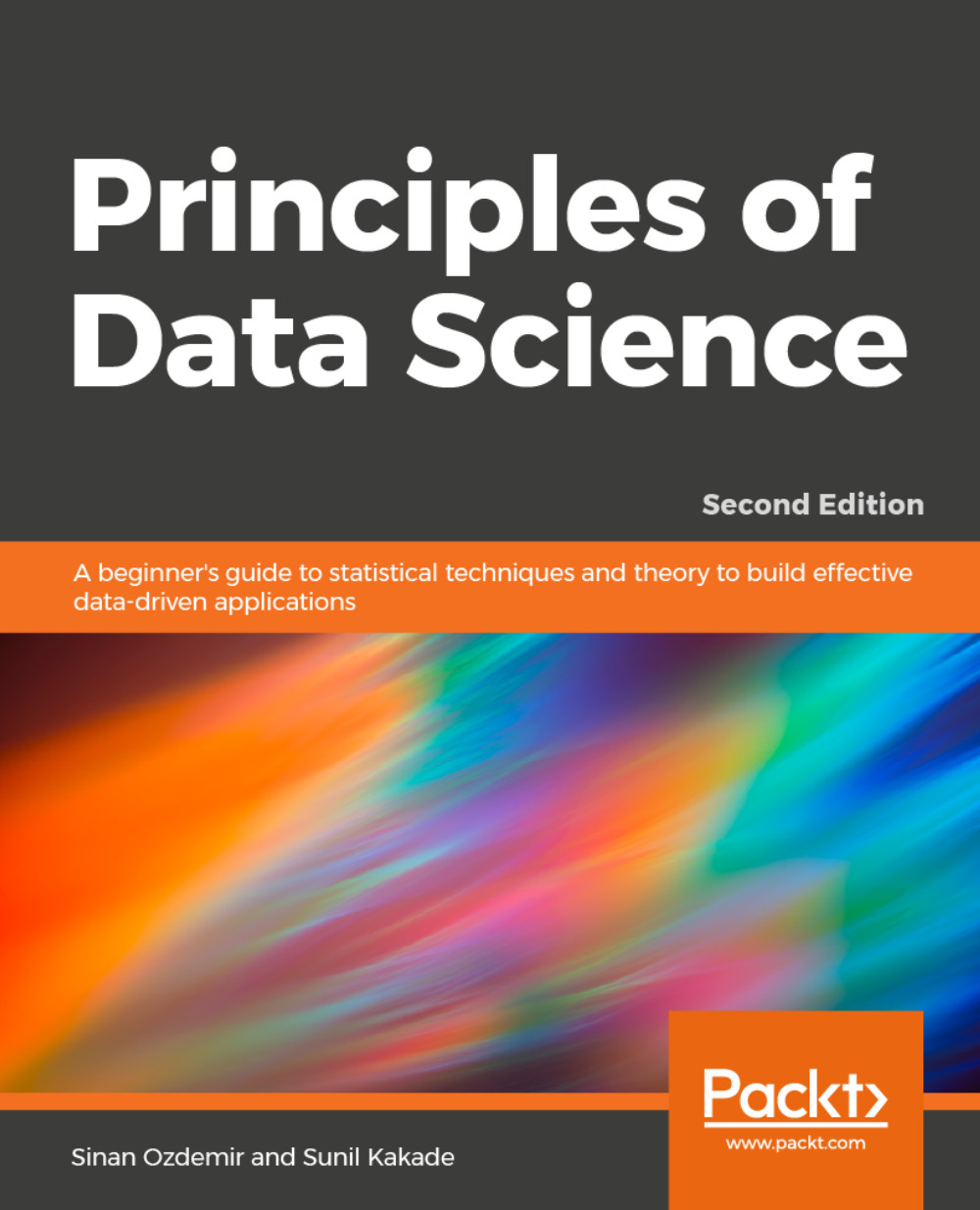
Principles of Data Science - Second Edition

By : Sinan Ozdemir, Kakade, Tibaldeschi
close
close
Principles of Data Science

Principles of Data Science

By: Sinan Ozdemir, Kakade, Tibaldeschi

Overview of this book

Need to turn programming skills into effective data science skills? This book helps you connect mathematics, programming, and business analysis. You’ll feel confident asking—and answering—complex, sophisticated questions of your data, making abstract and raw statistics into actionable ideas. Going through the data science pipeline, you'll clean and prepare data and learn effective data mining strategies and techniques to gain a comprehensive view of how the data science puzzle fits together. You’ll learn fundamentals of computational mathematics and statistics and pseudo-code used by data scientists and analysts. You’ll learn machine learning, discovering statistical models that help control and navigate even the densest datasets, and learn powerful visualizations that communicate what your data means.
Table of Contents (17 chapters)
close
close
16
Index

Case study 3 – Using TensorFlow

I would like to finish off our time together by looking at a somewhat more modern machine learning module called TensorFlow.

TensorFlow is an open source machine learning module that is used primarily for its simplified deep learning and neural network abilities. I would like to take some time to introduce the module and solve a few quick problems using TensorFlow. The syntax for TensorFlow (like PyBrain in Chapter 12, Beyond the Essentials) is a bit different than our normal scikit-learn syntax, so I will be going over it step by step. Let's start with some imports:

from sklearn import datasets, metrics 
import tensorflow as tf 
import numpy as np 
from sklearn.cross_validation import train_test_split 
%matplotlib inline 

Our imports from sklearn include train_test_split, datasets, and metrics. We will be utilizing our train test splits to reduce overfitting, we will use datasets in order to import our iris classification data, and we'll use...

CONTINUE READING
83
Tech Concepts
36
Programming languages
73
Tech Tools
Icon Unlimited access to the largest independent learning library in tech of over 8,000 expert-authored tech books and videos.
Icon Innovative learning tools, including AI book assistants, code context explainers, and text-to-speech.
Icon 50+ new titles added per month and exclusive early access to books as they are being written.
Principles of Data Science
notes
bookmark Notes and Bookmarks search Search in title playlist Add to playlist download Download options font-size Font size

Change the font size

margin-width Margin width

Change margin width

day-mode Day/Sepia/Night Modes

Change background colour

Close icon Search
Country selected

Close icon Your notes and bookmarks

Confirmation

Modal Close icon
claim successful

Buy this book with your credits?

Modal Close icon
Are you sure you want to buy this book with one of your credits?
Close
YES, BUY

Submit Your Feedback

Modal Close icon
Modal Close icon
Modal Close icon