Sign In Start Free Trial
Account

Add to playlist

Create a Playlist

Modal Close icon
You need to login to use this feature.
  • Book Overview & Buying Applied Data Science with Python and Jupyter
  • Table Of Contents Toc
Applied Data Science with Python and Jupyter

Applied Data Science with Python and Jupyter

By : Alex Galea
4.3 (3)
close
close
Applied Data Science with Python and Jupyter

Applied Data Science with Python and Jupyter

4.3 (3)
By: Alex Galea

Overview of this book

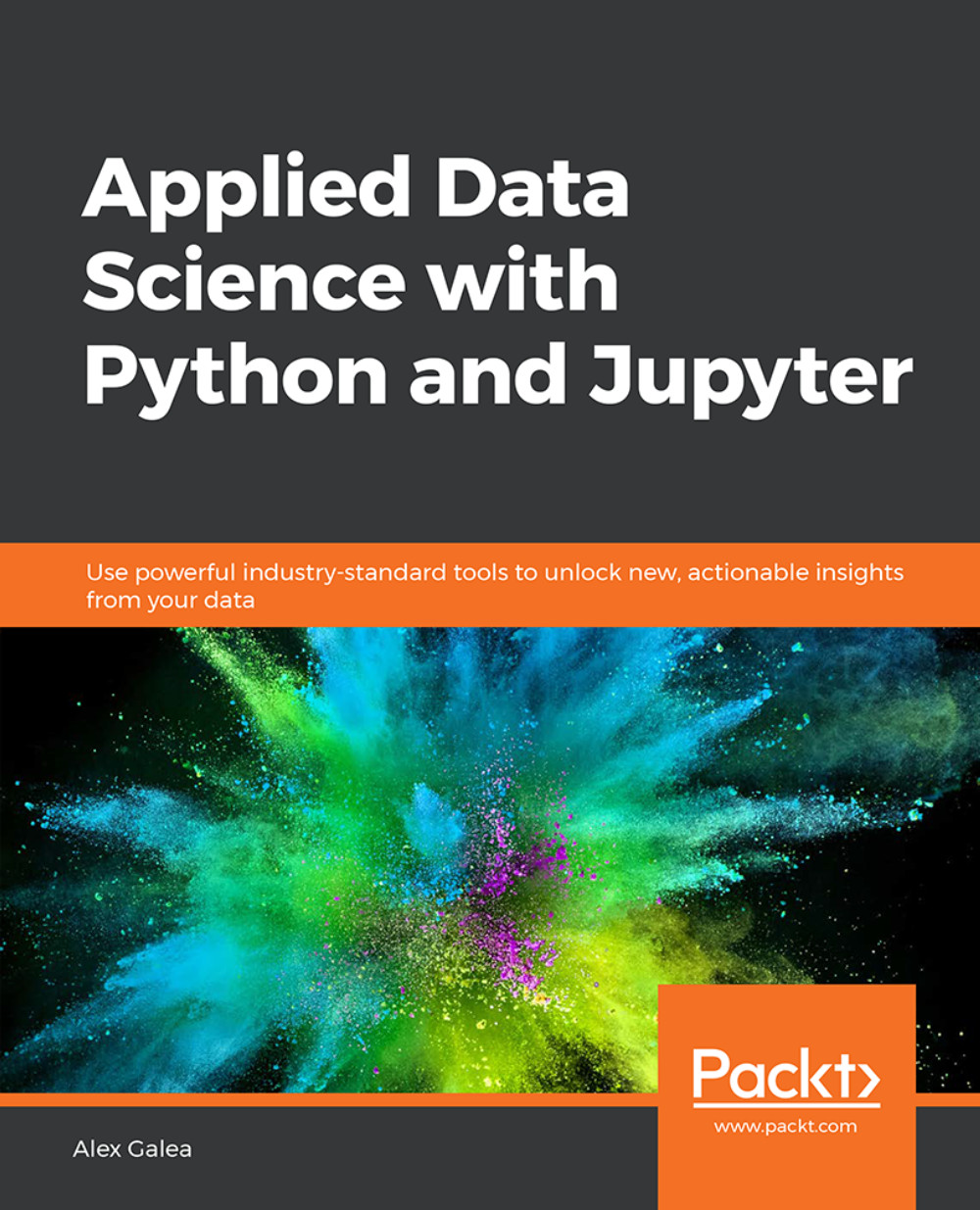
Getting started with data science doesn't have to be an uphill battle. Applied Data Science with Python and Jupyter is a step-by-step guide ideal for beginners who know a little Python and are looking for a quick, fast-paced introduction to these concepts. In this book, you'll learn every aspect of the standard data workflow process, including collecting, cleaning, investigating, visualizing, and modeling data. You'll start with the basics of Jupyter, which will be the backbone of the book. After familiarizing ourselves with its standard features, you'll look at an example of it in practice with our first analysis. In the next lesson, you dive right into predictive analytics, where multiple classification algorithms are implemented. Finally, the book ends by looking at data collection techniques. You'll see how web data can be acquired with scraping techniques and via APIs, and then briefly explore interactive visualizations.
Table of Contents (5 chapters)
close
close

Summary


In this chapter, we have seen how predictive models can be trained in Jupyter Notebooks.

To begin with, we talked about how to plan a machine learning strategy. We thought about how to design a plan that can lead to actionable business insights and stressed the importance of using the data to help set realistic business goals. We also explained machine learning terminology such as supervised learning, unsupervised learning, classification, and regression.

Next, we discussed methods for preprocessing data using scikit-learn and pandas. This included lengthy discussions and examples of a surprisingly time-consuming part of machine learning: dealing with missing data.

In the latter half of the chapter, we trained predictive classification models for our binary problem, comparing how decision boundaries are drawn for various models such as the SVM, k-Nearest Neighbors, and Random Forest. We then showed how validation curves can be used to make good parameter choices and how dimensionality...

CONTINUE READING
83
Tech Concepts
36
Programming languages
73
Tech Tools
Icon Unlimited access to the largest independent learning library in tech of over 8,000 expert-authored tech books and videos.
Icon Innovative learning tools, including AI book assistants, code context explainers, and text-to-speech.
Icon 50+ new titles added per month and exclusive early access to books as they are being written.
Applied Data Science with Python and Jupyter
notes
bookmark Notes and Bookmarks search Search in title playlist Add to playlist font-size Font size

Change the font size

margin-width Margin width

Change margin width

day-mode Day/Sepia/Night Modes

Change background colour

Close icon Search
Country selected

Close icon Your notes and bookmarks

Confirmation

Modal Close icon
claim successful

Buy this book with your credits?

Modal Close icon
Are you sure you want to buy this book with one of your credits?
Close
YES, BUY

Submit Your Feedback

Modal Close icon
Modal Close icon
Modal Close icon