Sign In Start Free Trial
Account

Add to playlist

Create a Playlist

Modal Close icon
You need to login to use this feature.
  • Book Overview & Buying Applied Data Science with Python and Jupyter
  • Table Of Contents Toc
Applied Data Science with Python and Jupyter

Applied Data Science with Python and Jupyter

By : Alex Galea
4.3 (3)
close
close
Applied Data Science with Python and Jupyter

Applied Data Science with Python and Jupyter

4.3 (3)
By: Alex Galea

Overview of this book

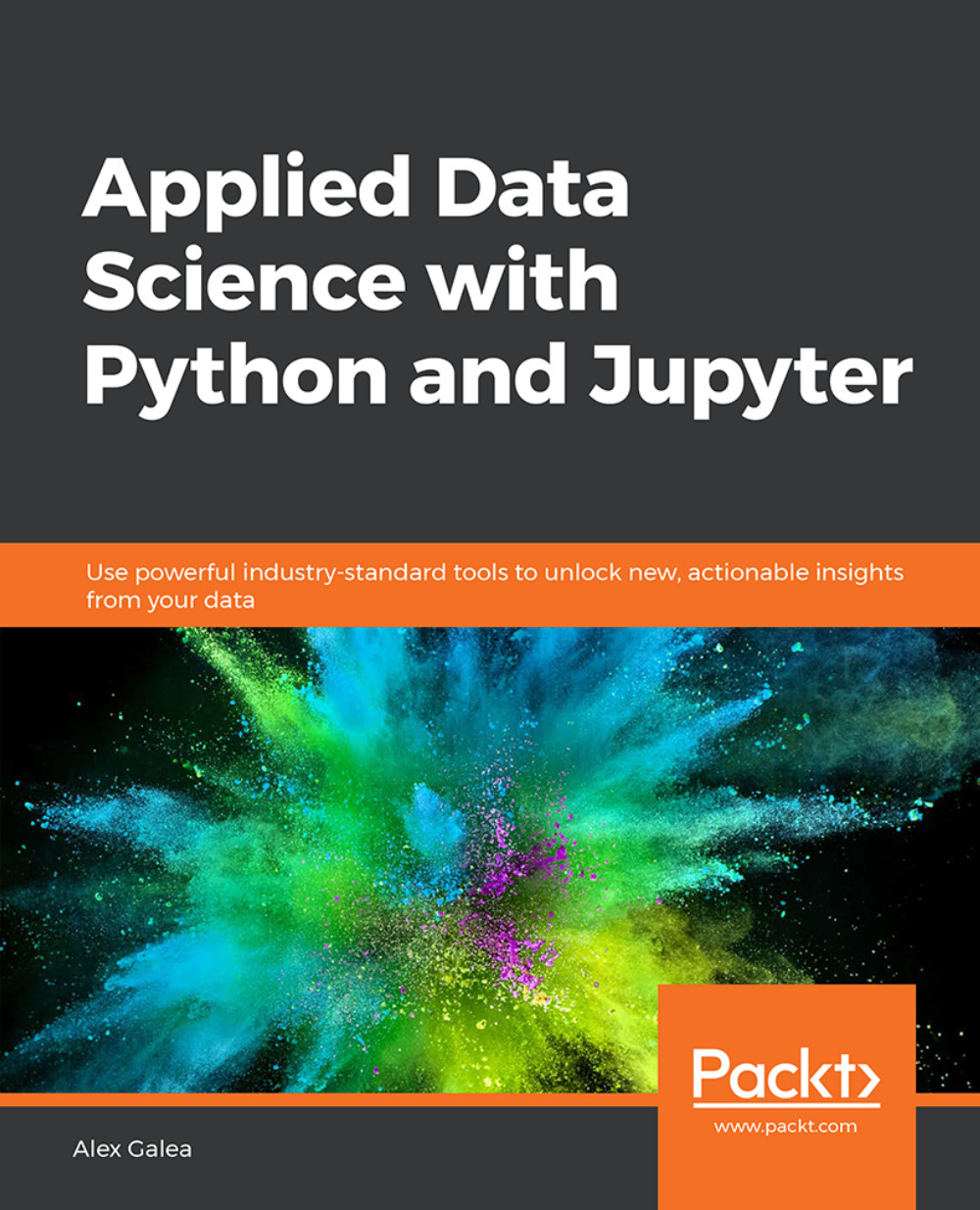
Getting started with data science doesn't have to be an uphill battle. Applied Data Science with Python and Jupyter is a step-by-step guide ideal for beginners who know a little Python and are looking for a quick, fast-paced introduction to these concepts. In this book, you'll learn every aspect of the standard data workflow process, including collecting, cleaning, investigating, visualizing, and modeling data. You'll start with the basics of Jupyter, which will be the backbone of the book. After familiarizing ourselves with its standard features, you'll look at an example of it in practice with our first analysis. In the next lesson, you dive right into predictive analytics, where multiple classification algorithms are implemented. Finally, the book ends by looking at data collection techniques. You'll see how web data can be acquired with scraping techniques and via APIs, and then briefly explore interactive visualizations.
Table of Contents (5 chapters)
close
close

Interactive Visualizations


Visualizations are quite useful as a means of extracting information from a dataset. For example, with a bar graph it's very easy to distinguish the value distribution, compared to looking at the values in a table. Of course, as we have seen earlier in this book, they can be used to study patterns in the dataset that would otherwise be quite difficult to identify. Furthermore, they can be used to help explain a dataset to an unfamiliar party. If included in a blog post, for example, they can boost reader interest levels and be used to break up blocks of text.

When thinking about interactive visualizations, the benefits are similar to static visualizations, but enhanced because they allow for active exploration on the viewer's part. Not only do they allow the viewer to answer questions they may have about the data, they also think of new questions while exploring. This can benefit a separate party such as a blog reader or co-worker, but also a creator, as it allows...

CONTINUE READING
83
Tech Concepts
36
Programming languages
73
Tech Tools
Icon Unlimited access to the largest independent learning library in tech of over 8,000 expert-authored tech books and videos.
Icon Innovative learning tools, including AI book assistants, code context explainers, and text-to-speech.
Icon 50+ new titles added per month and exclusive early access to books as they are being written.
Applied Data Science with Python and Jupyter
notes
bookmark Notes and Bookmarks search Search in title playlist Add to playlist font-size Font size

Change the font size

margin-width Margin width

Change margin width

day-mode Day/Sepia/Night Modes

Change background colour

Close icon Search
Country selected

Close icon Your notes and bookmarks

Confirmation

Modal Close icon
claim successful

Buy this book with your credits?

Modal Close icon
Are you sure you want to buy this book with one of your credits?
Close
YES, BUY

Submit Your Feedback

Modal Close icon
Modal Close icon
Modal Close icon