


-
Book Overview & Buying
-
Table Of Contents

Responsible AI in the Enterprise
By :


Responsible AI in the Enterprise
By:
Overview of this book
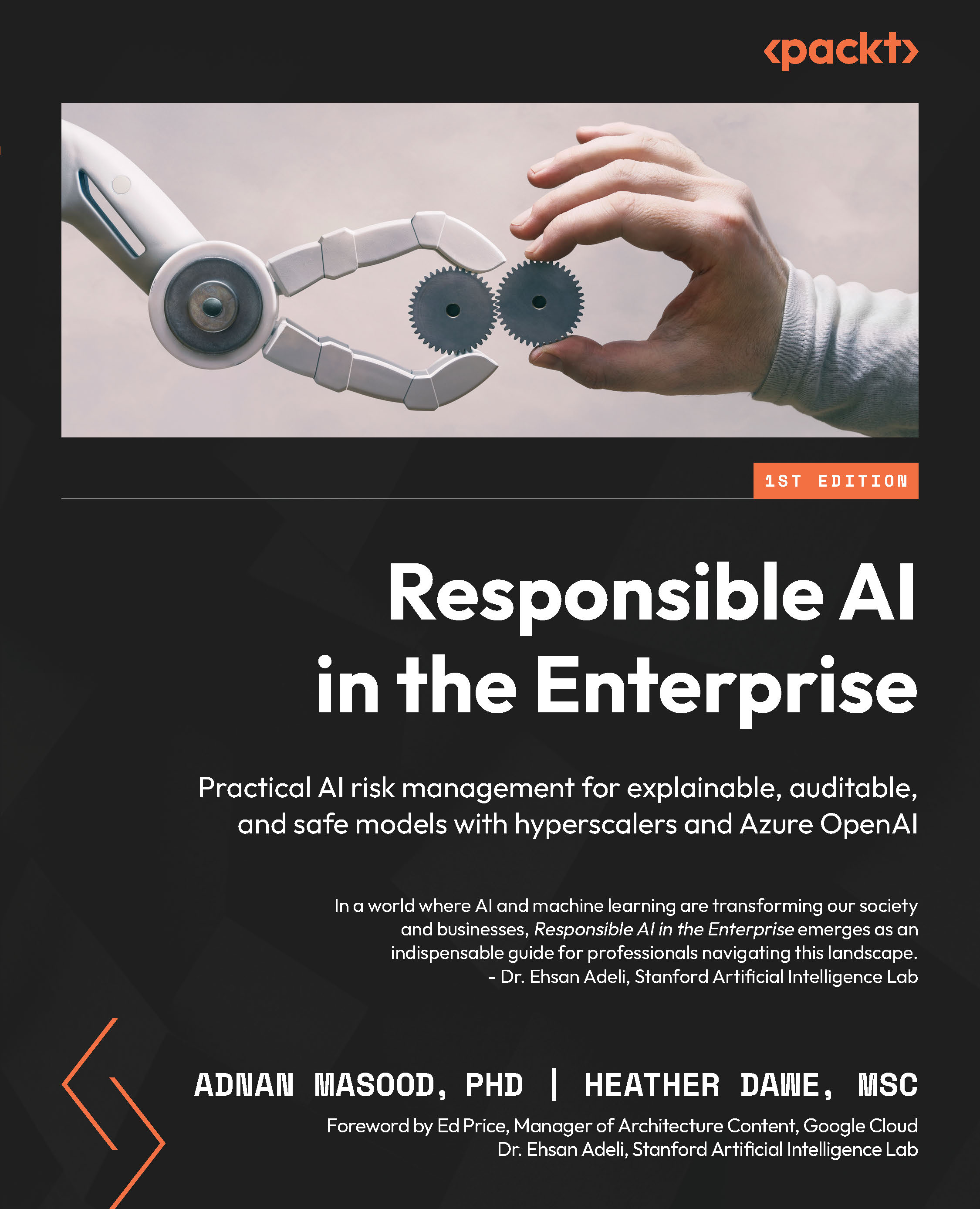
Responsible AI in the Enterprise is a comprehensive guide to implementing ethical, transparent, and compliant AI systems in an organization. With a focus on understanding key concepts of machine learning models, this book equips you with techniques and algorithms to tackle complex issues such as bias, fairness, and model governance.
Throughout the book, you’ll gain an understanding of FairLearn and InterpretML, along with Google What-If Tool, ML Fairness Gym, IBM AI 360 Fairness tool, and Aequitas. You’ll uncover various aspects of responsible AI, including model interpretability, monitoring and management of model drift, and compliance recommendations. You’ll gain practical insights into using AI governance tools to ensure fairness, bias mitigation, explainability, privacy compliance, and privacy in an enterprise setting. Additionally, you’ll explore interpretability toolkits and fairness measures offered by major cloud AI providers like IBM, Amazon, Google, and Microsoft, while discovering how to use FairLearn for fairness assessment and bias mitigation. You’ll also learn to build explainable models using global and local feature summary, local surrogate model, Shapley values, anchors, and counterfactual explanations.
By the end of this book, you’ll be well-equipped with tools and techniques to create transparent and accountable machine learning models.
Table of Contents (16 chapters)
Preface


Part 1: Bigot in the Machine – A Primer
 Free Chapter
Chapter 1: Explainable and Ethical AI Primer
Chapter 2: Algorithms Gone Wild
Part 2: Enterprise Risk Observability Model Governance
Chapter 3: Opening the Algorithmic Black Box
Chapter 4: Robust ML – Monitoring and Management

Chapter 5: Model Governance, Audit, and Compliance
Chapter 6: Enterprise Starter Kit for Fairness, Accountability, and Transparency
Part 3: Explainable AI in Action
Chapter 7: Interpretability Toolkits and Fairness Measures – AWS, GCP, Azure, and AIF 360
Chapter 8: Fairness in AI Systems with Microsoft Fairlearn
Chapter 9: Fairness Assessment and Bias Mitigation with Fairlearn and the Responsible AI Toolbox
Chapter 10: Foundational Models and Azure OpenAI
Index


