


-
Book Overview & Buying
-
Table Of Contents

Python Data Cleaning Cookbook - Second Edition
By :


Python Data Cleaning Cookbook
By:
Overview of this book
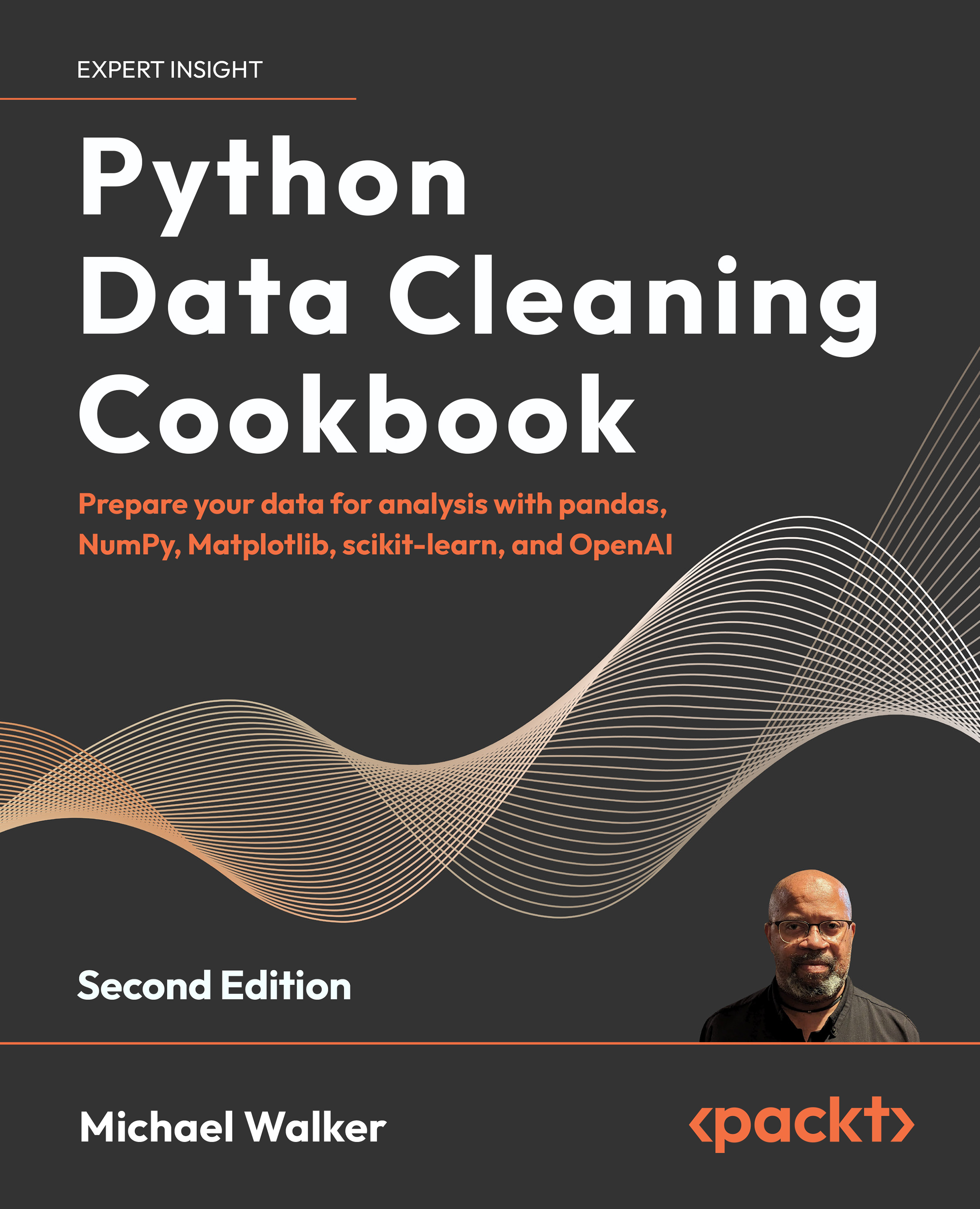
Jumping into data analysis without proper data cleaning will certainly lead to incorrect results. The Python Data Cleaning Cookbook - Second Edition will show you tools and techniques for cleaning and handling data with Python for better outcomes.
Fully updated to the latest version of Python and all relevant tools, this book will teach you how to manipulate and clean data to get it into a useful form. he current edition focuses on advanced techniques like machine learning and AI-specific approaches and tools for data cleaning along with the conventional ones. The book also delves into tips and techniques to process and clean data for ML, AI, and NLP models. You will learn how to filter and summarize data to gain insights and better understand what makes sense and what does not, along with discovering how to operate on data to address the issues you've identified. Next, you’ll cover recipes for using supervised learning and Naive Bayes analysis to identify unexpected values and classification errors and generate visualizations for exploratory data analysis (EDA) to identify unexpected values. Finally, you’ll build functions and classes that you can reuse without modification when you have new data.
By the end of this Data Cleaning book, you'll know how to clean data and diagnose problems within it.
Table of Contents (14 chapters)

 Free Chapter
Anticipating Data Cleaning Issues When Importing Tabular Data with pandas

Anticipating Data Cleaning Issues When Working with HTML, JSON, and Spark Data
Taking the Measure of Your Data
Identifying Outliers in Subsets of Data
Using Visualizations for the Identification of Unexpected Values
Cleaning and Exploring Data with Series Operations
Identifying and Fixing Missing Values

Encoding, Transforming, and Scaling Features
Fixing Messy Data When Aggregating
Addressing Data Issues When Combining DataFrames
Tidying and Reshaping Data
Automate Data Cleaning with User-Defined Functions, Classes, and Pipelines
Index


