


-
Book Overview & Buying
-
Table Of Contents

Python Natural Language Processing Cookbook - Second Edition
By :


Python Natural Language Processing Cookbook
By:
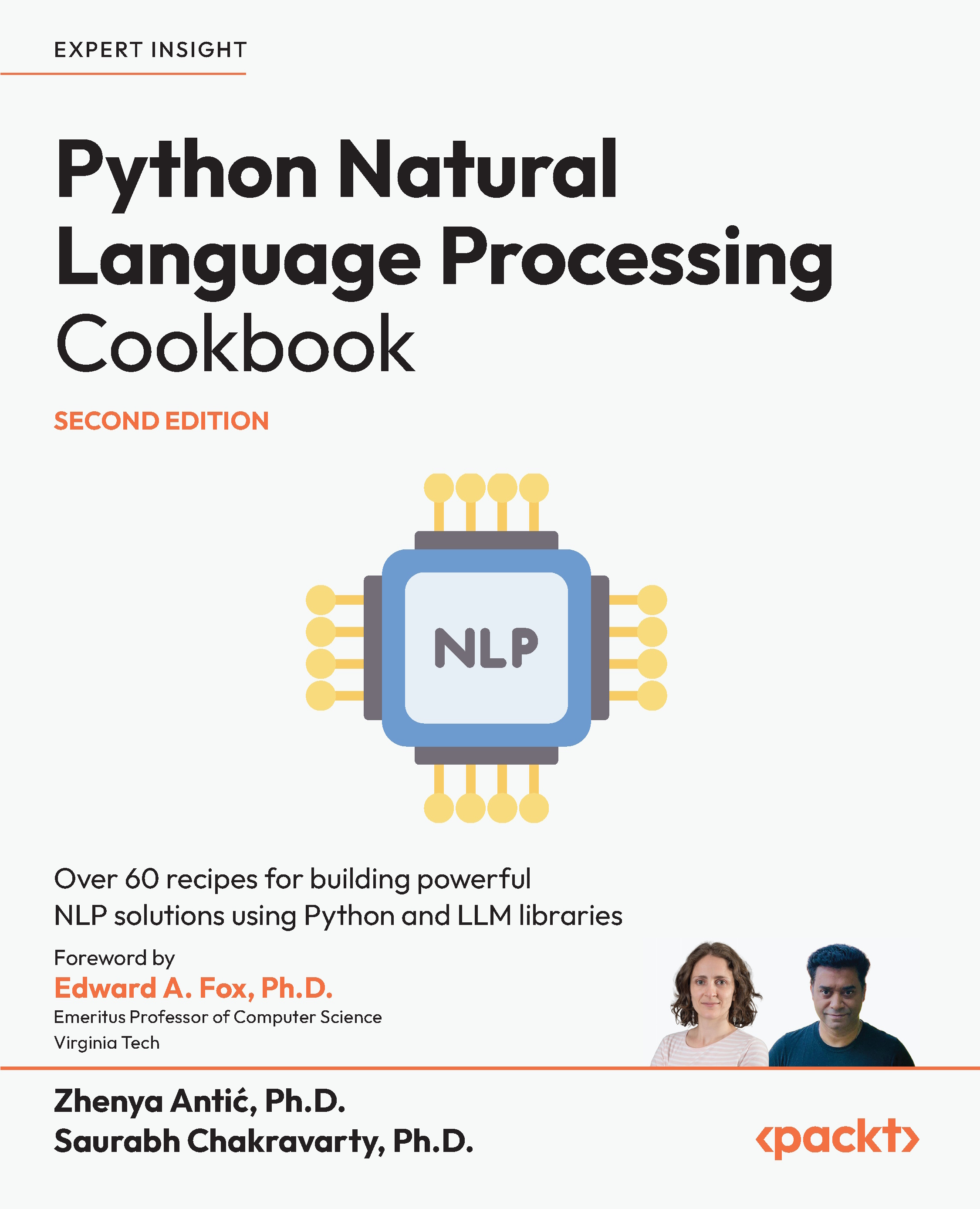
Overview of this book
Harness the power of Natural Language Processing (NLP) to overcome real-world text analysis challenges with this recipe-based roadmap written by two seasoned NLP experts with vast experience transforming various industries with their NLP prowess.
You’ll be able to make the most of the latest NLP advancements, including large language models (LLMs), and leverage their capabilities through Hugging Face transformers. Through a series of hands-on recipes, you’ll master essential techniques such as extracting entities and visualizing text data. The authors will expertly guide you through building pipelines for sentiment analysis, topic modeling, and question-answering using popular libraries like spaCy, Gensim, and NLTK. You’ll also learn to implement RAG pipelines to draw out precise answers from a text corpus using LLMs.
This second edition expands your skillset with new chapters on cutting-edge LLMs like GPT-4, Natural Language Understanding (NLU), and Explainable AI (XAI)—fostering trust in your NLP models.
By the end of this book, you'll be equipped with the skills to apply advanced text processing techniques, use pre-trained transformer models, build custom NLP pipelines to extract valuable insights from text data to drive informed decision-making.
Table of Contents (13 chapters)
Preface


Chapter 1: Learning NLP Basics
 Free Chapter
Chapter 2: Playing with Grammar
Chapter 3: Representing Text – Capturing Semantics
Chapter 4: Classifying Texts

Chapter 5: Getting Started with Information Extraction
Chapter 6: Topic Modeling
Chapter 7: Visualizing Text Data
Chapter 8: Transformers and Their Applications
Chapter 9: Natural Language Understanding
Chapter 10: Generative AI and Large Language Models
Index


