Sign In Start Free Trial
Account

Add to playlist

Create a Playlist

Modal Close icon
You need to login to use this feature.
  • Book Overview & Buying Data Engineering with dbt
  • Table Of Contents Toc
  • Feedback & Rating feedback
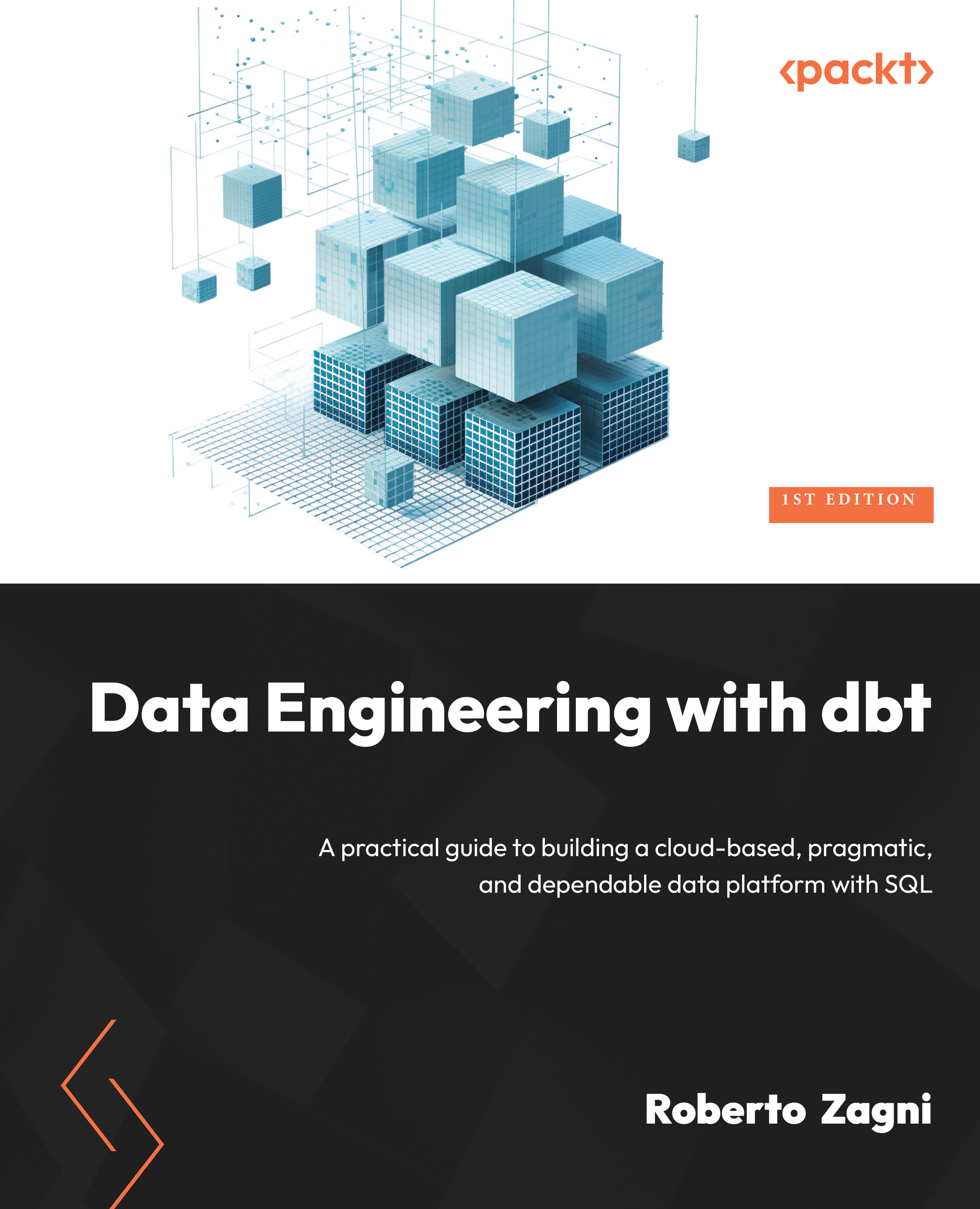
Data Engineering with dbt

Data Engineering with dbt

By : Zagni
4.6 (9)
close
close
Data Engineering with dbt

Data Engineering with dbt

4.6 (9)
By: Zagni

Overview of this book

dbt Cloud helps professional analytics engineers automate the application of powerful and proven patterns to transform data from ingestion to delivery, enabling real DataOps. This book begins by introducing you to dbt and its role in the data stack, along with how it uses simple SQL to build your data platform, helping you and your team work better together. You’ll find out how to leverage data modeling, data quality, master data management, and more to build a simple-to-understand and future-proof solution. As you advance, you’ll explore the modern data stack, understand how data-related careers are changing, and see how dbt enables this transition into the emerging role of an analytics engineer. The chapters help you build a sample project using the free version of dbt Cloud, Snowflake, and GitHub to create a professional DevOps setup with continuous integration, automated deployment, ELT run, scheduling, and monitoring, solving practical cases you encounter in your daily work. By the end of this dbt book, you’ll be able to build an end-to-end pragmatic data platform by ingesting data exported from your source systems, coding the needed transformations, including master data and the desired business rules, and building well-formed dimensional models or wide tables that’ll enable you to build reports with the BI tool of your choice.
Table of Contents (21 chapters)
close
close
1
Part 1: The Foundations of Data Engineering
7
Part 2: Agile Data Engineering with dbt
14
Part 3: Hands-On Best Practices for Simple, Future-Proof Data Platforms

The Basics of SQL to Transform Data

This book is about engineering data platforms with dbt. When working with dbt, you write code in Structured Query Language (normally referred to as SQL, pronounced sequel or as its letters: es-qu-el), with a spritz of Jinja templating.

This means that when we are not discussing architectural and design topics, we will be reading and writing code in SQL, so you should get up to speed with SQL to work proficiently with dbt.

In this chapter, you will review, or learn from scratch, the basics of SQL, becoming familiar with this powerful language that you find everywhere when working with data.

First, we will introduce SQL and walk you through its core concepts, so that even if you are new to this language, you can start building your competence and follow the rest of this chapter and the book.

To complement this introduction, you will quickly be presented with all the main SQL commands, organized by category of use. This will ensure that you know the most relevant parts of SQL and you can use this chapter as a quick reference when you start writing your code.

You will then be guided through how to create an account in Snowflake, the leading cloud database that is very often used with dbt. You will use Snowflake in the cloud, without the need to install anything, and it is free for a trial period.

Once you have a Snowflake account, you will be guided through creating your first role, user, and database.

With your cloud database ready and the basic SQL commands presented, we will look deeper into the SELECT statement and the JOIN clause, as they will be crucial in working with dbt.

Analytical and window functions are presented at the end of the chapter in a simple way, suitable for beginners as well as mid- to senior-experienced SQL users; these advanced functionalities will power up your SQL skills, vastly widening your abilities.

To summarize, in this chapter, we are going to cover these topics:

  • Introducing SQL
  • SQL basics – core concepts and commands
  • Setting up a Snowflake database with users and roles
  • Querying data in SQL – syntax and operators
  • Combining data in SQL – the JOIN clause
  • Advanced – introducing window functions
Visually different images
CONTINUE READING
83
Tech Concepts
36
Programming languages
73
Tech Tools
Icon Unlimited access to the largest independent learning library in tech of over 8,000 expert-authored tech books and videos.
Icon Innovative learning tools, including AI book assistants, code context explainers, and text-to-speech.
Icon 50+ new titles added per month and exclusive early access to books as they are being written.
Data Engineering with dbt
notes
bookmark Notes and Bookmarks search Search in title playlist Add to playlist download Download options font-size Font size

Change the font size

margin-width Margin width

Change margin width

day-mode Day/Sepia/Night Modes

Change background colour

Close icon Search
Country selected

Close icon Your notes and bookmarks

Confirmation

Modal Close icon
claim successful

Buy this book with your credits?

Modal Close icon
Are you sure you want to buy this book with one of your credits?
Close
YES, BUY

Submit Your Feedback

Modal Close icon
Modal Close icon
Modal Close icon