Sign In Start Free Trial
Account

Add to playlist

Create a Playlist

Modal Close icon
You need to login to use this feature.
  • Book Overview & Buying Federated Learning with Python
  • Table Of Contents Toc
Federated Learning with Python

Federated Learning with Python

By : Kiyoshi Nakayama, PhD , George Jeno
4.9 (12)
close
close
Federated Learning with Python

Federated Learning with Python

4.9 (12)
By: Kiyoshi Nakayama, PhD , George Jeno

Overview of this book

Federated learning (FL) is a paradigm-shifting technology in AI that enables and accelerates machine learning (ML), allowing you to work on private data. It has become a must-have solution for most enterprise industries, making it a critical part of your learning journey. This book helps you get to grips with the building blocks of FL and how the systems work and interact with each other using solid coding examples. FL is more than just aggregating collected ML models and bringing them back to the distributed agents. This book teaches you about all the essential basics of FL and shows you how to design distributed systems and learning mechanisms carefully so as to synchronize the dispersed learning processes and synthesize the locally trained ML models in a consistent manner. This way, you’ll be able to create a sustainable and resilient FL system that can constantly function in real-world operations. This book goes further than simply outlining FL's conceptual framework or theory, as is the case with the majority of research-related literature. By the end of this book, you’ll have an in-depth understanding of the FL system design and implementation basics and be able to create an FL system and applications that can be deployed to various local and cloud environments.
Table of Contents (17 chapters)
close
close
1
Part 1 Federated Learning – Conceptual Foundations
5
Part 2 The Design and Implementation of the Federated Learning System
10
Part 3 Moving Toward the Production of Federated Learning Applications

FL as the main solution for data problems

So far in this chapter, we confirmed that big data has issues to be addressed. Data privacy must be preserved in order to protect not only individuals but also data users who would face risks of data breaches and subsequent fines. Biases in a set of big data can affect inference significantly through proxies, even when factors about gender and race are omitted, and focus on correlation rather than causation makes predictive models vulnerable to model drift.

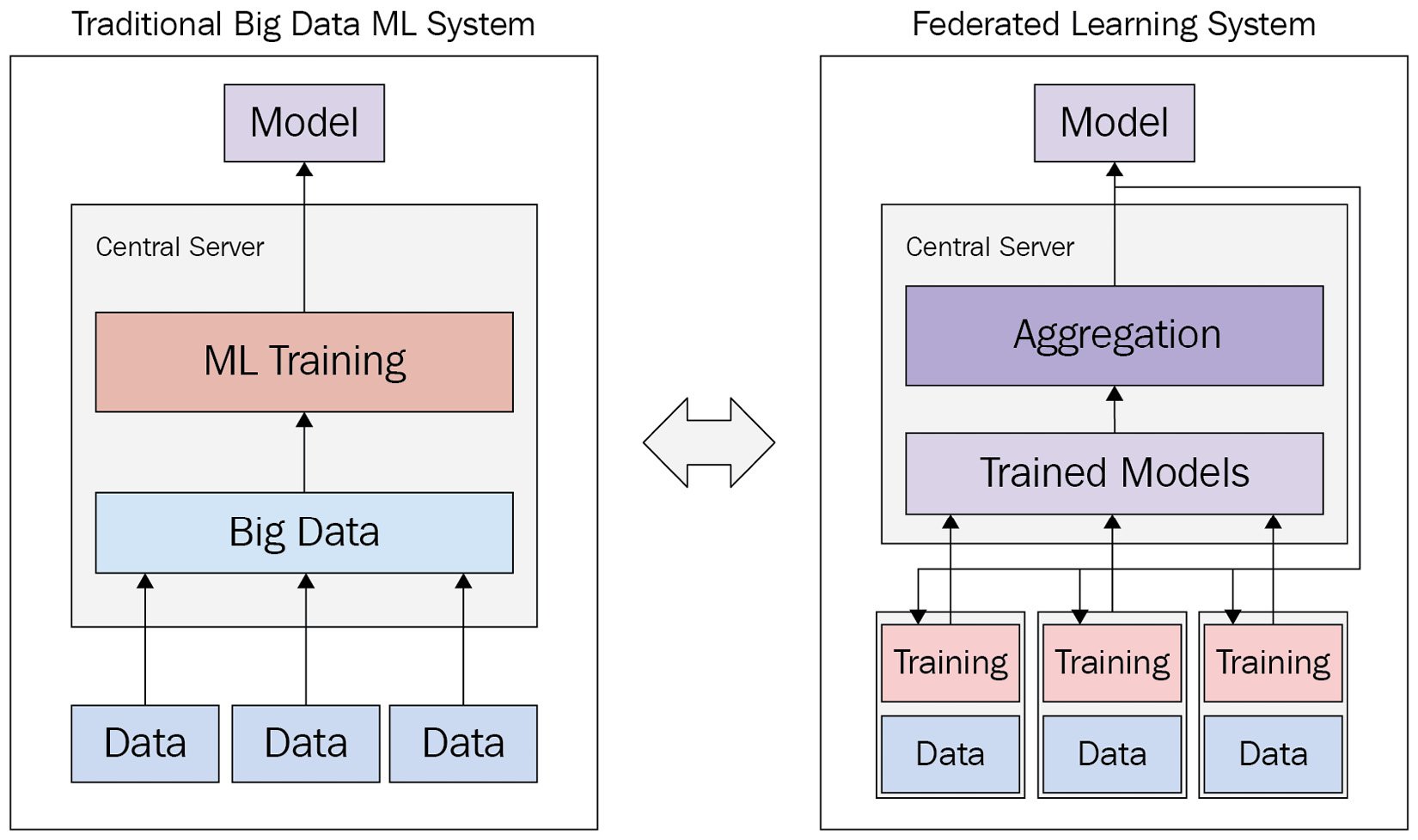
Here, let us discuss the difference between a traditional big data ML system and an FL system in terms of their architectures, processes, issues, and benefits. The following diagram depicts a visual comparison between a traditional big data ML system and an FL system:

Figure 1.3 – Comparison between traditional big data ML system and FL system

Figure 1.3 – Comparison between traditional big data ML system and FL system

In the traditional big data system, data is gathered to create large data stores. These large data stores are used to solve a specific problem using ML. The resulting model displays strong generalizability due to the volume of data it is trained on and is eventually deployed.

However, continuous data collection uses large amounts of communication bandwidth. In privacy-focused applications, the transmission of data may be banned entirely, making model creation impossible. Training large ML models on big data stores is computationally expensive, and traditional centralized training efficiency is limited by single-machine performance. Slow training processes lead to long delays between incremental model updates, leading to a lack of flexibility in accommodating new data trends.

On the other hand, in an FL system, ML training is performed directly at the location of the data. The resulting trained models are collected at the central server. Aggregation algorithms are used to produce an aggregated model from the collected models. The aggregated model is sent back to the data locations for further training.

FL approaches often incur overhead to set up and maintain training performance with distributed-system settings. However, even with a bit more complicated architecture and settings, there are benefits that excel its complication. Training is performed at the data location, so data is never transmitted, maintaining data privacy. Training can be performed asynchronously across a variable number of nodes, which results in efficient and easily scalable distributed learning. Only model weights are transmitted between server and nodes, thus FL is efficient in communication. Advanced aggregation algorithms can maintain training performance even in restricted scenarios and increase efficiency in standard ML scenarios too.

The vast majority of all AI projects do not seem to be delivered, or simply fall short altogether. To deliver an authentic AI application and product, all the issues discussed previously need to be considered seriously. It is obvious that FL, together with other key technologies to deal with local data processed by the ML pipeline and engine, is getting to be a critical solution to resolve data-related problems in a continuous and collaborative manner.

How can we harness the power of AI and ML to optimize the technical system for society in its entirety—that is, bring about a more joyous, comfortable, convenient, and safe world while being data minimalistic and ethical, as well as delivering improvements continuously? We contend that the key is a collective intelligence or intelligence-centric platform, also discussed in Chapter 10, Future Trends and Developments. In subsequent chapters of the book, we introduce the concept, design, and implementation of an FL system as a promising technology for orchestrating collective intelligence with networks of AI and ML models to fulfill those requirements discussed so far.

CONTINUE READING
83
Tech Concepts
36
Programming languages
73
Tech Tools
Icon Unlimited access to the largest independent learning library in tech of over 8,000 expert-authored tech books and videos.
Icon Innovative learning tools, including AI book assistants, code context explainers, and text-to-speech.
Icon 50+ new titles added per month and exclusive early access to books as they are being written.
Federated Learning with Python
notes
bookmark Notes and Bookmarks search Search in title playlist Add to playlist download Download options font-size Font size

Change the font size

margin-width Margin width

Change margin width

day-mode Day/Sepia/Night Modes

Change background colour

Close icon Search
Country selected

Close icon Your notes and bookmarks

Confirmation

Modal Close icon
claim successful

Buy this book with your credits?

Modal Close icon
Are you sure you want to buy this book with one of your credits?
Close
YES, BUY

Submit Your Feedback

Modal Close icon
Modal Close icon
Modal Close icon