Sign In Start Free Trial
Account

Add to playlist

Create a Playlist

Modal Close icon
You need to login to use this feature.
  • Book Overview & Buying Data Engineering with Scala and Spark
  • Table Of Contents Toc
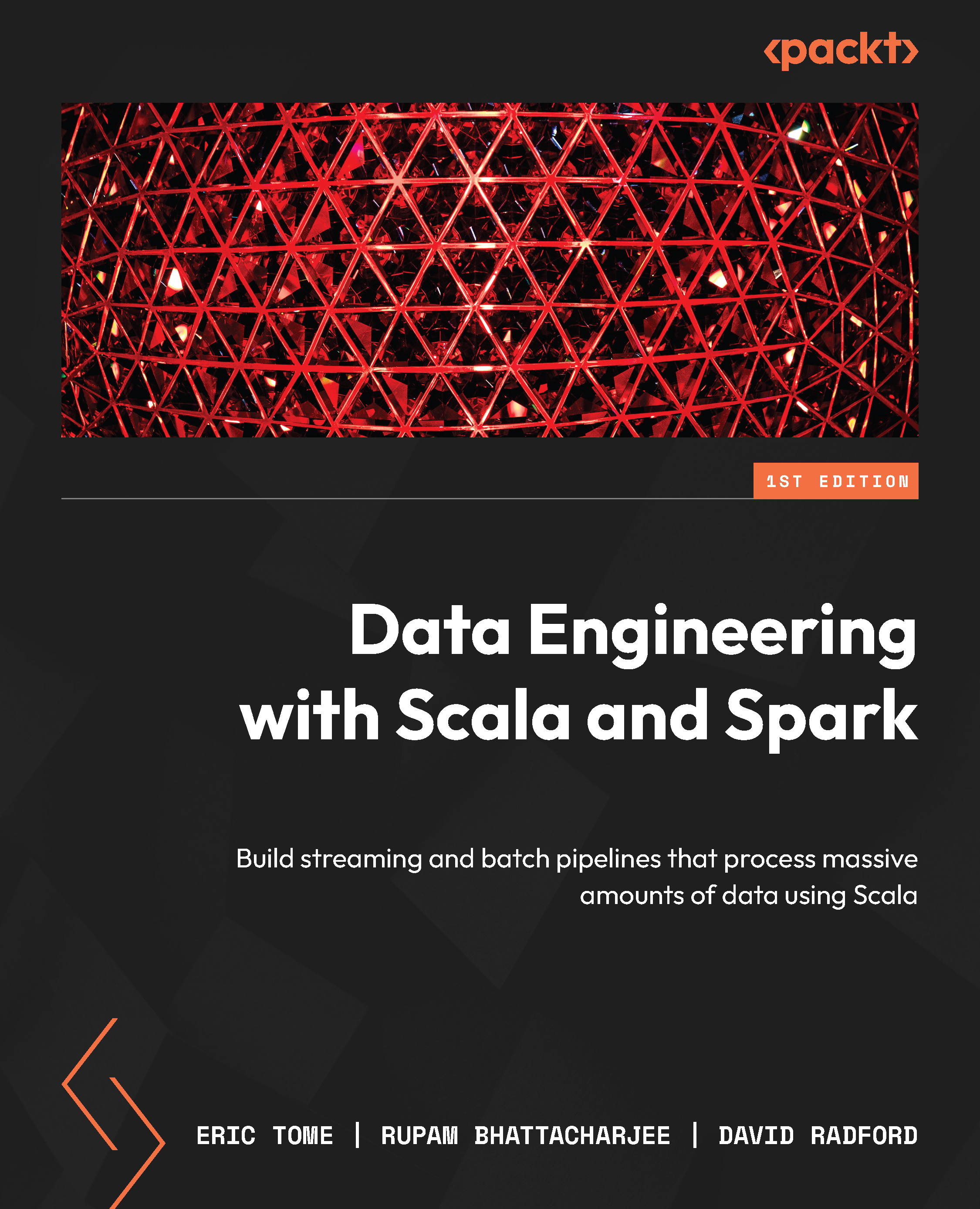
Data Engineering with Scala and Spark

Data Engineering with Scala and Spark

By : Eric Tome, Rupam Bhattacharjee, David Radford
4.2 (5)
close
close
Data Engineering with Scala and Spark

Data Engineering with Scala and Spark

4.2 (5)
By: Eric Tome, Rupam Bhattacharjee, David Radford

Overview of this book

Most data engineers know that performance issues in a distributed computing environment can easily lead to issues impacting the overall efficiency and effectiveness of data engineering tasks. While Python remains a popular choice for data engineering due to its ease of use, Scala shines in scenarios where the performance of distributed data processing is paramount. This book will teach you how to leverage the Scala programming language on the Spark framework and use the latest cloud technologies to build continuous and triggered data pipelines. You’ll do this by setting up a data engineering environment for local development and scalable distributed cloud deployments using data engineering best practices, test-driven development, and CI/CD. You’ll also get to grips with DataFrame API, Dataset API, and Spark SQL API and its use. Data profiling and quality in Scala will also be covered, alongside techniques for orchestrating and performance tuning your end-to-end pipelines to deliver data to your end users. By the end of this book, you will be able to build streaming and batch data pipelines using Scala while following software engineering best practices.
Table of Contents (21 chapters)
close
close
1
Part 1 – Introduction to Data Engineering, Scala, and an Environment Setup
4
Part 2 – Data Ingestion, Transformation, Cleansing, and Profiling Using Scala and Spark
10
Part 3 – Software Engineering Best Practices for Data Engineering in Scala
13
Part 4 – Productionalizing Data Engineering Pipelines – Orchestration and Tuning
16
Part 5 – End-to-End Data Pipelines

Understanding pattern matching

Scala has excellent support for pattern matching. The most prominent use is the match expression, which takes the following form:

selector match { alternatives }

selector is the expression that the alternatives will be tried against. Each alternative starts with the case keyword and includes a pattern, an arrow symbol =>, and one or more expressions, which will be evaluated if the pattern matches. The patterns can be of various types, such as the following:

  • Wildcard patterns
  • Constant patterns
  • Variable patterns
  • Constructor patterns
  • Sequence patterns
  • Tuple patterns
  • Typed patterns

Before going through each of these pattern types, let’s define our own custom List:

trait List[+A]
case class Cons[+A](head: A, tail: List[A]) extends List[A]
case object Nil extends List[Nothing]
object List {
  def apply[A](as: A*): List[A] = if (as.isEmpty) Nil else Cons(as.head, apply(as.tail: _*))
}

Example 1.56

Wildcard patterns

The wildcard pattern (_) matches any object and is used as a default, catch-all alternative. Consider the following example:

scala> def emptyList[A](l: List[A]): Boolean = l match {
     |   case Nil => true
     |   case _   => false
     | }
emptyList: [A](l: List[A])Boolean
scala> emptyList(List(1, 2))
res8: Boolean = false

Example 1.57

A wildcard can also be used to ignore parts of an object that we do not care about. Refer to the following code:

scala> def threeElements[A](l: List[A]): Boolean = l match {
     |   case Cons(_, Cons(_, Cons(_, Nil))) => true
     |   case _                            => false
     | }
threeElements: [A](l: List[A])Boolean
scala> threeElements(List(true, false))
res11: Boolean = false
scala> threeElements(Nil)
res12: Boolean = false
scala> threeElements(List(1, 2, 3))
res13: Boolean = true
scala> threeElements(List("a", "b", "c", "d"))
res14: Boolean = false

Example 1.58

In the preceding example, the threeElements method checks whether a given list has exactly three elements. The values themselves are not needed and are thus discarded in the pattern match.

Constant patterns

A constant pattern matches only itself. Any literal can be used as a constant – 1, true, and hi are all constant patterns. Any val or singleton object can also be used as a constant. The emptyList method from the previous example uses Nil to check whether the list is empty.

Variable patterns

Like a wildcard, a variable pattern matches any object and is bound to it. We can then use this variable to refer to the object:

scala> val ints = List(1, 2, 3, 4)
ints: List[Int] = Cons(1,Cons(2,Cons(3,Cons(4,Nil))))
scala> ints match {
     |   case Cons(_, Cons(_, Cons(_, Nil))) => println("A three element list")
     |   case l => println(s"$l is not a three element list")
     | }
Cons(1,Cons(2,Cons(3,Cons(4,Nil)))) is not a three element list

Example 1.59

In the preceding example, l is bound to the entire list, which then is printed to the console.

Constructor patterns

A constructor pattern looks like Cons(_, Cons(_, Cons(_, Nil))). It consists of the name of a case class (Cons), followed by a number of patterns in parentheses. These extra patterns can themselves be constructor patterns, and we can use them to check arbitrarily deep into an object. In this case, checks are performed at four levels.

Sequence patterns

Scala allows us to match against sequence types such as Seq, List, and Array among others. It looks similar to a constructor pattern. Refer to the following:

scala> def thirdElement[A](s: Seq[A]): Option[A] = s match {
     |   case Seq(_, _, a, _*) => Some(a)
     |   case _            => None
     | }
thirdElement: [A](s: Seq[A])Option[A]
scala> val intSeq = Seq(1, 2, 3, 4)
intSeq: Seq[Int] = List(1, 2, 3, 4)
scala> thirdElement(intSeq)
res16: Option[Int] = Some(3)
scala> thirdElement(Seq.empty[String])
res17: Option[String] = None

Example 1.60

As the example illustrates, thirdElement returns a value of type Option[A]. If a sequence has three or more elements, it will return the third element, whereas for any sequence with less than three elements, it will return None. Seq(_, _, a, _*) binds a to the third element if present. The _* pattern matches any number of elements.

Tuple patterns

We can pattern match against tuples too:

scala> val tuple3 = (1, 2, 3)
tuple3: (Int, Int, Int) = (1,2,3)
scala> def printTuple(a: Any): Unit = a match {
     |   case (a, b, c) => println(s"Tuple has $a, $b, $c")
     |   case _     =>
     | }
printTuple: (a: Any)Unit
scala> printTuple(tuple3)
Tuple has 1, 2, 3

Example 1.61

Running the preceding program will print Tuple has 1, 2, 3 to the console.

Typed patterns

A typed pattern allows us to check types in the pattern match and can be used for type tests and type casts:

scala> def getLength(a: Any): Int =
     |   a match {
     |     case s: String    => s.length
     |     case l: List[_]   => l.length //this is List from Scala collection library
     |     case m: Map[_, _] => m.size
     |     case _            => -1
     |   }
getLength: (a: Any)Int
scala> getLength("hello, world")
res3: Int = 12
scala> getLength(List(1, 2, 3, 4))
res4: Int = 4
scala> getLength(Map.empty[Int, String])
res5: Int = 0

Example 1.62

Please note that the argument a of type Any does not support methods such as length or size in the result expression. Scala automatically applies a type test and a type cast to match the target type. For example, case s: String => s.length is equivalent to the following snippet:

if (s.isInstanceOf[String]) {
  val x = s.asInstanceOf[String]
  x.length
}

Example 1.63

One important thing to note, though, is that Scala does not maintain type arguments during runtime. So, there is no way to check whether list has all integer elements or not. For example, the following will print A list of String to the console. The compiler will emit a warning to alert about the runtime behavior. Arrays are the only exception because the element type is stored with the array value:

scala> List.fill(5)(0) match {
     |   case _: List[String] => println("A list of String")
     |   case _           =>
     | }
<console>:13: warning: fruitless type test: a value of type List[Int] cannot also be a List[String] (the underlying of List[String]) (but still might match its erasure)
         case _: List[String] => println("A list of String")
                 ^
A list of String

Example 1.64

CONTINUE READING
83
Tech Concepts
36
Programming languages
73
Tech Tools
Icon Unlimited access to the largest independent learning library in tech of over 8,000 expert-authored tech books and videos.
Icon Innovative learning tools, including AI book assistants, code context explainers, and text-to-speech.
Icon 50+ new titles added per month and exclusive early access to books as they are being written.
Data Engineering with Scala and Spark
notes
bookmark Notes and Bookmarks search Search in title playlist Add to playlist download Download options font-size Font size

Change the font size

margin-width Margin width

Change margin width

day-mode Day/Sepia/Night Modes

Change background colour

Close icon Search
Country selected

Close icon Your notes and bookmarks

Confirmation

Modal Close icon
claim successful

Buy this book with your credits?

Modal Close icon
Are you sure you want to buy this book with one of your credits?
Close
YES, BUY

Submit Your Feedback

Modal Close icon
Modal Close icon
Modal Close icon