


-
Book Overview & Buying
-
Table Of Contents

Time Series Analysis with Python Cookbook - Second Edition
By :


Time Series Analysis with Python Cookbook
By:
Overview of this book
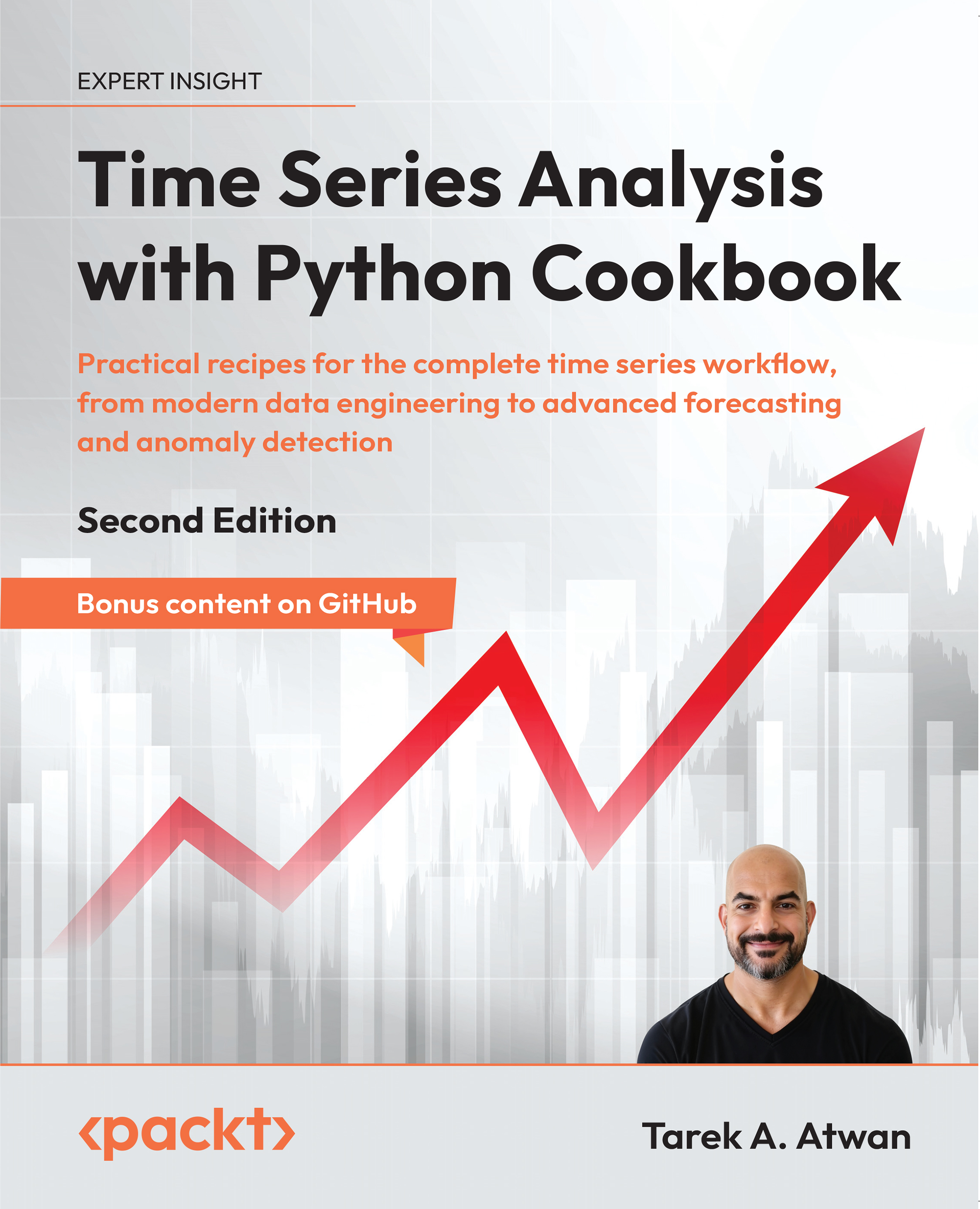
To use time series data to your advantage, you need to master data preparation, analysis, and forecasting. This fully refreshed second edition helps you unlock insights from time series data with new chapters on probabilistic models, signal processing techniques, and new content on transformers. You’ll work with the latest releases of popular libraries like Pandas, Polars, Sktime, stats models, stats forecast, Darts, and Prophet through up-to-date examples.
You'll hit the ground running by ingesting time series data from various sources and formats and learn strategies for handling missing data, dealing with time zones and custom business days, and detecting anomalies using intuitive statistical methods.
Through detailed instructions, you'll explore forecasting using classical statistical models such as Holt-Winters, SARIMA, and VAR, and learn practical techniques for handling non-stationary data using power transforms, ACF and PACF plots, and decomposing time series data with seasonal patterns. The recipes then level up to cover more advanced topics such as building ML and DL models using TensorFlow and PyTorch and applying probabilistic modeling techniques. In this part, you’ll also be able to evaluate, compare, and optimize models, finishing with a strong command of wrangling data with Python.
Table of Contents (18 chapters)
Preface


 Free Chapter
Reading Time Series Data from Files

Reading Time Series Data from Databases
Persisting Time Series Data to Files
Persisting Time Series Data to Databases
Working with Date and Time in Python
Handling Missing Data
Outlier Detection Using Statistical Methods
Exploratory Data Analysis and Diagnosis
Building Univariate Time Series Models Using Statistical Methods
Additional Statistical Modeling Techniques for Time Series
Forecasting Using Supervised Machine Learning
Deep Learning for Time Series Forecasting
Outlier Detection Using Unsupervised Machine Learning
Advanced Techniques for Complex Time Series
Unlock Your Exclusive Benefits
Other Books You May Enjoy
Index


