


-
Book Overview & Buying
-
Table Of Contents

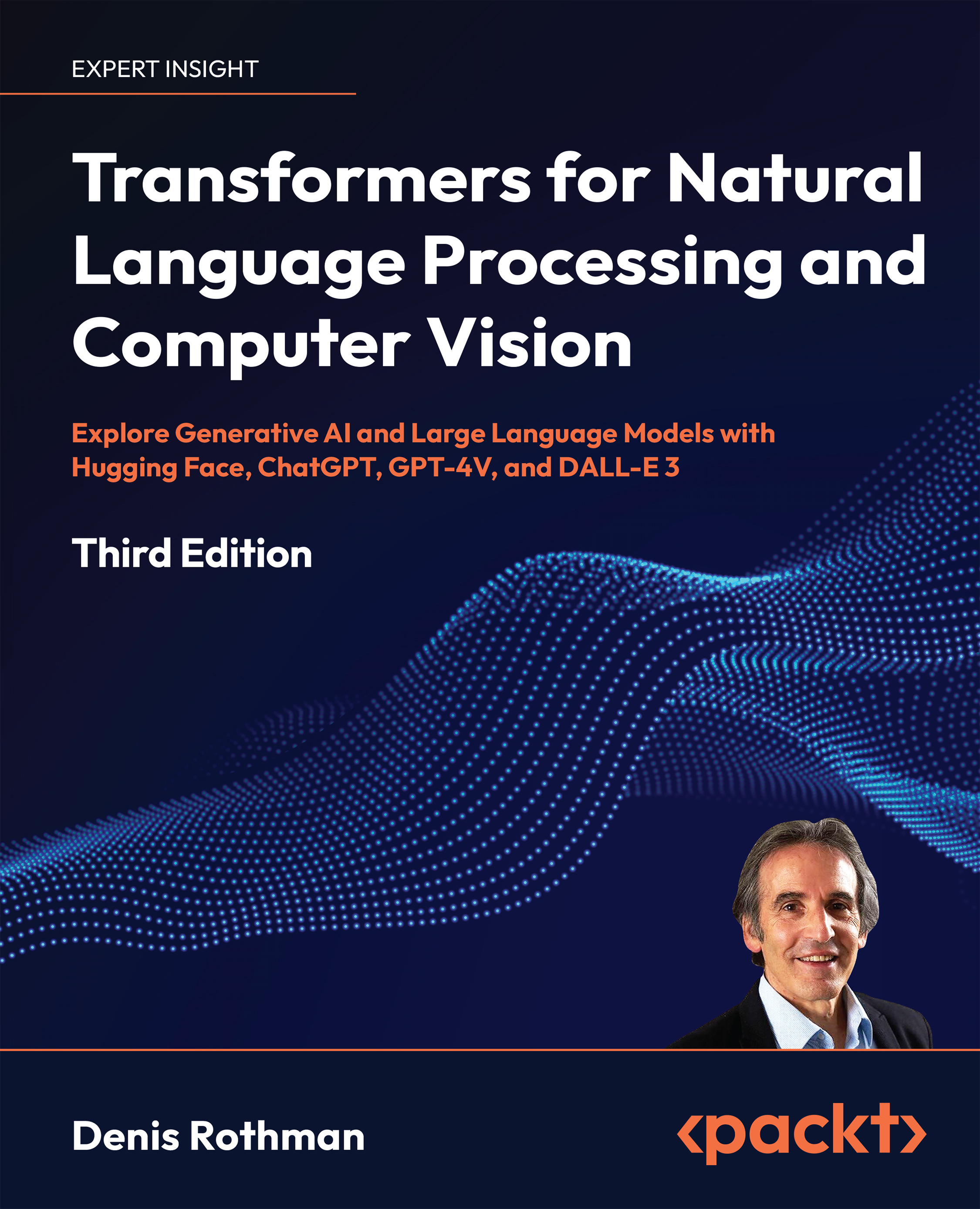
Transformers for Natural Language Processing and Computer Vision - Third Edition
By :


Transformers for Natural Language Processing and Computer Vision
By:
Overview of this book
Transformers for Natural Language Processing and Computer Vision, Third Edition, explores Large Language Model (LLM) architectures, practical applications, and popular platforms (Hugging Face, OpenAI, and Google Vertex AI) used for Natural Language Processing (NLP) and Computer Vision (CV).
The book guides you through a range of transformer architectures from foundation models and generative AI. You’ll pretrain and fine-tune LLMs and work through different use cases, from summarization to question-answering systems leveraging embedding-based search. You'll also implement Retrieval Augmented Generation (RAG) to enhance accuracy and gain greater control over your LLM outputs. Additionally, you’ll understand common LLM risks, such as hallucinations, memorization, and privacy issues, and implement mitigation strategies using moderation models alongside rule-based systems and knowledge integration.
Dive into generative vision transformers and multimodal architectures, and build practical applications, such as image and video classification. Go further and combine different models and platforms to build AI solutions and explore AI agent capabilities.
This book provides you with an understanding of transformer architectures, including strategies for pretraining, fine-tuning, and LLM best practices.
Table of Contents (25 chapters)
Preface


What Are Transformers?
 Free Chapter
Getting Started with the Architecture of the Transformer Model
Emergent vs Downstream Tasks: The Unseen Depths of Transformers
Advancements in Translations with Google Trax, Google Translate, and Gemini
Diving into Fine-Tuning through BERT
Pretraining a Transformer from Scratch through RoBERTa
The Generative AI Revolution with ChatGPT
Fine-Tuning OpenAI GPT Models
Shattering the Black Box with Interpretable Tools
Investigating the Role of Tokenizers in Shaping Transformer Models
Leveraging LLM Embeddings as an Alternative to Fine-Tuning
Toward Syntax-Free Semantic Role Labeling with ChatGPT and GPT-4
Summarization with T5 and ChatGPT
Exploring Cutting-Edge LLMs with Vertex AI and PaLM 2
Guarding the Giants: Mitigating Risks in Large Language Models
Beyond Text: Vision Transformers in the Dawn of Revolutionary AI
Transcending the Image-Text Boundary with Stable Diffusion
Hugging Face AutoTrain: Training Vision Models without Coding

On the Road to Functional AGI with HuggingGPT and its Peers
Beyond Human-Designed Prompts with Generative Ideation
Other Books You May Enjoy
Index
Appendix A: Revolutionizing AI: The Power of Optimized Time Complexity in Transformer Models
Appendix B: Answers to the Questions


