Sign In Start Free Trial
Account

Add to playlist

Create a Playlist

Modal Close icon
You need to login to use this feature.
  • Book Overview & Buying Transformers for Natural Language Processing and Computer Vision
  • Table Of Contents Toc
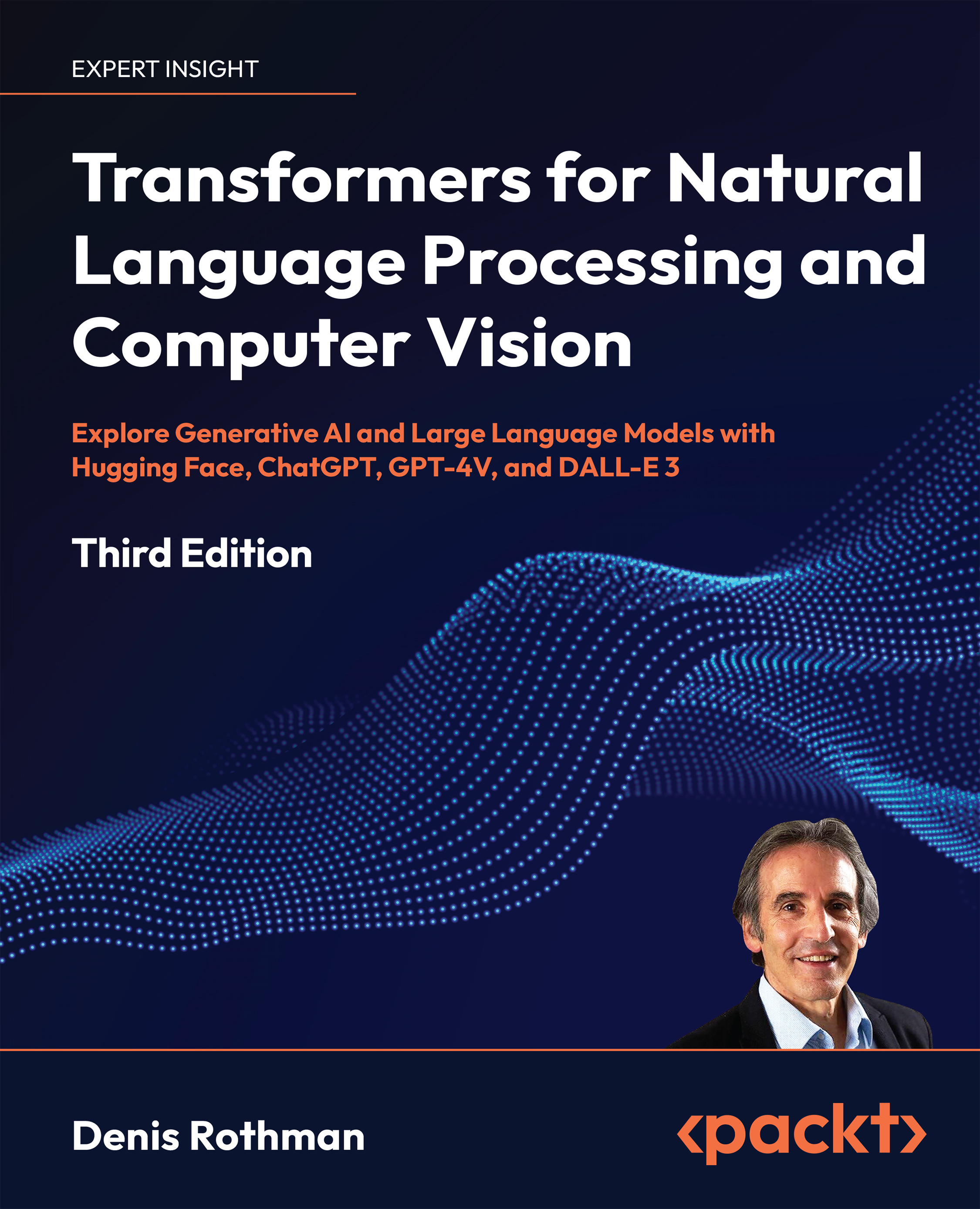
Transformers for Natural Language Processing and Computer Vision

Transformers for Natural Language Processing and Computer Vision - Third Edition

By : Denis Rothman
4.2 (35)
close
close
Transformers for Natural Language Processing and Computer Vision

Transformers for Natural Language Processing and Computer Vision

4.2 (35)
By: Denis Rothman

Overview of this book

Transformers for Natural Language Processing and Computer Vision, Third Edition, explores Large Language Model (LLM) architectures, practical applications, and popular platforms (Hugging Face, OpenAI, and Google Vertex AI) used for Natural Language Processing (NLP) and Computer Vision (CV). The book guides you through a range of transformer architectures from foundation models and generative AI. You’ll pretrain and fine-tune LLMs and work through different use cases, from summarization to question-answering systems leveraging embedding-based search. You'll also implement Retrieval Augmented Generation (RAG) to enhance accuracy and gain greater control over your LLM outputs. Additionally, you’ll understand common LLM risks, such as hallucinations, memorization, and privacy issues, and implement mitigation strategies using moderation models alongside rule-based systems and knowledge integration. Dive into generative vision transformers and multimodal architectures, and build practical applications, such as image and video classification. Go further and combine different models and platforms to build AI solutions and explore AI agent capabilities. This book provides you with an understanding of transformer architectures, including strategies for pretraining, fine-tuning, and LLM best practices.
Table of Contents (25 chapters)
close
close
21
Other Books You May Enjoy
22
Index

Preface

Transformer-driven Generative AI models are a game-changer for Natural Language Processing (NLP) and computer vision. Large Language Generative AI transformer models have achieved superhuman performance through services such as ChatGPT with GPT-4V for text, image, data science, and hundreds of domains. We have gone from primitive Generative AI to superhuman AI performance in just a few years!

Language understanding has become the pillar of language modeling, chatbots, personal assistants, question answering, text summarizing, speech-to-text, sentiment analysis, machine translation, and more. The expansion from the early Large Language Models (LLMs) to multimodal (text, image, sound) algorithms has taken AI into a new era.

For the past few years, we have been witnessing the expansion of social networks versus physical encounters, e-commerce versus physical shopping, digital newspapers, streaming versus physical theaters, remote doctor consultations versus physical visits, remote work instead of on-site tasks, and similar trends in hundreds more domains. This digital activity is now increasingly driven by transformer copilots in hundreds of applications.

The transformer architecture began just a few years ago as revolutionary and disruptive. It broke with the past, leaving the dominance of RNNs and CNNs behind. BERT and GPT models abandoned recurrent network layers and replaced them with self-attention. But in 2023, OpenAI GPT-4 propelled AI into new realms with GPT-4V (vision transformer), which is paving the path for functional (everyday tasks) AGI. Google Vertex AI offered similar technology. 2024 is not a new year in AI; it’s a new decade! Meta (formerly Facebook) has released Llama 2, which we can deploy seamlessly on Hugging Face.

Transformer encoders and decoders contain attention heads that train separately, parallelizing cutting-edge hardware. Attention heads can run on separate GPUs, opening the door to billion-parameter models and soon-to-come trillion-parameter models.

The increasing amount of data requires training AI models at scale. As such, transformers pave the way to a new era of parameter-driven AI. Learning to understand how hundreds of millions of words and images fit together requires a tremendous amount of parameters. Transformer models such as Google Vertex AI PaLM 2 and OpenAI GPT-4V have taken emergence to another level. Transformers can perform hundreds of NLP tasks they were not trained for.

Transformers can also learn image classification and reconstruction by embedding images as sequences of words. This book will introduce you to cutting-edge computer vision transformers such as Vision Transformers (ViTs), CLIP, GPT-4V, DALL-E 3, and Stable Diffusion.

Think of how many humans it would take to control the content of the billions of messages posted on social networks per day to decide if they are legal and ethical before extracting the information they contain.

Think of how many humans would be required to translate the millions of pages published each day on the web. Or imagine how many people it would take to manually control the millions of messages and images made per minute!

Imagine how many humans it would take to write the transcripts of all of the vast amount of hours of streaming published per day on the web. Finally, think about the human resources that would be required to replace AI image captioning for the billions of images that continuously appear online.

This book will take you from developing code to prompt engineering, a new “programming” skill that controls the behavior of a transformer model. Each chapter will take you through the key aspects of language understanding and computer vision from scratch in Python, PyTorch, and TensorFlow.

You will learn the architecture of the Original Transformer, Google BERT, GPT-4, PaLM 2, T5, ViT, Stable Diffusion, and several other models. You will fine-tune transformers, train models from scratch, and learn to use powerful APIs.

You will keep close to the market and its demand for language understanding in many fields, such as media, social media, and research papers, for example. You will learn how to improve Generative AI models with Retrieval Augmented Generation (RAG), embedding-based searches, prompt engineering, and automated ideation with AI-generated prompts.

Throughout the book, you will work hands-on with Python, PyTorch, and TensorFlow. You will be introduced to the key AI language understanding neural network models. You will then learn how to explore and implement transformers.

You will learn the skills required not only to adapt to the present market but also to acquire the vision to face innovative projects and AI evolutions. This book aims to give readers both the knowledge and the vision to select the right models and environment for any given project.

CONTINUE READING
83
Tech Concepts
36
Programming languages
73
Tech Tools
Icon Unlimited access to the largest independent learning library in tech of over 8,000 expert-authored tech books and videos.
Icon Innovative learning tools, including AI book assistants, code context explainers, and text-to-speech.
Icon 50+ new titles added per month and exclusive early access to books as they are being written.
Transformers for Natural Language Processing and Computer Vision
notes
bookmark Notes and Bookmarks search Search in title playlist Add to playlist download Download options font-size Font size

Change the font size

margin-width Margin width

Change margin width

day-mode Day/Sepia/Night Modes

Change background colour

Close icon Search
Country selected

Close icon Your notes and bookmarks

Confirmation

Modal Close icon
claim successful

Buy this book with your credits?

Modal Close icon
Are you sure you want to buy this book with one of your credits?
Close
YES, BUY

Submit Your Feedback

Modal Close icon
Modal Close icon
Modal Close icon