


-
Book Overview & Buying
-
Table Of Contents

DeepSeek in Practice
By :


DeepSeek in Practice
By:
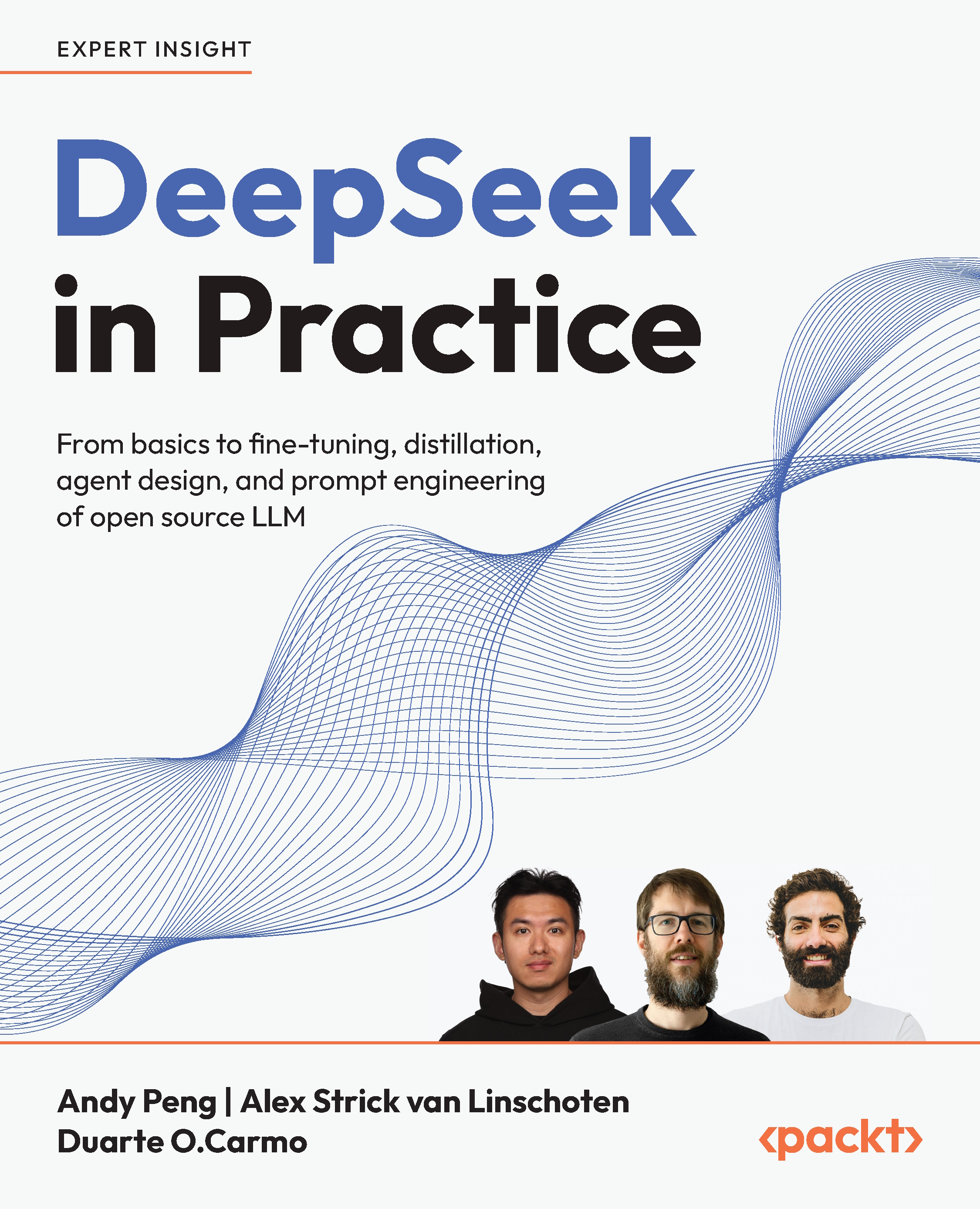
Overview of this book
Learn how to build, fine-tune, and deploy AI systems using DeepSeek, one of the most influential open-source large language models available today. This book guides you through real-world DeepSeek applications—from understanding its core architecture and training foundations to developing reasoning agents and deploying production-ready systems.
Starting with a concise synthesis of DeepSeek's research, breakthroughs, and open-source philosophy, you’ll progress to hands-on projects including prompt engineering, workflow design, and rationale distillation. Through detailed case studies—ranging from document understanding to legal clause analysis—you’ll see how to use DeepSeek in high-value GenAI scenarios.
You’ll also learn to build sophisticated agent workflows and prepare data for fine-tuning. By the end of the book, you’ll have the skills to integrate DeepSeek into local deployments, cloud CI/CD pipelines, and custom LLMOps environments.
Written by experts with deep knowledge of open-source LLMs and deployment ecosystems, this book is your comprehensive guide to DeepSeek’s capabilities and implementation.
Table of Contents (17 chapters)
Preface


 Free Chapter
Understanding and Exploring DeepSeek

What Is DeepSeek?
Deep Dive into DeepSeek
Prompting DeepSeek
Part 2: Using DeepSeek
Using DeepSeek: Case Studies
Building with DeepSeek
Agents with DeepSeek
Part 3: Distilling and Deploying DeepSeek
DeepSeek-Driven Fine-Tuning of Gemma 3 for Legal Reasoning
Deploying DeepSeek Models
Epilogue
Unlock Your Exclusive Benefits
Other Books You May Enjoy
Index


