


-
Book Overview & Buying
-
Table Of Contents

Python Data Analysis - Fourth Edition
By :


Python Data Analysis
By:
Overview of this book
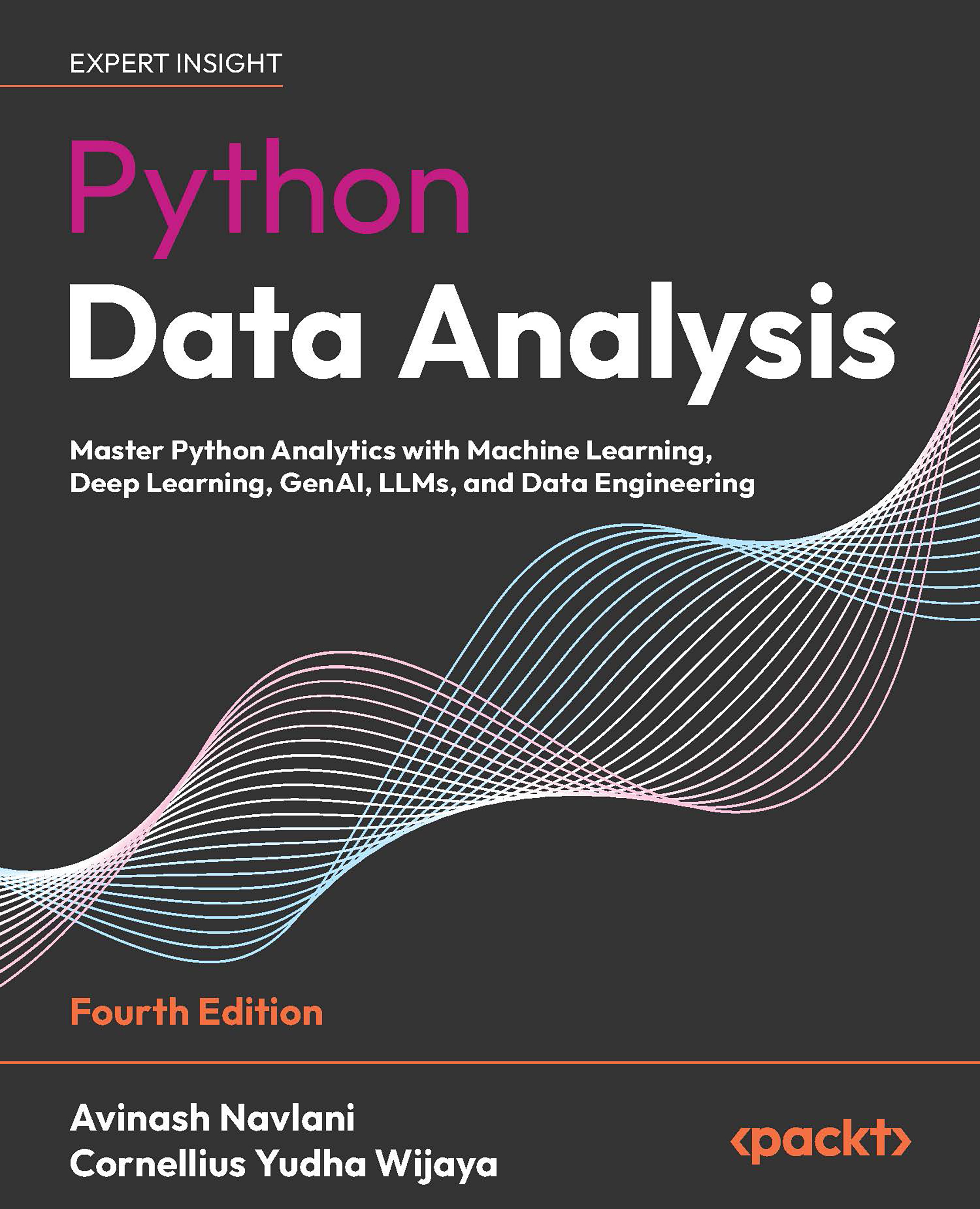
Modern data analysis goes beyond cleaning and visualizing data. Today's practitioners need to build scalable data pipelines, apply machine learning, work with text and image data, and understand emerging AI techniques such as Generative AI and Large Language Models (LLMs). This guide shows you how to tackle these challenges using Python's modern data ecosystem.
Unlike books focused on a single library or technique, this book provides an end-to-end approach to Python data analysis. You'll learn how to move from data preparation and exploratory analysis to machine learning, NLP, image analytics, scalable processing, and AI-powered workflows.
Starting with statistical foundations, you'll learn how to clean, transform, wrangle, and visualize data. You'll then explore time series analysis, signal processing, forecasting, and predictive analytics before applying machine learning techniques such as regression, classification, clustering, PCA, probabilistic methods, and Bayesian approaches.
The book also covers graph analytics, sentiment analysis, NLP, image analytics, Generative AI, and LLMs. Finally, you'll learn to scale analytics workflows using Dask, Modin, Ray, and PySpark.
By the end of the book, you'll be able to build end-to-end data analysis pipelines and apply modern data science and AI techniques to solve real-world challenges.
Table of Contents (25 chapters)
Preface


Getting Started with Python Libraries
NumPy and Pandas
Statistics for Data Insights
Linear Algebra
Part 2: Exploratory Data Analysis and Data Cleaning
Data Visualization
Retrieving, Processing, and Storing Data
Cleaning Messy Data
Time-Series Analysis
Part 3: Deep Dive into Machine Learning
Supervised Learning: Regression and Classification
Unsupervised Learning: Dimensionality Reduction, Clustering, Anomaly Detection
Ensemble Methods: Bagging and Boosting Methods
Artificial Neural Networks and Deep Learning
Part 4: NLP, Image Analytics, and Parallel Computing
Analyzing Text Data
Analyzing Image Data
LLMs and Gen AI
Parallel Computing Using Dask, Modin, and Ray

Big Data Analytics Using PySpark
Unlock Access to the Code Bundle and the PDF Version
Other Books You May Enjoy
Index


