Sign In Start Free Trial
Account

Add to playlist

Create a Playlist

Modal Close icon
You need to login to use this feature.
  • Book Overview & Buying Learn Model Context Protocol with Python
  • Table Of Contents Toc
Learn Model Context Protocol with Python

Learn Model Context Protocol with Python

By : Christoffer Noring
4 (1)
close
close
Learn Model Context Protocol with Python

Learn Model Context Protocol with Python

4 (1)
By: Christoffer Noring

Overview of this book

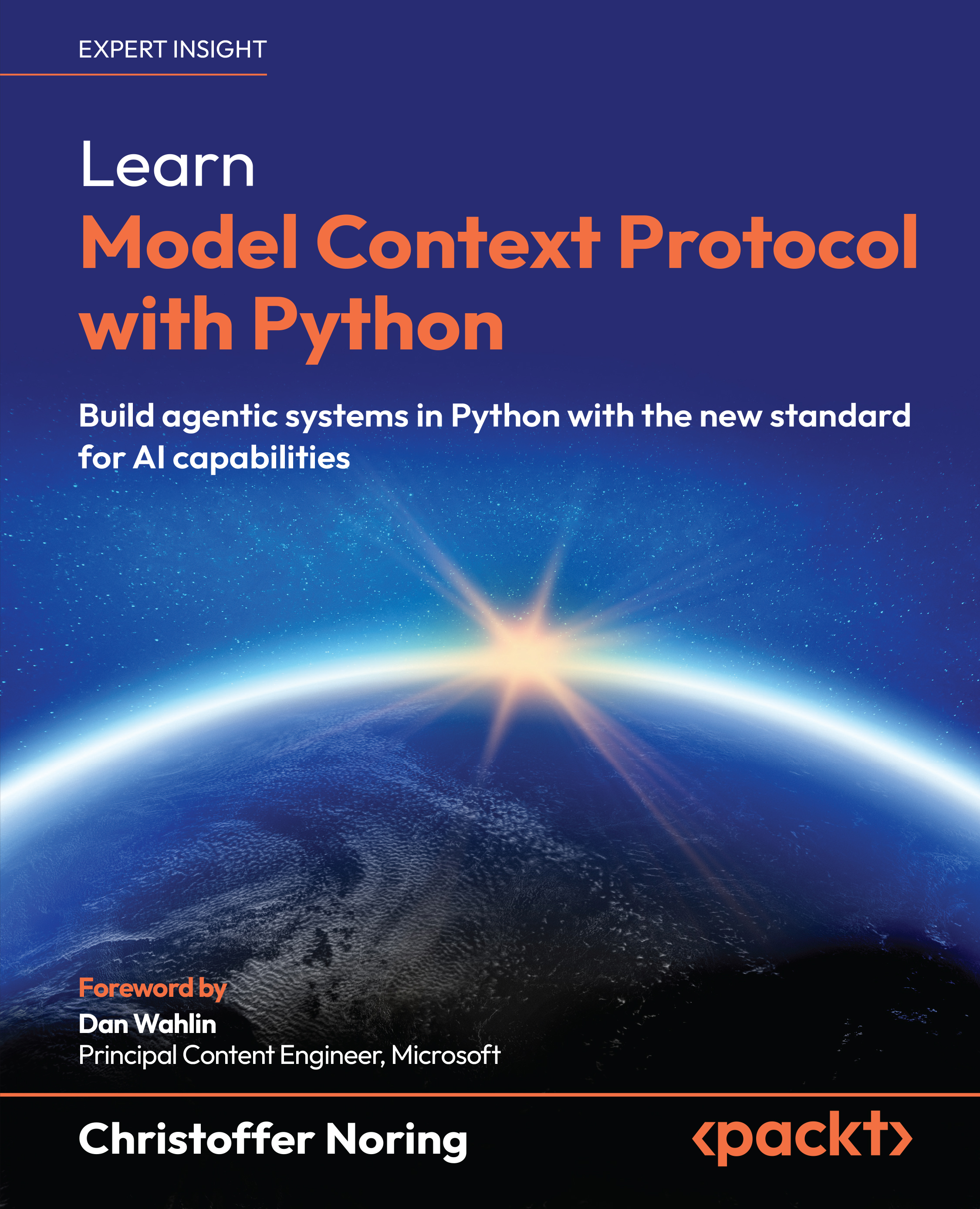
Learn Model Context Protocol with Python introduces developers, architects, and AI practitioners to the transformative capabilities of Model Context Protocol (MCP), an emerging protocol designed to standardize, distribute, and scale AI-driven applications. Through the lens of a practical project, the book tackles the modern challenges of resource management, client-server interaction, and deployment at scale. Drawing from Christoffer's expertise as a published author and tutor at the University of Oxford, you’ll explore the components of MCP and how they streamline server and client development. Next, you’ll progress from building robust backends and integrating LLMs into intelligent clients to interacting with servers via tools such as Claude for desktop and Visual Studio Code agents. The chapters help you understand how to describe the capabilities of hosts, clients, and servers, facilitating better interoperability, easier integration, and clearer communication between different components. The book also covers security best practices and building for the cloud, ensuring that you're ready to deploy your MCP-based apps. Each chapter enables you to develop hands-on skills for building and operating MCP-based agentic apps. The Python primer at the end rounds out the practical toolkit, making this book essential for any team building AI-native applications today.
Table of Contents (17 chapters)
close
close
14
Other Books You May Enjoy
15
Index

Preface

The Model Context Protocol (MCP) represents a revolutionary approach to building artificial intelligence (AI) applications that can efficiently distribute resources, standardize capabilities, and facilitate seamless communication between different components in complex systems. As AI continues to evolve and integrate into every aspect of our digital lives, the need for standardized, scalable, and secure protocols becomes increasingly critical.

MCP addresses fundamental challenges that developers face when building AI applications: resource distribution bottlenecks, lack of standardization across different components, complexity in building and testing distributed systems, and the intricate process of developing clients that can effectively interact with servers and large language models (LLMs). By providing a structured framework, MCP enables developers to create more efficient, maintainable, and scalable AI applications.

Among all the protocols and frameworks available for AI application development, MCP stands out because it offers several key advantages:

  • It provides a standardized way to describe and communicate capabilities between different system components
  • It enables efficient resource distribution across multiple servers, improving performance and scalability
  • It offers comprehensive guidelines for building, testing, and deploying both servers and clients
  • It supports multiple communication methods, including standard input/output (STDIO) and server-sent events (SSE)
  • It facilitates integration with modern development tools and platforms

In this comprehensive book, we will first explore the foundational concepts of the MCP, understanding its architecture, components, and the problems it solves in modern AI application development.

Once you understand the core protocol concepts, we will dive deep into practical implementation, covering how to build and test MCP servers using various approaches, including STDIO and SSE-based servers. We will also explore advanced server development techniques and patterns that will help you create robust, production-ready applications.

The book then progresses to client development, showing you how to build effective clients both with and without LLM integration, and how to consume MCP servers using popular tools such as Claude Desktop and Virtual Studio Code (VS Code) agent mode. We will also cover advanced topics such as sampling and elicitation techniques that can enhance your AI applications.

Finally, we will address critical production concerns, including security best practices, deployment strategies, and scaling considerations that are essential for running MCP applications in real-world environments.

This book will guide you through numerous practical examples and exercises, demonstrating best practices for building MCP applications and providing hands-on experience with real-world scenarios. The examples and code samples are designed to be immediately applicable to your own projects, whether you’re building simple proofs of concept or complex enterprise applications.

Throughout the book, we include comprehensive solutions and code examples in Python. The appendix also provides a comprehensive Python primer for those who need to brush up on their Python skills.

The author acknowledges the use of cutting-edge AI, in this case GitHub Copilot, with the sole aim of enhancing the language and clarity within the book, thereby ensuring a smooth reading experience for readers. It’s important to note that the content itself has been crafted by the author and edited by a professional publishing team.

CONTINUE READING
83
Tech Concepts
36
Programming languages
73
Tech Tools
Icon Unlimited access to the largest independent learning library in tech of over 8,000 expert-authored tech books and videos.
Icon Innovative learning tools, including AI book assistants, code context explainers, and text-to-speech.
Icon 50+ new titles added per month and exclusive early access to books as they are being written.
Learn Model Context Protocol with Python
notes
bookmark Notes and Bookmarks search Search in title playlist Add to playlist download Download options font-size Font size

Change the font size

margin-width Margin width

Change margin width

day-mode Day/Sepia/Night Modes

Change background colour

Close icon Search
Country selected

Close icon Your notes and bookmarks

Confirmation

Modal Close icon
claim successful

Buy this book with your credits?

Modal Close icon
Are you sure you want to buy this book with one of your credits?
Close
YES, BUY

Submit Your Feedback

Modal Close icon
Modal Close icon
Modal Close icon