Sign In Start Free Trial
Account

Add to playlist

Create a Playlist

Modal Close icon
You need to login to use this feature.
  • Book Overview & Buying Data Engineering with Azure Databricks
  • Table Of Contents Toc
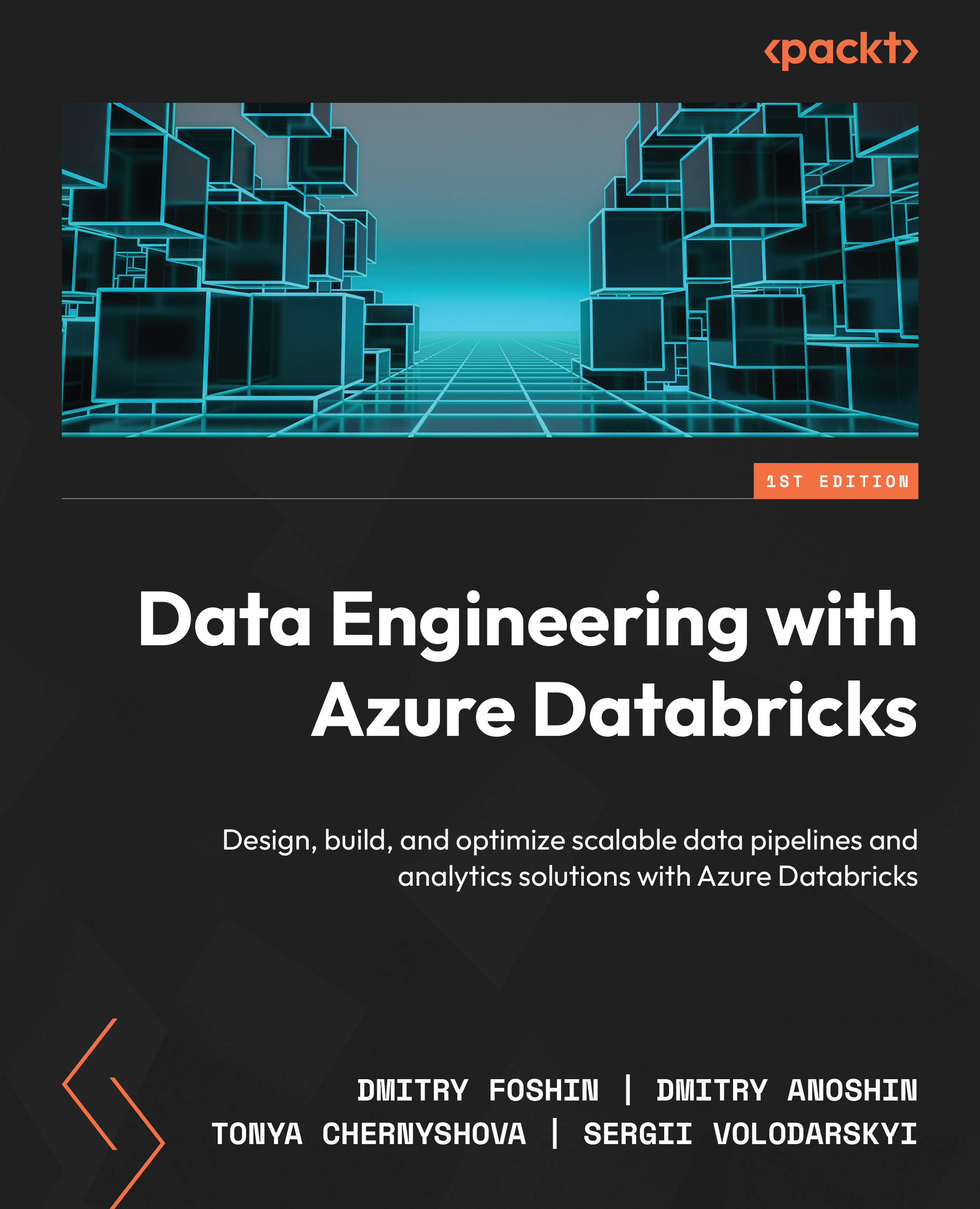
Data Engineering with Azure Databricks

Data Engineering with Azure Databricks

By : Dmitry Foshin, Dmitry Anoshin, Tonya Chernyshova, Sergii Volodarskyi
close
close
Data Engineering with Azure Databricks

Data Engineering with Azure Databricks

By: Dmitry Foshin, Dmitry Anoshin, Tonya Chernyshova, Sergii Volodarskyi

Overview of this book

"Data Engineering with Azure Databricks" is your essential guide to building scalable, secure, and high-performing data pipelines using the powerful Databricks platform on Azure. Designed for data engineers, architects, and developers, this book demystifies the complexities of Spark-based workloads, Delta Lake, Unity Catalog, and real-time data processing. Beginning with the foundational role of Azure Databricks in modern data engineering, you’ll explore how to set up robust environments, manage data ingestion with Auto Loader, optimize Spark performance, and orchestrate complex workflows using tools like Azure Data Factory and Airflow. The book offers deep dives into structured streaming, Delta Live Tables, and Delta Lake’s ACID features for data reliability and schema evolution. You’ll also learn how to manage security, compliance, and access controls using Unity Catalog, and gain insights into managing CI/CD pipelines with Azure DevOps and Terraform. With a special focus on machine learning and generative AI, the final chapters guide you in automating model workflows, leveraging MLflow, and fine-tuning large language models on Databricks. Whether you're building a modern data lakehouse or operationalizing analytics at scale, this book provides the tools and insights you need.
Table of Contents (15 chapters)
close
close
14
Index

Meet databricks

In 2013, a group of UC Berkeley researchers—including Ali Ghodsi, Matei Zaharia, Ion Stoica, Reynold Xin, Andy Konwinski, Patrick Wendell, and Arsalan Tavakoli—founded Databricks in San Francisco.

Their goal was simple: bring the power of Apache Spark to enterprises in the cloud, making it easier, faster, and more collaborative.

Databricks didn't just package Spark. It evolved it into a unified Lakehouse platform (a blend of data warehouse and data lake) with enterprise-grade features:

  • Automated cluster management: No more manual spinning up Spark clusters. Infrastructure is provisioned and managed automatically, whether on AWS, Azure, or GCP
  • Unified workspace and collaboration: It combines notebooks, version control (Git integration/Re), jobs, and visualizations into a single interface, ideal for data engineers, scientists, and analysts working together
  • Delta Lake & Delta Engine: Databricks created Delta Lake, an open-source storage layer that adds ACID transactions, reliable schema enforcement, and time travel on top of cloud data lakes. The Delta Engine, introduced in 2020, dramatically improved query performance
  • Databricks SQL: Launched in late 2020, this SQL analytics service enables data analysts to run BI-style queries directly on data lakes and integrate with popular visualization tools like Tableau, Looker, and Power BI
  • MLflow & feature store: The platform includes MLflow for managing the machine learning lifecycle-tracking experiments, models, and deployments, as well as a centralized feature store for sharing and reusing ML features across teams
  • Generative AI & LLM integration: Databricks continues to innovate with tools like Mosaic AI, built-in LLMs, vector search, and model serving capabilities, alongside open-sourcing its own DBRX model in 2024

The company grew rapidly alongside cloud adoption and AI/ML demand, attaining a 60% annual revenue growth and scaling to over 12,000 customers by early 2025. It also announced a massive $10 billion funding round in late 2024, raising its valuation to $62 billion. Source: https://www.databricks.com/company/newsroom/press-releases/databricks-deepens-san-francisco-investment-new-office-and-multi.

With its cloud-native, unified Lakehouse architecture, automatic infrastructure, and deep integrations across data engineering, analytics, and AI, Databricks has transformed Spark into a fully managed enterprise platform, setting the stage for modern data and AI workflows.

Azure Databricks key concepts

In November 2017, Microsoft and Databricks launched Azure Databricks as a first-party service on Azure, integrating the collaborative and high-performance capabilities of Apache Spark directly into the Azure ecosystem. It simplified large-scale data and AI workflows with one-click setup, seamless integration with Azure services like Entra ID (ex. Active Directory), Data Lake Storage, Synapse Analytics (ex. SQL Data Warehouse), Cosmos DB, and Power BI, with enterprise-grade security.

Let's highlight key concepts and components:

  1. Hybrid Control Plane & Compute Plane:
    • The control plane (managed by Databricks) hosts the workspace UI, metadata, and orchestration
    • The compute plane runs Spark clusters within your own Azure subscription. You can choose between classic clusters provisioned in your VNet and serverless compute, where the infrastructure is abstracted away.
  2. Azure-Native Setup:
    • When you create a workspace, Azure Databricks deploys a managed resource group with a VNet, security groups, a storage account, and a Databricks "appliance"—while you keep control over VM size (F, M, D-series) and network configuration. All metadata is stored in a geo-replicated Azure SQL Server.
  3. Interactive Collaboration:
    • Shared interactive notebooks provide real-time collaboration, integrated debugging, Spark job monitoring, and pre-installed Python/R machine-learning libraries—all within an Azure-native context
    • Git and Repos support means you can manage code and notebooks as versioned "data-as-code."
  4. Delta Lake & Lakehouse Foundation:
    • Built on Delta Lake, Azure Databricks ensures ACID transactions, schema enforcement, and time travel over data lake files
    • Patterns like Auto Loader, Lakeflow pipelines, and SQL Warehouses support scalable ingestion, ETL, streaming, and BI workloads
  5. SQL Warehousing:
    • Dedicated SQL endpoints provide BI-like query performance over data lakes. These integrate seamlessly with Power BI and other tools.
  6. Advanced Governance via Unity Catalog:
    • Introduced in 2023, Unity Catalog brings centralized schema management, fine-grained access control, lineage tracking, and data discovery—all with ANSI SQL syntax across tables, views, and AI assets
  7. ML & AI Integration:
    • Azure Databricks includes ML tools like MLflow and a feature store, plus built-in support for LLMs, Mosaic AI, model serving, and vector search

According to Microsoft, in 2024, Azure was deployed by approximately 348,000 organizations worldwide, ranging from startups to large enterprises. 95% of Fortune 500 companies use Azure in some capacity—whether for infrastructure, platform services, analytics, or identity/access management.

Almost all of these organizations are Microsoft Analytics shops, and many of them use Azure Databricks, Azure Synapse, or Microsoft Fabric. Based on my personal experience, Azure Databricks is the best available product for the Azure environment. Synapse and Fabric, while capable, have not yet reached the level of advancement that Azure Databricks provides.

CONTINUE READING
83
Tech Concepts
36
Programming languages
73
Tech Tools
Icon Unlimited access to the largest independent learning library in tech of over 8,000 expert-authored tech books and videos.
Icon Innovative learning tools, including AI book assistants, code context explainers, and text-to-speech.
Icon 50+ new titles added per month and exclusive early access to books as they are being written.
Data Engineering with Azure Databricks
notes
bookmark Notes and Bookmarks search Search in title playlist Add to playlist download Download options font-size Font size

Change the font size

margin-width Margin width

Change margin width

day-mode Day/Sepia/Night Modes

Change background colour

Close icon Search
Country selected

Close icon Your notes and bookmarks

Confirmation

Modal Close icon
claim successful

Buy this book with your credits?

Modal Close icon
Are you sure you want to buy this book with one of your credits?
Close
YES, BUY

Submit Your Feedback

Modal Close icon
Modal Close icon
Modal Close icon