-
Book Overview & Buying
-
Table Of Contents
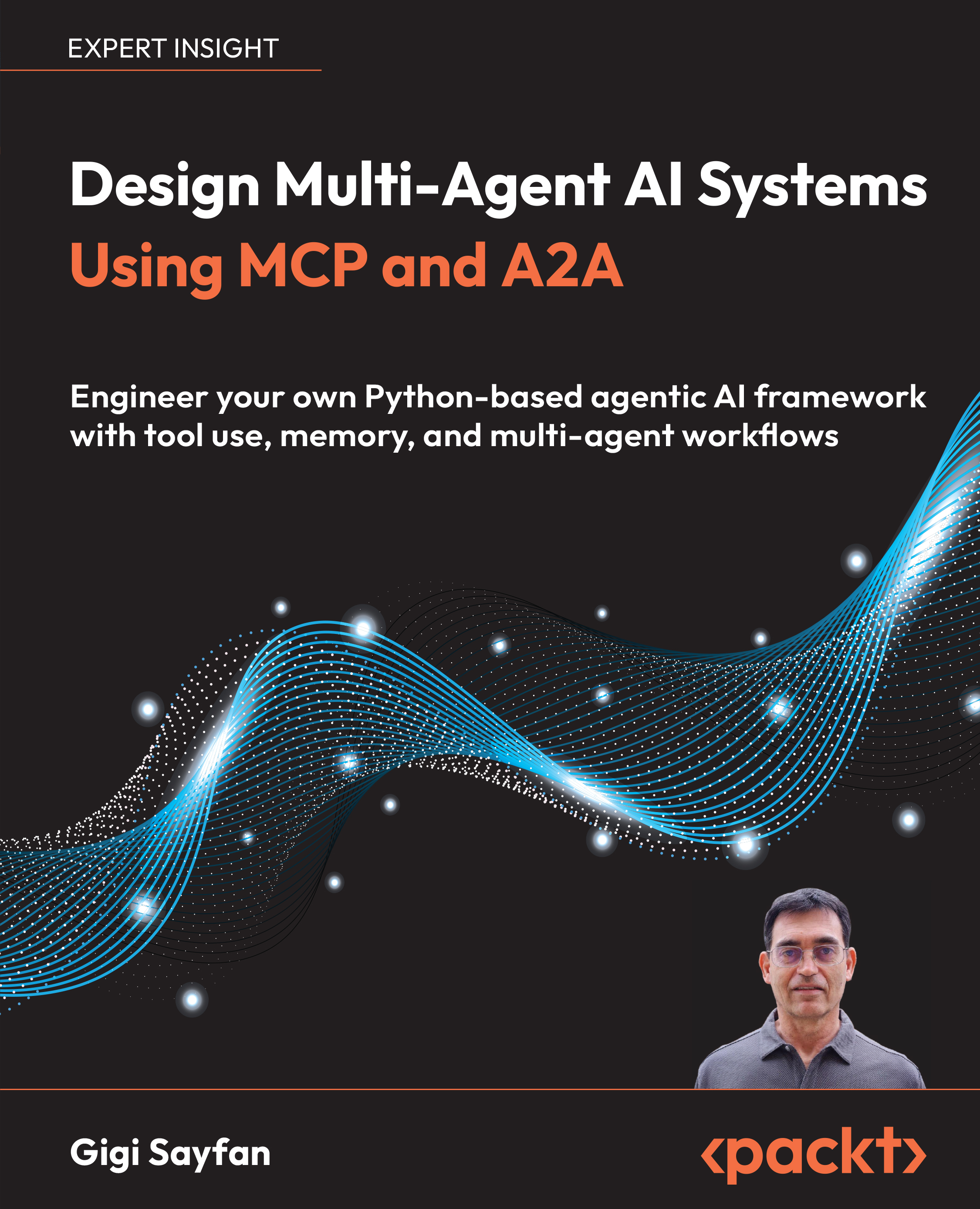
Design Multi-Agent AI Systems Using MCP and A2A
By :
The rapid evolution of large language models has shifted artificial intelligence from static, prompt-driven systems to dynamic, agentic architectures capable of reasoning, planning, and acting in the real world. Today’s most powerful AI applications are no longer single-model pipelines; they are systems of collaborating agents that use tools, manage context, and coordinate with one another to solve complex problems. Building such systems requires going far beyond surface-level framework usage. It demands a deep understanding of how agentic AI actually works.
Rather than treating agent frameworks as black boxes, this book takes a ground-up, hands-on approach. You will explore what happens behind the curtain of modern agentic systems by building a flexible and extensible multi-agent framework in Python from first principles. Core concepts such as tool use, secure execution, context management through the Model Context Protocol (MCP), and agent collaboration via Agent-to-Agent (A2A) messaging are broken down into concrete implementations and reusable design patterns. This foundational understanding will enable you not only to build your own frameworks but also to reason about, customize, and troubleshoot agentic systems built with existing tools.
The journey through the book is intentionally practical and progressive. You will begin by constructing a simple tool-using agent, then incrementally enhance its capabilities—adding secure tool execution, persistent and structured context handling, collaborative planning, and memory. As the book progresses, these individual components come together into fully autonomous, multi-agent systems capable of coordinating actions and solving complex tasks through structured communication and shared context.
Complete with step-by-step walk-throughs, annotated Python code, and deep dives into real-world agent workflows, this book bridges theory and practice. By the end, you will be able to design and implement your own agentic AI systems, build custom tools for intelligent agents, integrate protocols such as MCP and A2A, and deploy collaborative AI workflows that reason, plan, and act effectively in real-world environments. Armed with these skills, you will be well prepared to build the next generation of intelligent, adaptive AI applications.
The book is structured into three parts:
The target audience for this book encompasses AI engineers, machine learning practitioners, and software architects interested in building sophisticated, real-world agentic AI systems. It’s especially valuable for those working with LLMs in production, developing tool-using agents, or exploring multi-agent orchestration. DevOps engineers, AI product managers, and researchers experimenting with advanced LLM frameworks will also benefit from this book.
Chapter 1, Introduction to Generative AI and AI Agents, sets the stage for the rest of the book by introducing the foundational concepts behind generative AI and agentic systems. It covers the current landscape of generative models, including large language models (LLMs), and explains why AI agents represent a compelling next step in leveraging these models for real-world applications. You will come away with a clear understanding of the distinction between simple LLM use and full-fledged agentic behavior, along with historical context and emerging patterns.
Chapter 2, Understanding How AI Agents Work, dives into the core mechanics of AI agents: how they perceive, plan, and act. It introduces the fundamental loop that governs agent behavior (from perception to reasoning to action) and explains the infrastructure behind it. You will understand the internal architecture of AI agents and what makes them effective in solving complex problems.
Chapter 3, A Hands-On Walk-Through of a Simple AI Agent, guides you through building a basic tool-using AI agent that interacts with a live Kubernetes cluster. The agent leverages OpenAI's tool calling capabilities to accept natural language input, interpret intent, execute corresponding kubectl commands, and return results. This real-world walk-through demystifies tool integration and message handling within an agentic AI framework.
Chapter 4, Building a Tool-Based Agentic AI Framework, introduces the foundational concepts and implementation strategy for building an AI agent framework that supports dynamic tool use. You will learn how to construct a robust architecture where an agent can decide when and how to invoke external tools (e.g., APIs, shell commands, command-line tools) to enhance its capabilities. The focus is on building a minimal yet functional core framework that can be extended with more complex behavior later.
Chapter 5, Implementing Custom Tools, explores the design and implementation of custom tools, enabling agents to take real actions, retrieve structured data, and interact with external systems. You will learn how to define tool interfaces, handle argument schemas, return structured results, and ensure safe and reliable execution. The chapter emphasizes the role of tools in extending an agent’s capabilities beyond simple text generation.
Chapter 6, Creating Chat Interfaces Using Slack and Chainlit, demonstrates how to create engaging chat interfaces for interacting with your AI agents. You'll learn how to build integrations with Slack to bring your agents into the workplace and how to use Chainlit to create web-based UIs. These interfaces are key to making your AI agents accessible, interactive, and useful in real-world scenarios.
Chapter 7, Integrating with the Model Context Protocol Ecosystem, introduces the Model Context Protocol (MCP) and its role in enhancing context awareness, interoperability, and modularity in agentic AI systems. You will learn the principles behind MCP, how to build MCP servers and clients, and how to leverage MCP-compatible components to extend agent capabilities across different execution environments. The chapter also shows how to use MCP as the backbone of the tool-calling agentic loop.
Chapter 8, Designing Multi-Agent Systems, explores how multiple AI agents can work together toward a shared goal using Agent-to-Agent (A2A) communication. You will learn about the patterns and architectures for multi-agent orchestration, including broadcasting, delegation, and consensus. The chapter will cover real-world use cases, challenges in coordination and conflict resolution, and provide best practices for designing scalable, resilient collaborative agentic systems.
Chapter 9, Implementing Multi-Agent Systems with A2A, presents the implementation of a full-fledged multi-agent system that brings together all the core ideas from earlier chapters. We’ll build an AI-powered DevOps team composed of specialized agents that communicate via the A2A protocol and utilize MCP for powerful tool-using capabilities. The team includes a Kubernetes expert agent, a CI/CD expert agent, a security specialist agent, and a DevOps manager agent who oversees coordination and interacts with human engineers. This project showcases how multiple agents collaborate to solve real-world problems in a complex, distributed environment.
Chapter 10, Testing, Debugging, and Troubleshooting Multi-Agent Systems, equips you with practical debugging strategies for identifying issues in tool execution, message routing, context sharing, and multi-agent coordination. It covers logging, tracing, observability hooks, and diagnostics tailored for autonomous agents operating in dynamic environments.
Chapter 11, Deploying Multi-Agent Systems, focuses on deploying our multi-agent DevOps system across two separate Kubernetes-in-Docker (KinD) clusters to simulate a distributed, production-like environment. We’ll run the manager agent on one cluster and deploy the rest of the specialized agents – Kubernetes, CI/CD, and Security – on the other. This setup models a realistic architecture where the control plane (manager) is decoupled from the worker agents for scalability, isolation, and operational resilience. We’ll cover configuration, service exposure, inter-cluster communication, and common pitfalls when deploying agent-based systems in Kubernetes environments.
Chapter 12, Advanced Topics and Future Directions, surveys the frontier of agentic AI capabilities, from superhuman reasoning and large-context comprehension to long-horizon planning and emergent autonomous behaviors. You will gain perspective on how breakthroughs such as 1M+ token context windows and generative memory architectures unlock new patterns of interaction, enable strategic foresight, and hint at agents that reason beyond human capabilities. We also introduce the concept of Generative User Experience (GenUX) as the next evolution in human-agent interface design.
You should have a basic understanding of Python programming, familiarity with machine learning concepts, and a basic understanding of large language models.
|
Software/hardware covered in the book |
Operating system requirements |
|---|---|
|
Python 3.x |
Windows, macOS, or Linux |
|
OpenAI API key |
Windows, macOS, or Linux |
You will need access to a Python development environment. An OpenAI API key is required for many of the examples. A machine with at least 8 GB of RAM is recommended for running the more complex examples.
If you are using the digital version of this book, we advise you to type the code yourself or access the code from the book’s GitHub repository (a link is available in the next section). Doing so will help you avoid any potential errors related to the copying and pasting of code.
The code bundle for the book is hosted on GitHub at https://github.com/PacktPublishing/Design-Multi-Agent-AI-Systems-Using-MCP-and-A2A. We also have other code bundles from our rich catalog of books and videos available at https://github.com/PacktPublishing. Check them out!
Change the font size
Change margin width
Change background colour