


-
Book Overview & Buying
-
Table Of Contents

Unlocking Data with Generative AI and RAG - Second Edition
By :


Unlocking Data with Generative AI and RAG
By:
Overview of this book
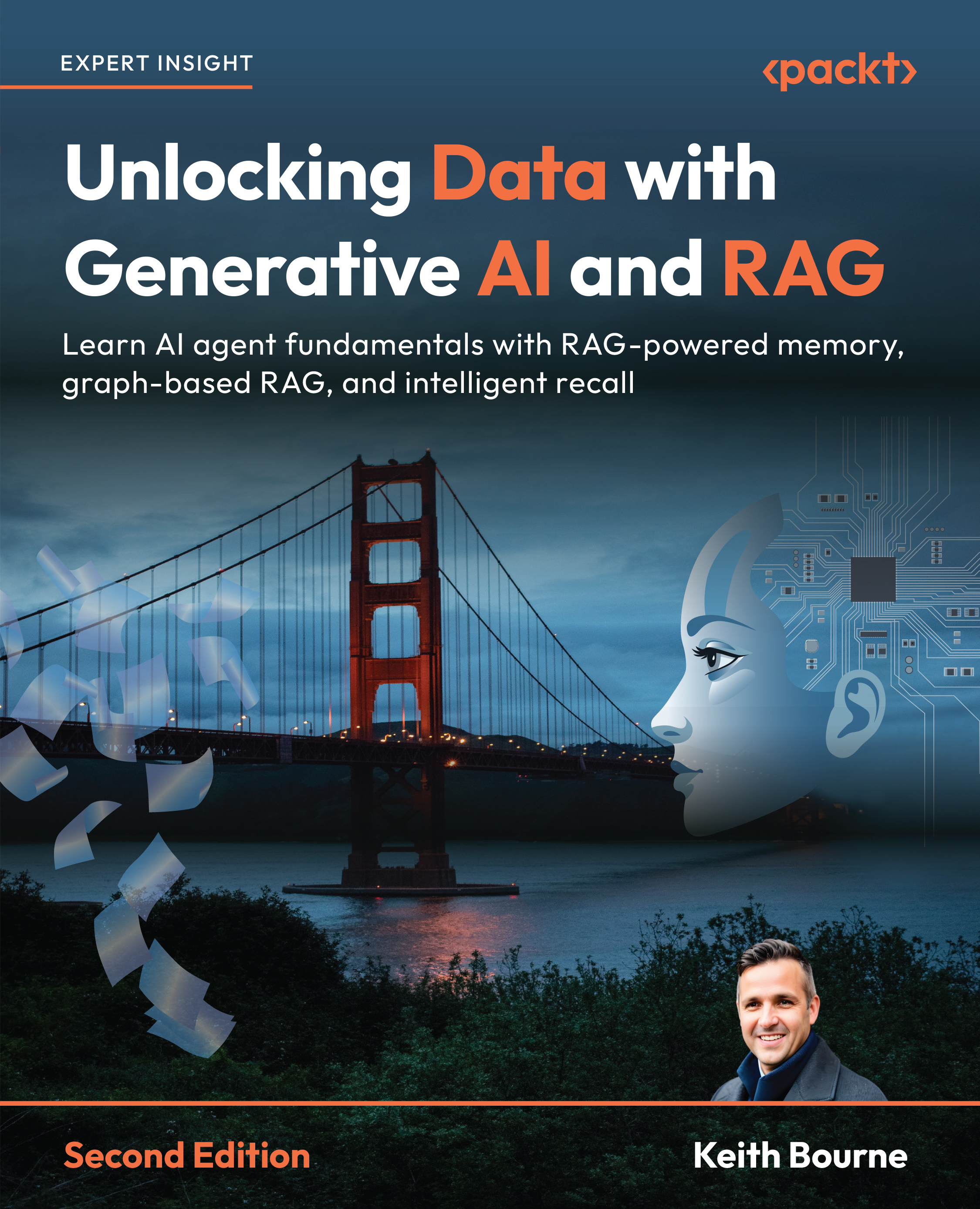
Developing AI agents that remember, adapt, and reason over complex knowledge isn’t a distant vision anymore; it’s happening now with Retrieval-Augmented Generation (RAG). This second edition of the bestselling guide leads you to the forefront of agentic system design, showing you how to build intelligent, explainable, and context-aware applications powered by RAG pipelines.
You’ll master the building blocks of agentic memory, including semantic caches, procedural learning with LangMem, and the emerging CoALA framework for cognitive agents. You’ll also learn how to integrate GraphRAG with tools such as Neo4j to create deeply contextualized AI responses grounded in ontology-driven data.
This book walks you through real implementations of working, episodic, semantic, and procedural memory using vector stores, prompting strategies, and feedback loops to create systems that continuously learn and refine their behavior. With hands-on code and production-ready patterns, you’ll be ready to build advanced AI systems that not only generate answers but also learn, recall, and evolve.
Written by a seasoned AI educator and engineer, this book blends conceptual clarity with practical insight, offering both foundational knowledge and cutting-edge tools for modern AI development.
*Email sign-up and proof of purchase required
Table of Contents (26 chapters)
Preface


 Free Chapter
Part 1: Introduction to Retrieval-Augmented Generation (RAG)
What Is Retrieval-Augmented Generation?
Code Lab: An Entire RAG Pipeline
Practical Applications of RAG
Components of a RAG System
Managing Security in RAG Applications
Part 2: Components of RAG
Interfacing with RAG and Gradio
The Key Role Vectors and Vector Stores Play in RAG
Similarity Searching with Vectors
Evaluating RAG Quantitatively and with Visualizations
Key RAG Components in LangChain
Using LangChain to Get More from RAG

Part 3: Implementing Agentic RAG
Combining RAG with the Power of AI Agents and LangGraph
Ontology-Based Knowledge Engineering for Graphs
Graph-Based RAG
Semantic Caches
Agentic Memory: Extending RAG with Stateful Intelligence
RAG-Based Agentic Memory in Code
Procedural Memory for RAG with LangMem
Advanced RAG with Complete Memory Integration
Unlock Your Exclusive Benefits
Other Books You May Enjoy
Index


