


-
Book Overview & Buying
-
Table Of Contents

Python Machine Learning By Example - Fourth Edition
By :


Python Machine Learning By Example
By:
Overview of this book
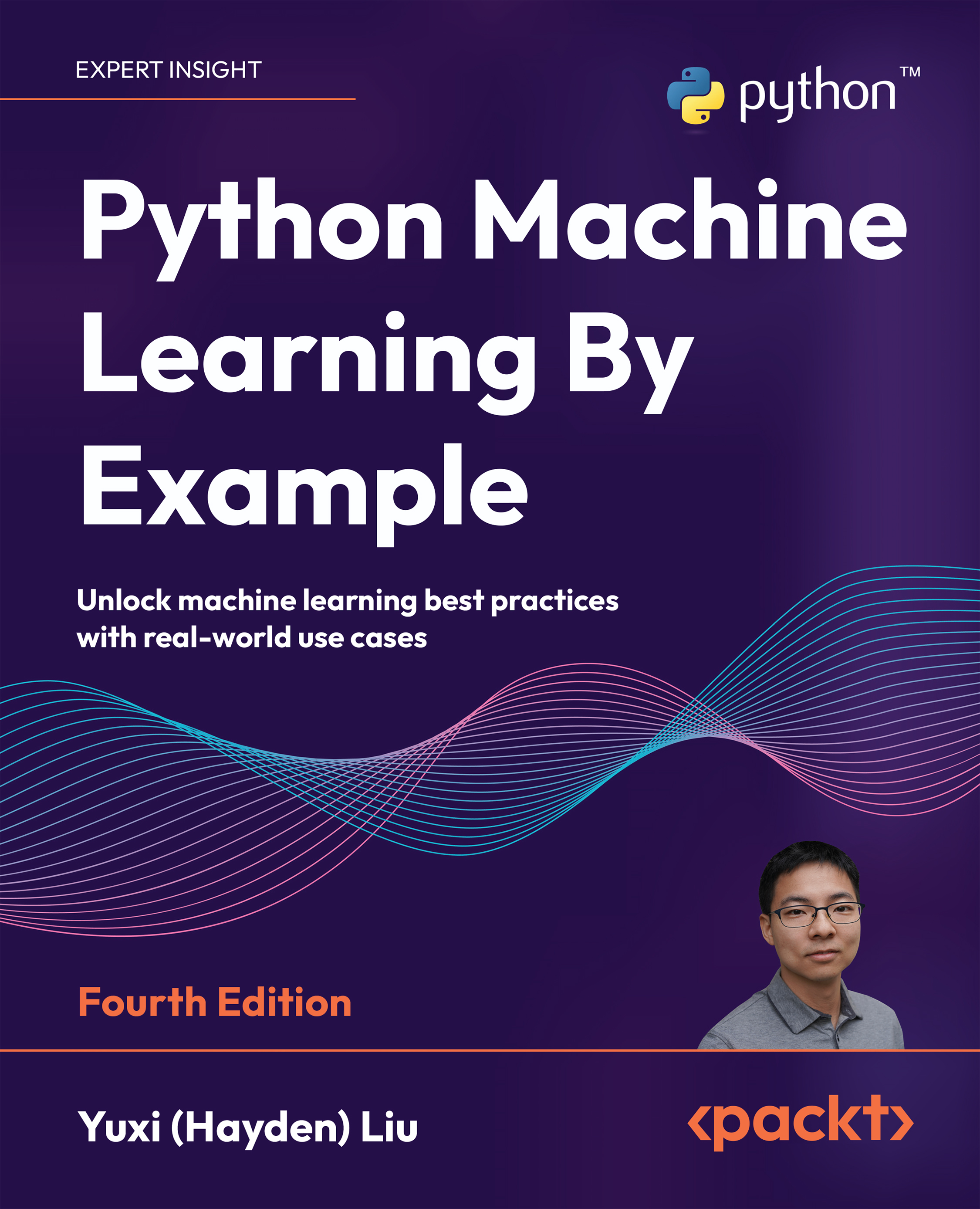
The fourth edition of Python Machine Learning By Example is a comprehensive guide for beginners and experienced machine learning practitioners who want to learn more advanced techniques, such as multimodal modeling. Written by experienced machine learning author and ex-Google machine learning engineer Yuxi (Hayden) Liu, this edition emphasizes best practices, providing invaluable insights for machine learning engineers, data scientists, and analysts.
Explore advanced techniques, including two new chapters on natural language processing transformers with BERT and GPT, and multimodal computer vision models with PyTorch and Hugging Face. You’ll learn key modeling techniques using practical examples, such as predicting stock prices and creating an image search engine.
This hands-on machine learning book navigates through complex challenges, bridging the gap between theoretical understanding and practical application. Elevate your machine learning and deep learning expertise, tackle intricate problems, and unlock the potential of advanced techniques in machine learning with this authoritative guide.
*Email sign-up and proof of purchase required
Table of Contents (18 chapters)
Preface


 Free Chapter
Getting Started with Machine Learning and Python
Building a Movie Recommendation Engine with Naïve Bayes
Predicting Online Ad Click-Through with Tree-Based Algorithms
Predicting Online Ad Click-Through with Logistic Regression
Predicting Stock Prices with Regression Algorithms
Predicting Stock Prices with Artificial Neural Networks
Mining the 20 Newsgroups Dataset with Text Analysis Techniques
Discovering Underlying Topics in the Newsgroups Dataset with Clustering and Topic Modeling

Recognizing Faces with Support Vector Machine
Machine Learning Best Practices
Categorizing Images of Clothing with Convolutional Neural Networks
Making Predictions with Sequences Using Recurrent Neural Networks
Advancing Language Understanding and Generation with the Transformer Models
Building an Image Search Engine Using CLIP: a Multimodal Approach
Making Decisions in Complex Environments with Reinforcement Learning
Other Books You May Enjoy
Index


