Sign In Start Free Trial
Account

Add to playlist

Create a Playlist

Modal Close icon
You need to login to use this feature.
  • Book Overview & Buying Generative AI with Python and PyTorch
  • Table Of Contents Toc
  • Feedback & Rating feedback
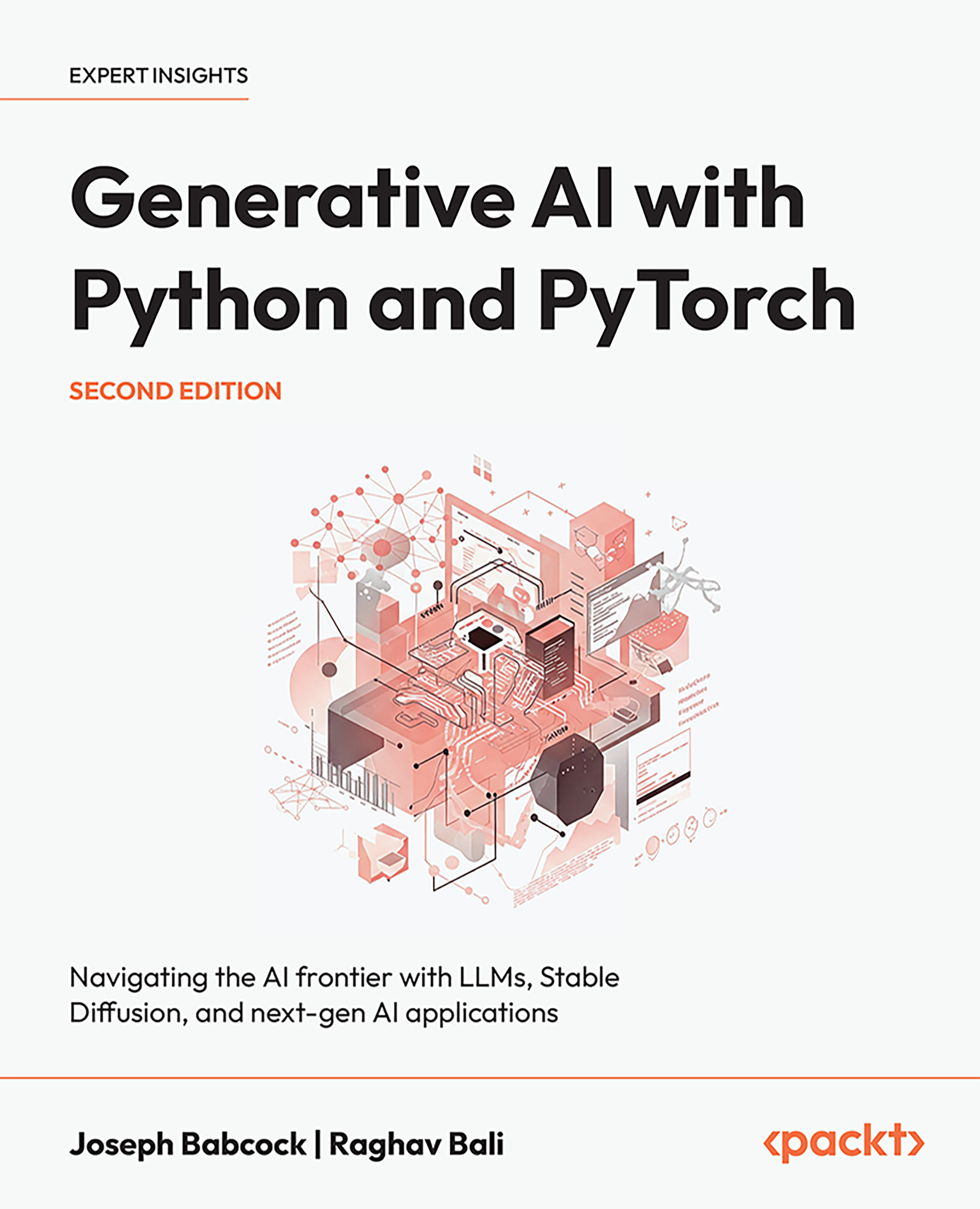
Generative AI with Python and PyTorch

Generative AI with Python and PyTorch - Second Edition

By : Joseph Babcock, Raghav Bali
5 (1)
close
close
Generative AI with Python and PyTorch

Generative AI with Python and PyTorch

5 (1)
By: Joseph Babcock, Raghav Bali

Overview of this book

Become an expert in Generative AI through immersive, hands-on projects that leverage today’s most powerful models for Natural Language Processing (NLP) and computer vision. Generative AI with Python and PyTorch is your end-to-end guide to creating advanced AI applications, made easy by Raghav Bali, a seasoned data scientist with multiple patents in AI, and Joseph Babcock, a PhD and machine learning expert. Through business-tested approaches, this book simplifies complex GenAI concepts, making learning both accessible and immediately applicable. From NLP to image generation, this second edition explores practical applications and the underlying theories that power these technologies. By integrating the latest advancements in LLMs, it prepares you to design and implement powerful AI systems that transform data into actionable intelligence. You’ll build your versatile LLM toolkit by gaining expertise in GPT-4, LangChain, RLHF, LoRA, RAG, and more. You’ll also explore deep learning techniques for image generation and apply styler transfer using GANs, before advancing to implement CLIP and diffusion models. Whether you’re generating dynamic content or developing complex AI-driven solutions, this book equips you with everything you need to harness the full transformative power of Python and AI.
Table of Contents (19 chapters)
close
close
17
Other Books You May Enjoy
18
Index

Implementing generative models

While generative models could theoretically be implemented using a wide variety of machine learning algorithms, in practice, they are usually built with deep neural networks, which are well suited to capture the complex variation in data such as images or language. In this book, we will focus on implementing these deep-learning-based generative models for many different applications using PyTorch. PyTorch is a Python programming library used to develop and produce deep learning models. It was open-sourced by Meta (formerly Facebook) in 2016 and has become one of the most popular libraries for the research and deployment of neural network models. We’ll execute PyTorch code on the cloud using Google’s Colab notebook environment, which allows you to access world-class computing infrastructure including graphic processing units (GPUs) and tensor processing units (TPUs) on demand and without the need for onerous environment setups. We’ll also leverage the Pipelines library from Hugging Face, which provides an easy interface to run experiments using a catalog of some of the most sophisticated models available.

In the following chapters, you will learn not only the underlying theory behind these models but also the practical skills to implement them in popular programming frameworks. In Chapter 2, we’ll review how, since 2006, an explosion of research in “deep learning” using large neural network models has produced a wide variety of generative modeling applications. Innovations arising from this research included variational autoencoders (VAEs), which can efficiently generate complex data samples from random numbers that are “decoded” into realistic images, using techniques we will describe in Chapter 11. We will also describe a related image generation algorithm, the generative adversarial network (GAN), in more detail in Chapters 12-14 of this book through applications for image generation, style transfer, and deepfakes. Conceptually, the GAN model creates a competition between two neural networks.

One (termed the generator) produces realistic (or, in the case of the experiments by Obvious, artistic) images starting from a set of random numbers that are “decoded” into realistic images by applying a mathematical transformation. In a sense, the generator is like an art student, producing new paintings from brushstrokes and creative inspiration. The second network, known as the discriminator, attempts to classify whether a picture comes from a set of real-world images, or whether it was created by the generator. Thus, the discriminator acts like a teacher, grading whether the student has produced work comparable to the paintings they are attempting to mimic. As the generator becomes better at fooling the discriminator, its output becomes closer and closer to the historical examples it is designed to copy. In Chapter 11, we’ll also describe the algorithm used in Théâtre D’opéra Spatial, the latent diffusion model, which builds on VAEs to provide scalable image synthesis based on natural language prompts from a human user.

Another key innovation in generative models is in the domain of natural language data—by representing the complex interrelationship between words in a sentence in a computationally scalable way, the Transformer network and the Bidirectional Encoder from Transformers (BERT) model built on top of it present powerful building blocks to generate textual data in applications such as chatbots and large language models (LLMs), which we’ll cover in Chapters 4 and 5. In Chapter 6, we will dive deeper into the most famous open-source models in the current LLM landscape, including Llama. In Chapters 7 and 8.

Before diving into further details on the various applications of generative models and how to implement them in PyTorch, we will take a step back and examine how exactly generative models are different from other kinds of machine learning. This difference lies with the basic units of any machine learning algorithm: probability and the various ways we use mathematics to quantify the shape and distribution of data we encounter in the world. In the rest of this chapter, we will cover the following:

  • How we can use the statistical rules of probability to describe how machine learning models represent the shapes of the datasets we study
  • The difference between discriminative and generative models, based on the kinds of probability rules they embody
  • Examples of areas where generative modeling has been applied: image generation, style transfer, chatbots and text synthesis, and reinforcement learning
Visually different images
CONTINUE READING
83
Tech Concepts
36
Programming languages
73
Tech Tools
Icon Unlimited access to the largest independent learning library in tech of over 8,000 expert-authored tech books and videos.
Icon Innovative learning tools, including AI book assistants, code context explainers, and text-to-speech.
Icon 50+ new titles added per month and exclusive early access to books as they are being written.
Generative AI with Python and PyTorch
notes
bookmark Notes and Bookmarks search Search in title playlist Add to playlist download Download options font-size Font size

Change the font size

margin-width Margin width

Change margin width

day-mode Day/Sepia/Night Modes

Change background colour

Close icon Search
Country selected

Close icon Your notes and bookmarks

Confirmation

Modal Close icon
claim successful

Buy this book with your credits?

Modal Close icon
Are you sure you want to buy this book with one of your credits?
Close
YES, BUY

Submit Your Feedback

Modal Close icon
Modal Close icon
Modal Close icon