


-
Book Overview & Buying
-
Table Of Contents

Unlocking Data with Generative AI and RAG
By :


Unlocking Data with Generative AI and RAG
By:
Overview of this book
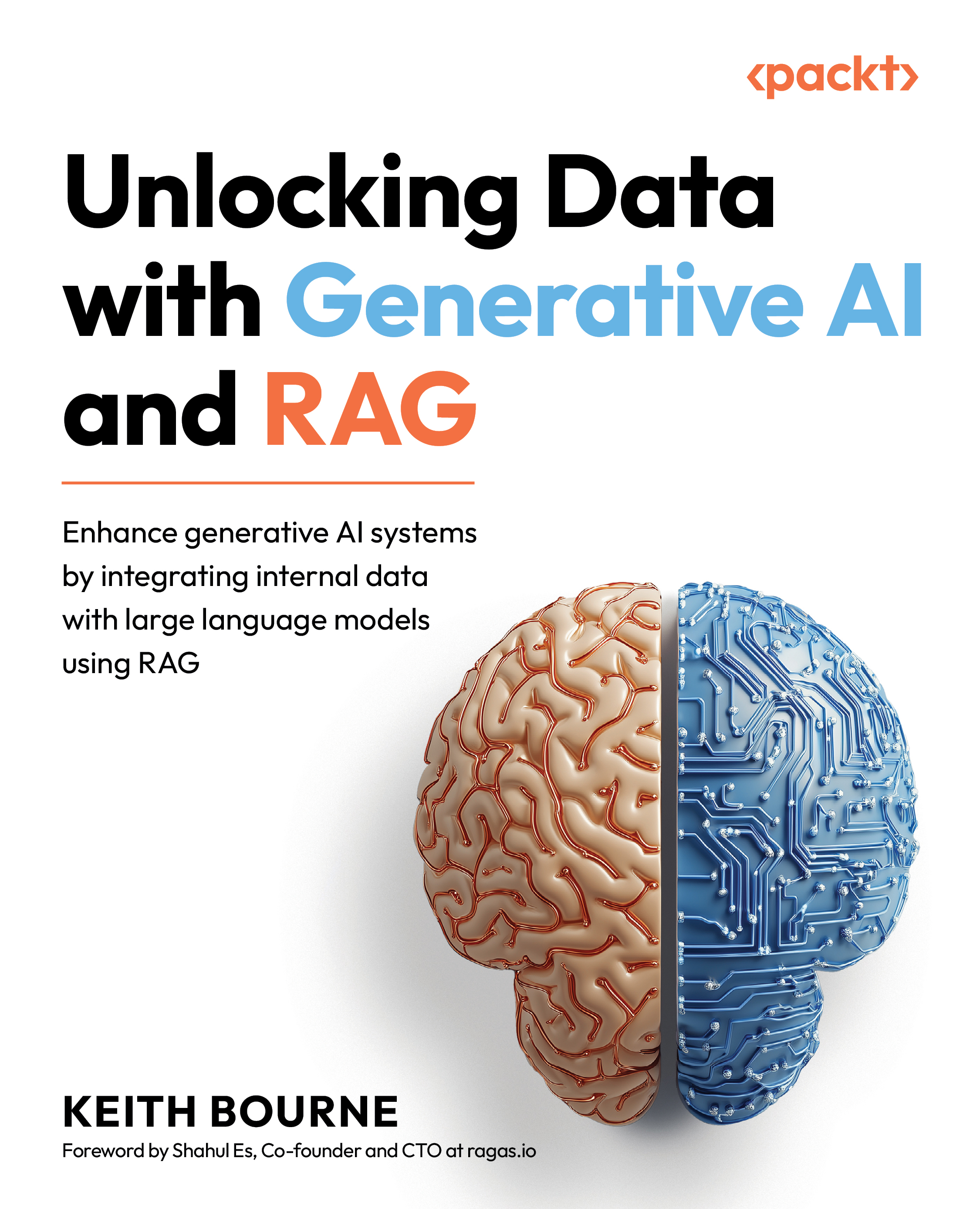
Generative AI is helping organizations tap into their data in new ways, with RAG combining the strengths of LLMs with internal data for more intelligent and relevant AI applications. The author harnesses his decade of ML experience in this book to equip you with the strategic insights and technical expertise needed when using RAG to drive transformative outcomes.
The book explores RAG’s role in enhancing organizational operations by blending theoretical foundations with practical techniques. You’ll work with detailed coding examples using tools such as LangChain and Chroma’s vector database to gain hands-on experience in integrating RAG into AI systems. The chapters contain real-world case studies and sample applications that highlight RAG’s diverse use cases, from search engines to chatbots. You’ll learn proven methods for managing vector databases, optimizing data retrieval, effective prompt engineering, and quantitatively evaluating performance. The book also takes you through advanced integrations of RAG with cutting-edge AI agents and emerging non-LLM technologies.
By the end of this book, you’ll be able to successfully deploy RAG in business settings, address common challenges, and push the boundaries of what’s possible with this revolutionary AI technique.
*Email sign-up and proof of purchase required
Table of Contents (20 chapters)
Preface


 Free Chapter
Part 1 – Introduction to Retrieval-Augmented Generation (RAG)
Chapter 1: What Is Retrieval-Augmented Generation (RAG)
Chapter 2: Code Lab – An Entire RAG Pipeline
Chapter 3: Practical Applications of RAG
Chapter 4: Components of a RAG System
Chapter 5: Managing Security in RAG Applications
Part 2 – Components of RAG
Chapter 6: Interfacing with RAG and Gradio
Chapter 7: The Key Role Vectors and Vector Stores Play in RAG
Chapter 8: Similarity Searching with Vectors
Chapter 9: Evaluating RAG Quantitatively and with Visualizations
Chapter 10: Key RAG Components in LangChain
Chapter 11: Using LangChain to Get More from RAG

Part 3 – Implementing Advanced RAG
Chapter 12: Combining RAG with the Power of AI Agents and LangGraph
Chapter 13: Using Prompt Engineering to Improve RAG Efforts
Chapter 14: Advanced RAG-Related Techniques for Improving Results
Index


