


-
Book Overview & Buying
-
Table Of Contents

RAG-Driven Generative AI
By :


RAG-Driven Generative AI
By:
Overview of this book
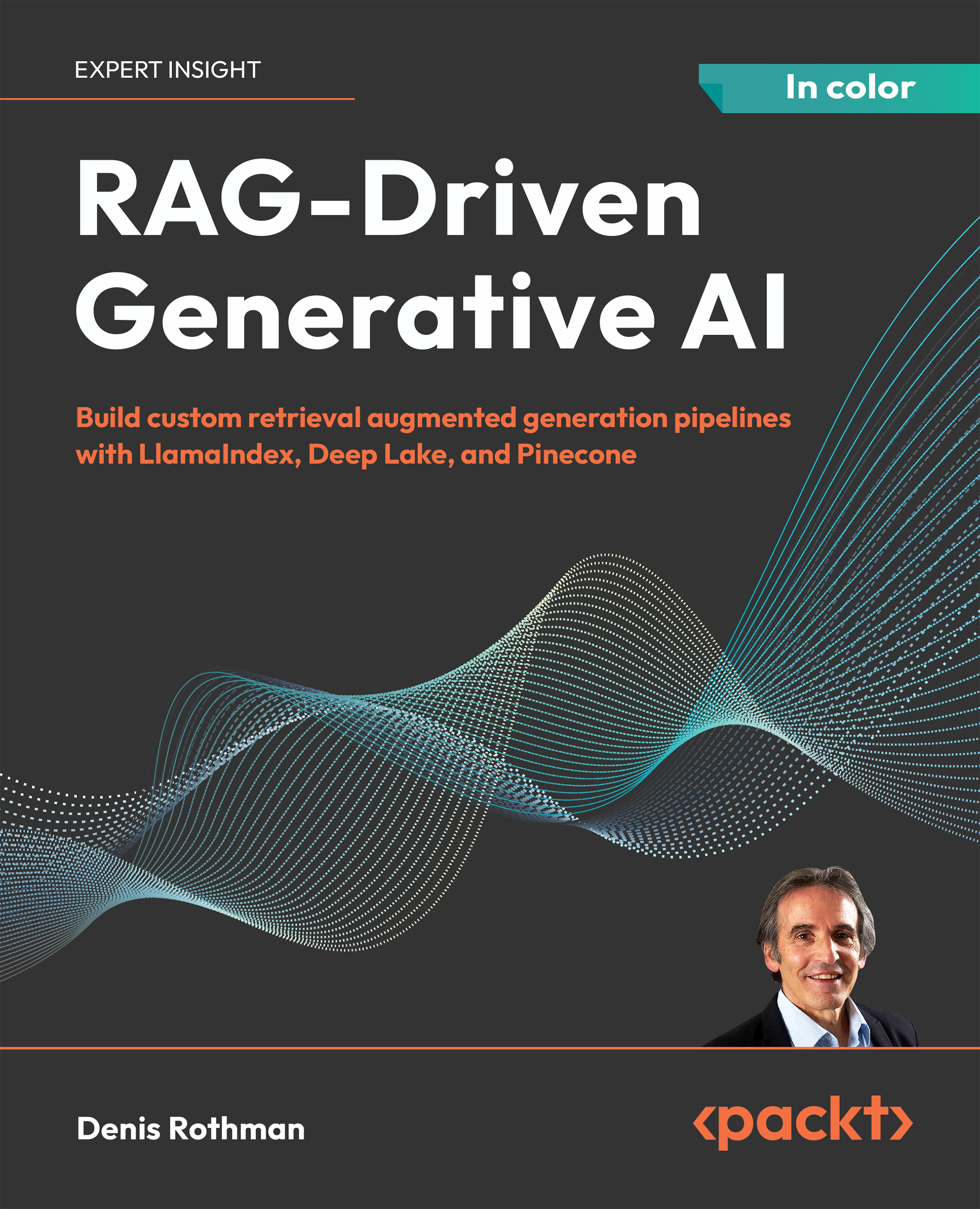
RAG-Driven Generative AI provides a roadmap for building effective LLM, computer vision, and generative AI systems that balance performance and costs.
This book offers a detailed exploration of RAG and how to design, manage, and control multimodal AI pipelines. By connecting outputs to traceable source documents, RAG improves output accuracy and contextual relevance, offering a dynamic approach to managing large volumes of information. This AI book shows you how to build a RAG framework, providing practical knowledge on vector stores, chunking, indexing, and ranking. You’ll discover techniques to optimize your project’s performance and better understand your data, including using adaptive RAG and human feedback to refine retrieval accuracy, balancing RAG with fine-tuning, implementing dynamic RAG to enhance real-time decision-making, and visualizing complex data with knowledge graphs.
You’ll be exposed to a hands-on blend of frameworks like LlamaIndex and Deep Lake, vector databases such as Pinecone and Chroma, and models from Hugging Face and OpenAI. By the end of this book, you will have acquired the skills to implement intelligent solutions, keeping you competitive in fields from production to customer service across any project.
*Email sign-up and proof of purchase required
Table of Contents (14 chapters)
Preface


 Free Chapter
Why Retrieval Augmented Generation?
RAG Embedding Vector Stores with Deep Lake and OpenAI

Building Index-Based RAG with LlamaIndex, Deep Lake, and OpenAI
Multimodal Modular RAG for Drone Technology
Boosting RAG Performance with Expert Human Feedback
Scaling RAG Bank Customer Data with Pinecone
Building Scalable Knowledge-Graph-Based RAG with Wikipedia API and LlamaIndex
Dynamic RAG with Chroma and Hugging Face Llama
Empowering AI Models: Fine-Tuning RAG Data and Human Feedback
RAG for Video Stock Production with Pinecone and OpenAI
Other Books You May Enjoy
Index
Appendix


