


-
Book Overview & Buying
-
Table Of Contents

LLMs in Enterprise
By :


LLMs in Enterprise
By:
Overview of this book
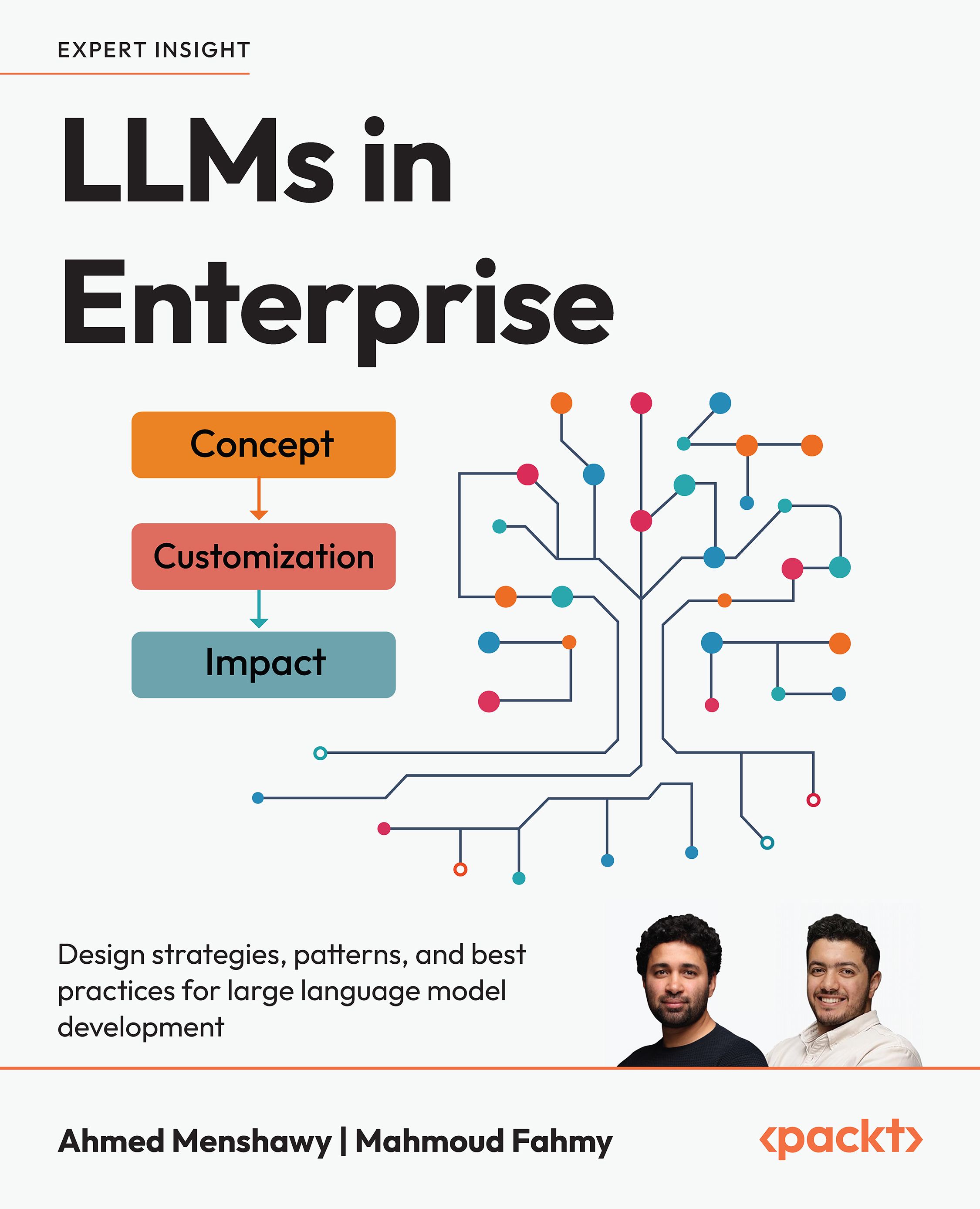
The integration of large language models (LLMs) into enterprise applications is transforming how businesses use AI to drive smarter decisions and efficient operations. LLMs in Enterprise is your practical guide to bringing these capabilities into real-world business contexts. It demystifies the complexities of LLM deployment and provides a structured approach for enhancing decision-making and operational efficiency with AI.
Starting with an introduction to the foundational concepts, the book swiftly moves on to hands-on applications focusing on real-world challenges and solutions. You’ll master data strategies and explore design patterns that streamline the optimization and deployment of LLMs in enterprise environments. From fine-tuning techniques to advanced inferencing patterns, the book equips you with a toolkit for solving complex challenges and driving AI-led innovation in business processes.
By the end of this book, you’ll have a solid grasp of key LLM design patterns and how to apply them to enhance the performance and scalability of your generative AI solutions.
*Email sign-up and proof of purchase required
Table of Contents (20 chapters)
Preface


 Free Chapter
Part 1: Background and Foundational Concepts
Introduction to Large Language Models
LLMs in Enterprise: Applications, Challenges, and Design Patterns
Advanced Fine-Tuning Techniques and Strategies for Large Language Models
Retrieval-Augmented Generation Pattern
Customizing Contextual LLMs
Part 2: Advanced Design Patterns and Techniques
The Art of Prompt Engineering for Enterprise LLMs
Enterprise Challenges in Evaluating LLM Applications
The Data Blueprint: Crafting Effective Strategies for LLM Development

Managing Model Deployments in Production
Accelerated and Optimized Inferencing Patterns
Part 3: GenAI in the Enterprise
Connected LLMs Pattern
Monitoring LLMs in Production
Responsible AI in LLMs
Emerging Trends and Multimodality
Other Books You May Enjoy
Index


