Sign In Start Free Trial
Account

Add to playlist

Create a Playlist

Modal Close icon
You need to login to use this feature.
  • Book Overview & Buying scikit-learn Cookbook
  • Table Of Contents Toc
scikit-learn Cookbook

scikit-learn Cookbook - Third Edition

By : John Sukup
close
close
scikit-learn Cookbook

scikit-learn Cookbook

By: John Sukup

Overview of this book

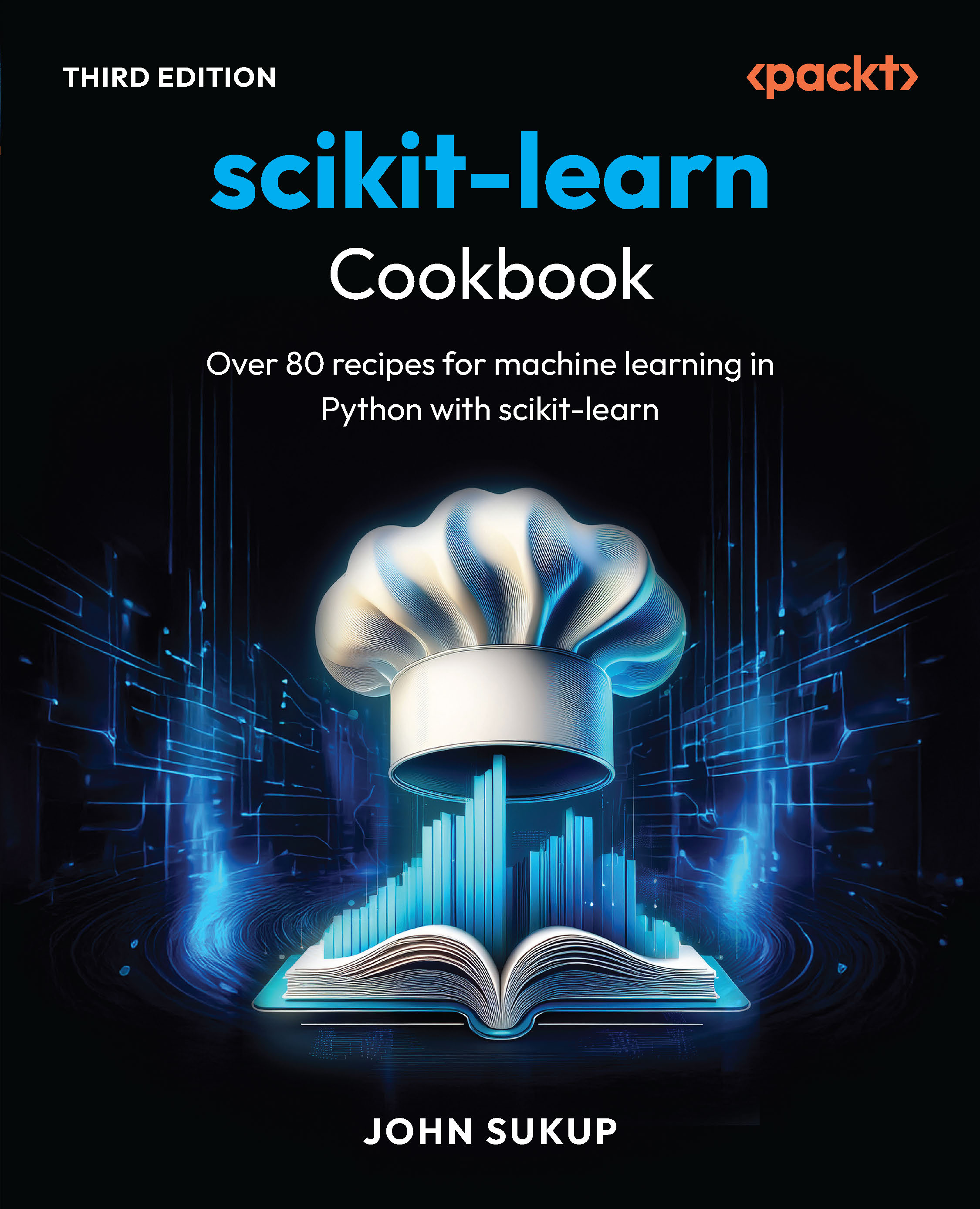
Trusted by data scientists, ML engineers, and software developers alike, scikit-learn offers a versatile, user-friendly framework for implementing a wide range of ML algorithms, enabling the efficient development and deployment of predictive models in real-world applications. This third edition of scikit-learn Cookbook will help you master ML with real-world examples and scikit-learn 1.5 features. This updated edition takes you on a journey from understanding the fundamentals of ML and data preprocessing, through implementing advanced algorithms and techniques, to deploying and optimizing ML models in production. Along the way, you’ll explore practical, step-by-step recipes that cover everything from feature engineering and model selection to hyperparameter tuning and model evaluation, all using scikit-learn. By the end of this book, you’ll have gained the knowledge and skills needed to confidently build, evaluate, and deploy sophisticated ML models using scikit-learn, ready to tackle a wide range of data-driven challenges.
Table of Contents (17 chapters)
close
close

Common Conventions and API Elements of scikit-learn

It’s hard to believe that the scikit-learn project started back in 2007 and officially launched in 2009. Even after so many years, it is hard to deny the impact the Python library has had on the world of data science and machine learning (ML). For many of us, scikit-learn is one of the first libraries we hear about when we begin our journey in ML programming and engineering—and that hasn’t changed, with the library being one of the most widely used in research, academia, and production applications at scale in the business world.

This chapter will cover the standard conventions and core API elements of scikit-learn, including the design principles behind estimators, transformers, and pipelines, as well as common methods such as fit(), predict(), and transform(). The exercises provided throughout the rest of this book will involve using these conventions to build and evaluate models, all while focusing on understanding the consistent structure of scikit-learn’s API to enhance usability and flexibility in ML projects.

In this chapter, we’re going to cover the following recipes:

  • Introduction to scikit-learn’s design philosophy
  • Understanding estimators
  • Transformers and the transform() method
  • Handling custom estimators and transformers
  • Pipelines and workflow automation
  • Common attributes and methods
  • Hyperparameter tuning with search methods
  • Working with metadata: Tags and more
  • Best practices for API usage

Free Benefits with Your Book

Your purchase includes a free PDF copy of this book along with other exclusive benefits. Check the Free Benefits with Your Book section in the Preface to unlock them instantly and maximize your learning experience.

Visually different images
CONTINUE READING
83
Tech Concepts
36
Programming languages
73
Tech Tools
Icon Unlimited access to the largest independent learning library in tech of over 8,000 expert-authored tech books and videos.
Icon Innovative learning tools, including AI book assistants, code context explainers, and text-to-speech.
Icon 50+ new titles added per month and exclusive early access to books as they are being written.
scikit-learn Cookbook
notes
bookmark Notes and Bookmarks search Search in title playlist Add to playlist download Download options font-size Font size

Change the font size

margin-width Margin width

Change margin width

day-mode Day/Sepia/Night Modes

Change background colour

Close icon Search
Country selected

Close icon Your notes and bookmarks

Confirmation

Modal Close icon
claim successful

Buy this book with your credits?

Modal Close icon
Are you sure you want to buy this book with one of your credits?
Close
YES, BUY

Submit Your Feedback

Modal Close icon
Modal Close icon
Modal Close icon