


-
Book Overview & Buying
-
Table Of Contents

scikit-learn Cookbook - Third Edition
By :


scikit-learn Cookbook
By:
Overview of this book
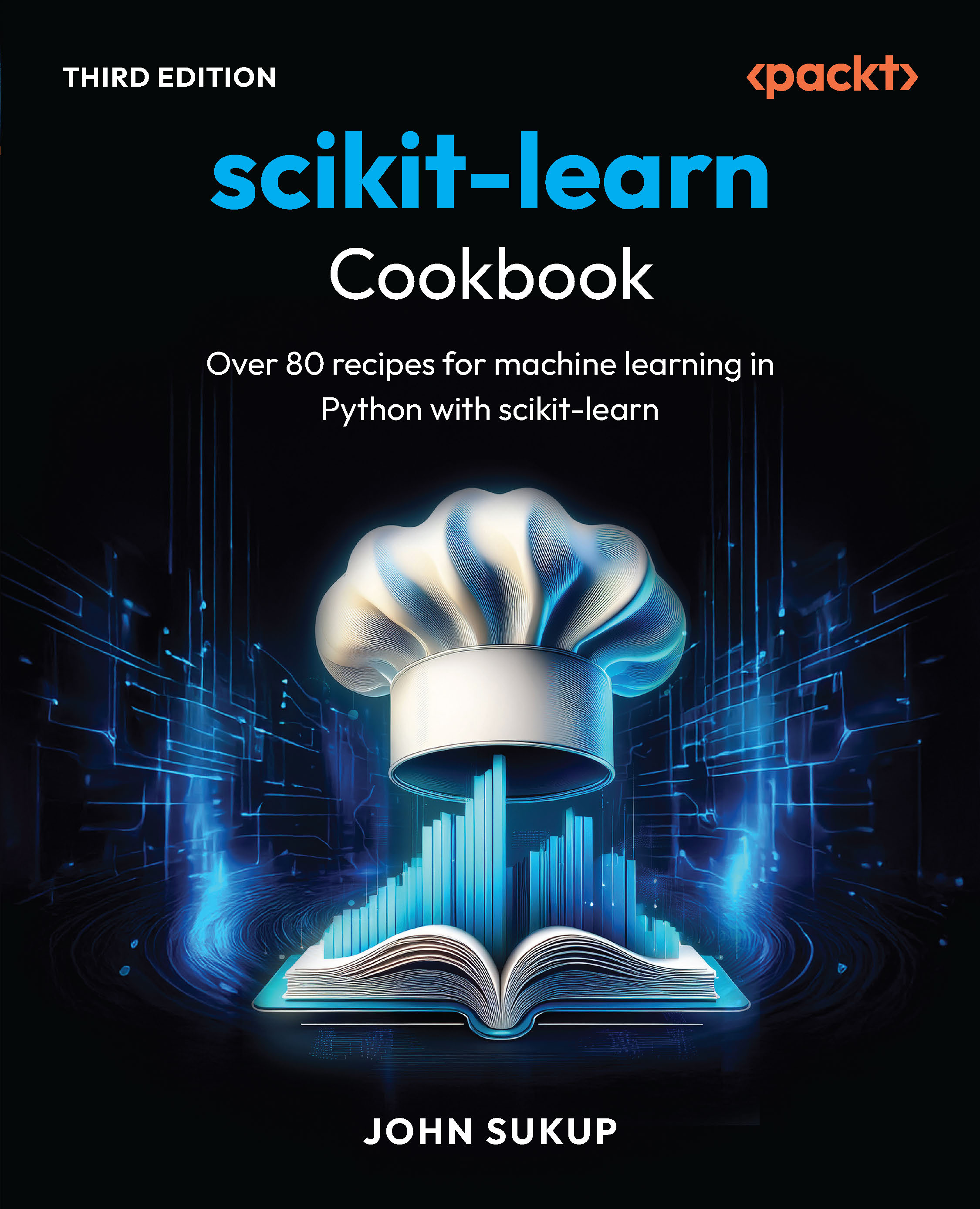
Trusted by data scientists, ML engineers, and software developers alike, scikit-learn offers a versatile, user-friendly framework for implementing a wide range of ML algorithms, enabling the efficient development and deployment of predictive models in real-world applications. This third edition of scikit-learn Cookbook will help you master ML with real-world examples and scikit-learn 1.5 features.
This updated edition takes you on a journey from understanding the fundamentals of ML and data preprocessing, through implementing advanced algorithms and techniques, to deploying and optimizing ML models in production. Along the way, you’ll explore practical, step-by-step recipes that cover everything from feature engineering and model selection to hyperparameter tuning and model evaluation, all using scikit-learn.
By the end of this book, you’ll have gained the knowledge and skills needed to confidently build, evaluate, and deploy sophisticated ML models using scikit-learn, ready to tackle a wide range of data-driven challenges.
*Email sign-up and proof of purchase required
Table of Contents (17 chapters)
Preface


 Free Chapter
Chapter 1: Common Conventions and API Elements of scikit-learn
Chapter 2: Pre-Model Workflow and Data Preprocessing
Chapter 3: Dimensionality Reduction Techniques
Chapter 4: Building Models with Distance Metrics and Nearest Neighbors
Chapter 5: Linear Models and Regularization
Chapter 6: Advanced Logistic Regression and Extensions
Chapter 7: Support Vector Machines and Kernel Methods
Chapter 8: Tree-Based Algorithms and Ensemble Methods
Chapter 9: Text Processing and Multiclass Classification

Chapter 10: Clustering Techniques
Chapter 11: Novelty and Outlier Detection
Chapter 12: Cross-Validation and Model Evaluation Techniques
Chapter 13: Deploying scikit-learn Models in Production
Chapter 14: Unlock Your Exclusive Benefits
Index
Other Books You May Enjoy


