Sign In Start Free Trial
Account

Add to playlist

Create a Playlist

Modal Close icon
You need to login to use this feature.
  • Book Overview & Buying Building Business-Ready Generative AI Systems
  • Table Of Contents Toc
Building Business-Ready Generative AI Systems

Building Business-Ready Generative AI Systems

By : Denis Rothman
close
close
Building Business-Ready Generative AI Systems

Building Business-Ready Generative AI Systems

By: Denis Rothman

Overview of this book

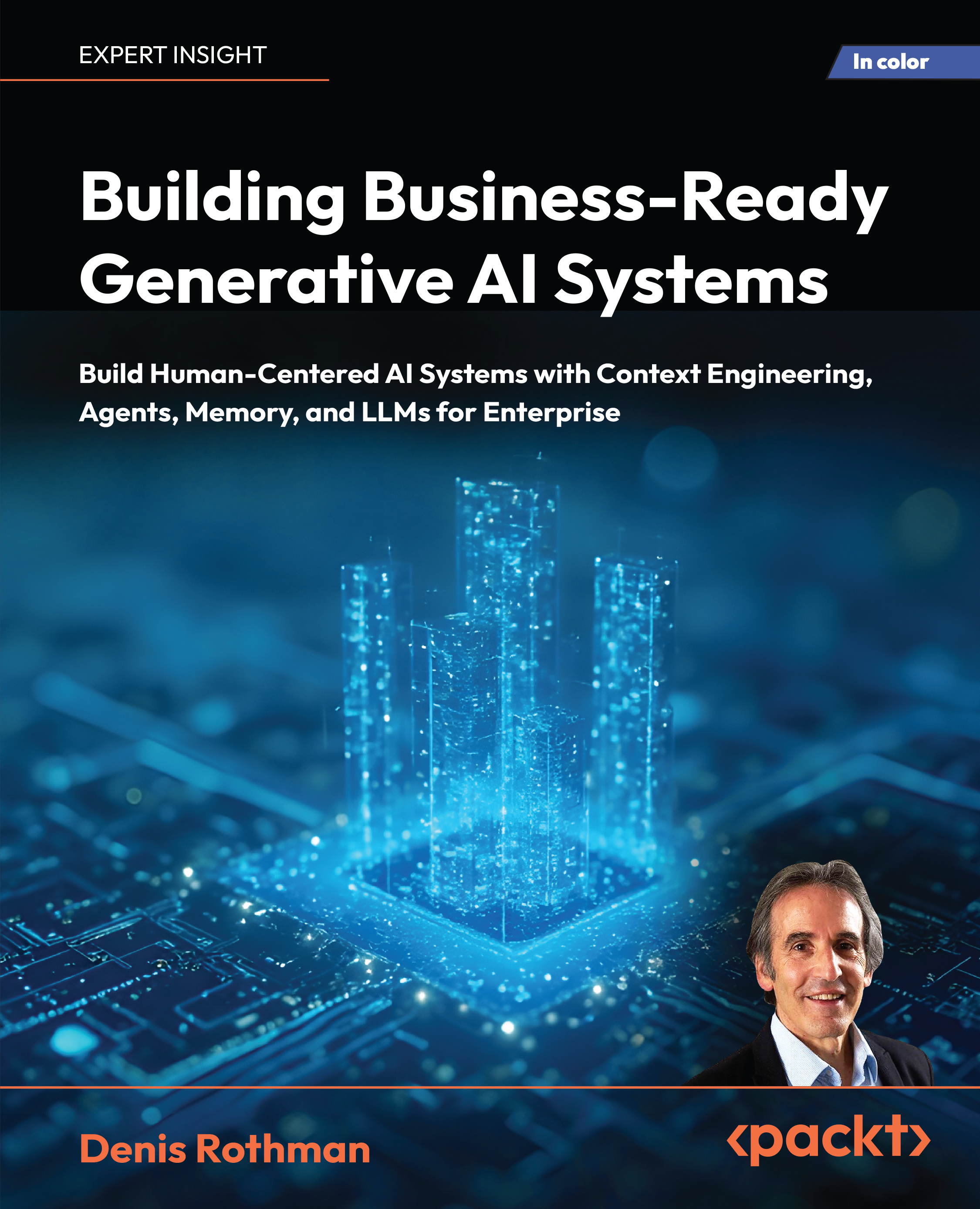
Standalone LLMs no longer deliver sufficient business value on their own. This guide moves beyond basic chatbots, showing you how to build agentic, ChatGPT-grade systems capable of sophisticated semantic and sentiment analysis, powered by context engineering. You'll design AI controller architectures with multi-user memory retention to dynamically adapt your system to diverse user and system inputs. You'll architect a Retrieval-Augmented Generation system with Pinecone to combine instruction-driven scenarios. Through context engineering, you’ll minimize token usage, maximize response quality, and create systems that reason across complex tasks with precision. You'll enhance your system’s intelligence with multimodal capabilities—image generation, voice interactions, and machine-driven reasoning—leveraging Chain-of-Thought and context chaining to address cross-domain automation challenges. You'll also integrate OpenAI’s suite and DeepSeek-R1 without disrupting your existing GenAISys ecosystem. With context engineering as the backbone, every step becomes a deliberate act of shaping model behavior. Your GenAISys will apply neuroscience-inspired insights to marketing strategies, predict human mobility, integrate smoothly into human workflows, and connect to live external data, all wrapped in a polished, investor-ready interface.
Table of Contents (14 chapters)
close
close
12
Other Books You May Enjoy

Defining a Business-Ready Generative AI System

Implementing a generative AI system (GenAISys) in an organization doesn’t stop at simply integrating a standalone model such as GPT, Grok, Llama, or Gemini via an API. While this is often a starting point, we often mistake it as the finish line. The rising demand for AI, as it expands across all domains, calls for the implementation of advanced AI systems that go beyond simply integrating a prebuilt model.

A business-ready GenAISys should provide ChatGPT-grade functionality in an organization, but also go well beyond it. Its capabilities and features must include natural language understanding (NLU), contextual awareness through memory retention across dialogues in a chat session, and agentic functions such as autonomous image, audio, and document analysis and generation. This requires thoughtful context engineering, where we strategically manage the information given to the model to guide its responses. Think of a generative AI model as an entity with a wide range of functions, including AI agents as agentic co-workers.

We will begin the chapter by defining what a business-ready GenAISys is. From there, we’ll focus on the central role of a generative AI model, such as GPT-4o, that can both orchestrate and execute tasks. Building on that, we will lay the groundwork for contextual awareness and memory retention, discussing four types of generative AI memory: memoryless, short-term, long-term, and multiple sessions. We will also define a new approach to retrieval-augmented generation (RAG) that introduces an additional dimension to data retrieval: instruction and agentic reasoning scenarios. Adding instructions stored in a vector store takes RAG to another level by retrieving instructions that we can add to a prompt. In parallel, we will examine a critical component of a GenAISys: human roles. We will see how, throughout its life cycle, an AI system requires human expertise. Additionally, we will define several levels of implementation to adapt the scope and scale of a GenAISys, not only to business requirements but also to available budgets and resources.

Finally, we’ll illustrate how contextual awareness and memory retention can be implemented using OpenAI’s LLM and multimodal API. A GenAISys cannot work without solid memory retention functionality—without memory, there’s no context, and without context, there’s no sustainable generation. Throughout this book, we will create modules for memoryless, short-term, long-term, and multisession types depending on the task at hand. By the end of this chapter, you will have acquired a clear conceptual framework for what makes an AI system business-ready and practical experience in building the first bricks of an AI controller.

In a nutshell, this chapter covers the following topics:

  • Components of a business-ready GenAISys
  • AI controllers and agentic functionality (model-agnostic)
  • Hybrid human roles and collaboration with AI
  • Business opportunities and scope
  • Contextual awareness through memory retention

Let’s begin by defining what a business-ready GenAISys is.

CONTINUE READING
83
Tech Concepts
36
Programming languages
73
Tech Tools
Icon Unlimited access to the largest independent learning library in tech of over 8,000 expert-authored tech books and videos.
Icon Innovative learning tools, including AI book assistants, code context explainers, and text-to-speech.
Icon 50+ new titles added per month and exclusive early access to books as they are being written.
Building Business-Ready Generative AI Systems
notes
bookmark Notes and Bookmarks search Search in title playlist Add to playlist download Download options font-size Font size

Change the font size

margin-width Margin width

Change margin width

day-mode Day/Sepia/Night Modes

Change background colour

Close icon Search
Country selected

Close icon Your notes and bookmarks

Confirmation

Modal Close icon
claim successful

Buy this book with your credits?

Modal Close icon
Are you sure you want to buy this book with one of your credits?
Close
YES, BUY

Submit Your Feedback

Modal Close icon
Modal Close icon
Modal Close icon