


-
Book Overview & Buying
-
Table Of Contents

Building Business-Ready Generative AI Systems
By :


Building Business-Ready Generative AI Systems
By:
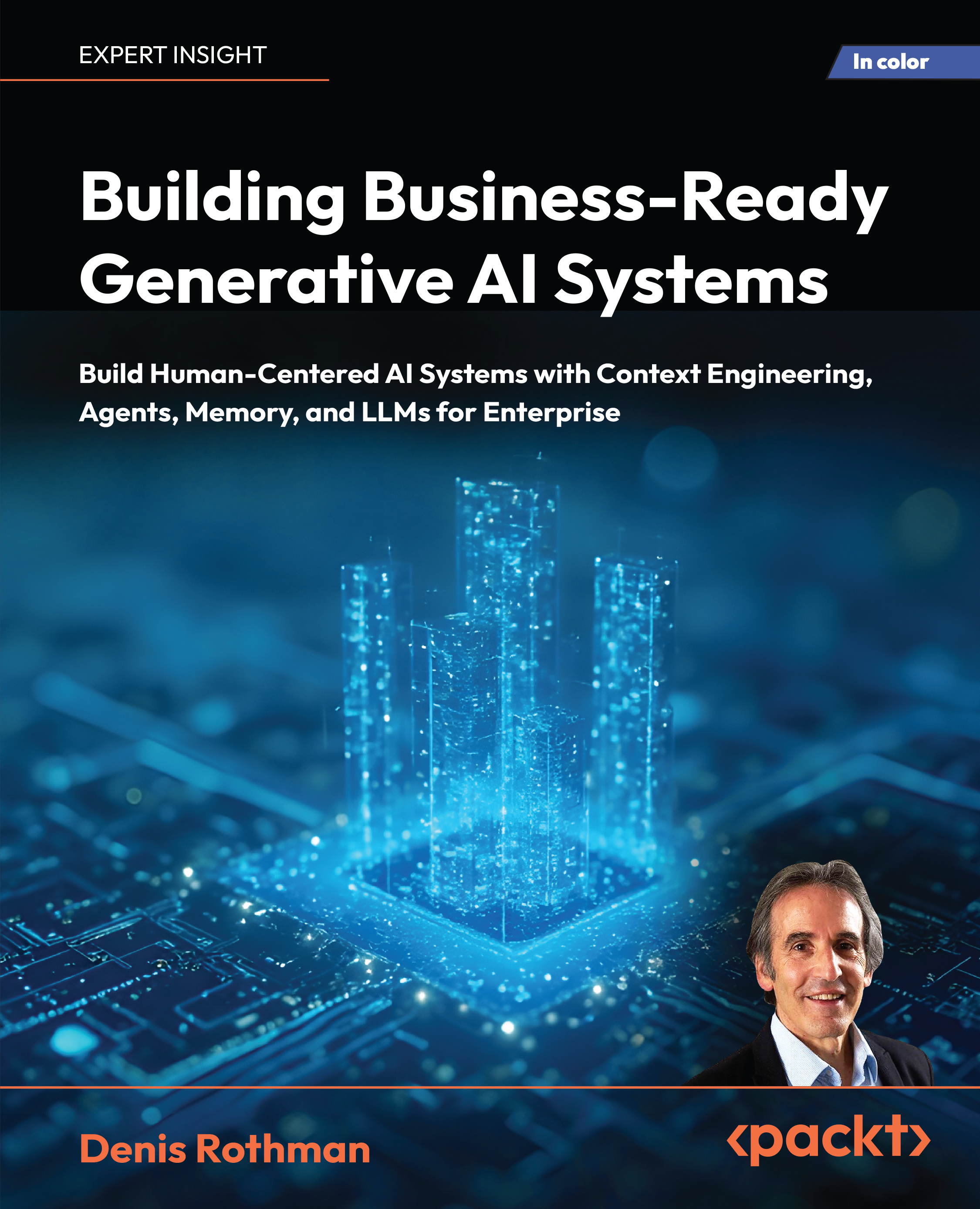
Overview of this book
Standalone LLMs no longer deliver sufficient business value on their own. This guide moves beyond basic chatbots, showing you how to build agentic, ChatGPT-grade systems capable of sophisticated semantic and sentiment analysis, powered by context engineering.
You'll design AI controller architectures with multi-user memory retention to dynamically adapt your system to diverse user and system inputs. You'll architect a Retrieval-Augmented Generation system with Pinecone to combine instruction-driven scenarios. Through context engineering, you’ll minimize token usage, maximize response quality, and create systems that reason across complex tasks with precision. You'll enhance your system’s intelligence with multimodal capabilities—image generation, voice interactions, and machine-driven reasoning—leveraging Chain-of-Thought and context chaining to address cross-domain automation challenges. You'll also integrate OpenAI’s suite and DeepSeek-R1 without disrupting your existing GenAISys ecosystem.
With context engineering as the backbone, every step becomes a deliberate act of shaping model behavior. Your GenAISys will apply neuroscience-inspired insights to marketing strategies, predict human mobility, integrate smoothly into human workflows, and connect to live external data, all wrapped in a polished, investor-ready interface.
Table of Contents (14 chapters)
Preface


 Free Chapter
Defining a Business-Ready Generative AI System
Building the Generative AI Controller
Integrating Dynamic RAG into the GenAISys
Building the AI Controller Orchestration Interface
Adding Multimodal, Multifunctional Reasoning with Chain of Thought
Reasoning E-Marketing AI Agents
Enhancing the GenAISys with DeepSeek
GenAISys for Trajectory Simulation and Prediction

Upgrading the GenAISys with Data Security and Moderation for Customer Service
Presenting Your Business-Ready Generative AI System
Answers
Other Books You May Enjoy


