


-
Book Overview & Buying
-
Table Of Contents

TinyML Cookbook - Second Edition
By :


TinyML Cookbook
By:
Overview of this book
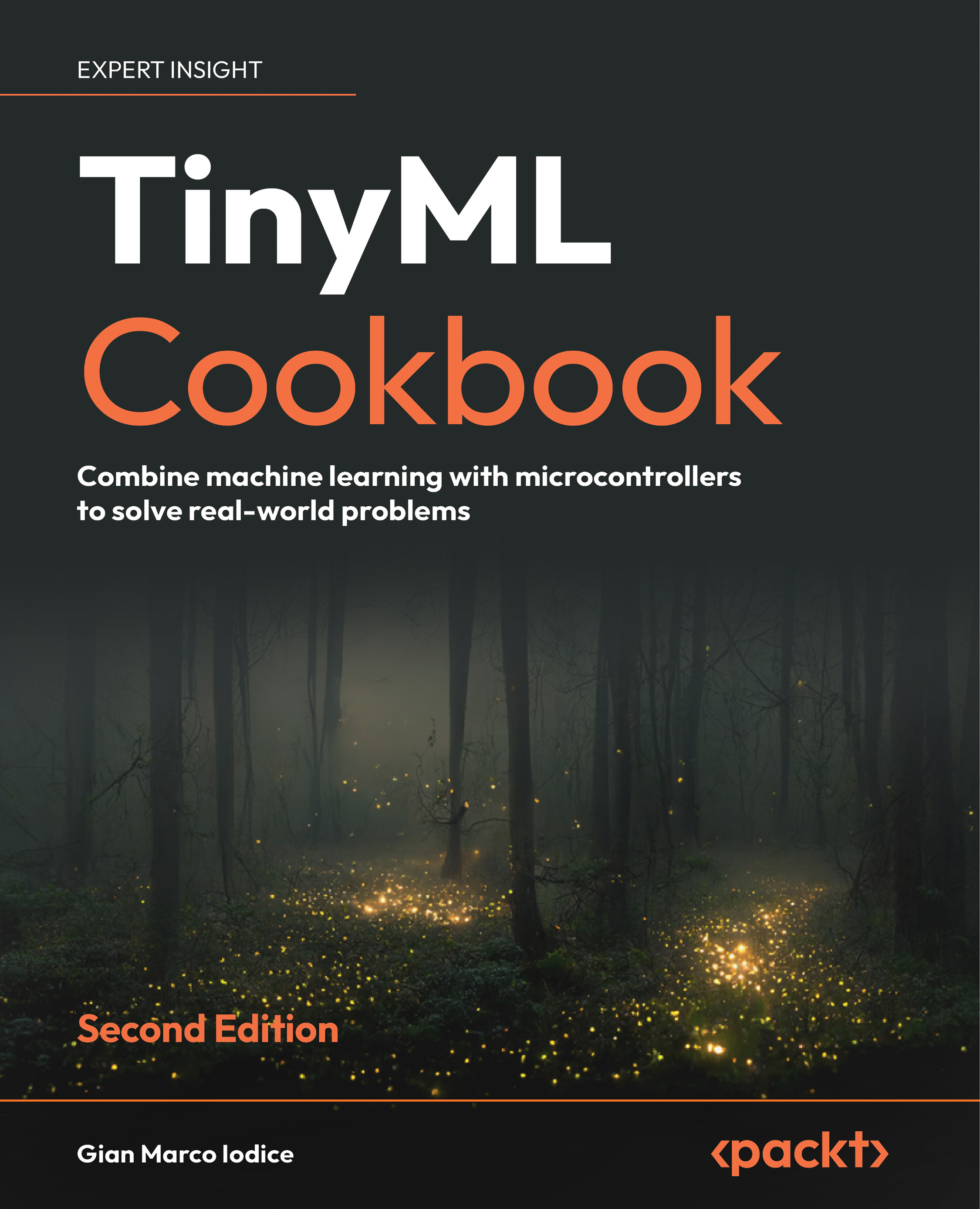
Discover the incredible world of tiny Machine Learning (tinyML) and create smart projects using real-world data sensors with the Arduino Nano 33 BLE Sense, Raspberry Pi Pico, and SparkFun RedBoard Artemis Nano.
TinyML Cookbook, Second Edition, will show you how to build unique end-to-end ML applications using temperature, humidity, vision, audio, and accelerometer sensors in different scenarios. These projects will equip you with the knowledge and skills to bring intelligence to microcontrollers. You'll train custom models from weather prediction to real-time speech recognition using TensorFlow and Edge Impulse.Expert tips will help you squeeze ML models into tight memory budgets and accelerate performance using CMSIS-DSP.
This improved edition includes new recipes featuring an LSTM neural network to recognize music genres and the Faster-Objects-More-Objects (FOMO) algorithm for detecting objects in a scene. Furthermore, you’ll work on scikit-learn model deployment on microcontrollers, implement on-device training, and deploy a model using microTVM, including on a microNPU. This beginner-friendly and comprehensive book will help you stay up to date with the latest developments in the tinyML community and give you the knowledge to build unique projects with microcontrollers!
Table of Contents (16 chapters)
Preface


 Free Chapter
Getting Ready to Unlock ML on Microcontrollers
Unleashing Your Creativity with Microcontrollers
Building a Weather Station with TensorFlow Lite for Microcontrollers
Using Edge Impulse and the Arduino Nano to Control LEDs with Voice Commands
Recognizing Music Genres with TensorFlow and the Raspberry Pi Pico – Part 1

Recognizing Music Genres with TensorFlow and the Raspberry Pi Pico – Part 2
Detecting Objects with Edge Impulse Using FOMO on the Raspberry Pi Pico
Classifying Desk Objects with TensorFlow and the Arduino Nano
Building a Gesture-Based Interface for YouTube Playback with Edge Impulse and the Raspberry Pi Pico
Deploying a CIFAR-10 Model for Memory-Constrained Devices with the Zephyr OS on QEMU
Running ML Models on Arduino and the Arm Ethos-U55 microNPU Using Apache TVM
Enabling Compelling tinyML Solutions with On-Device Learning and scikit-learn on the Arduino Nano and Raspberry Pi Pico
Conclusion
Other Books You May Enjoy
Index


