
Sign In Start Free Trial
Account

Add to playlist

Create a Playlist

Modal Close icon
You need to login to use this feature.
  • Book Overview & Buying Machine Learning with Go Quick Start Guide
  • Table Of Contents Toc
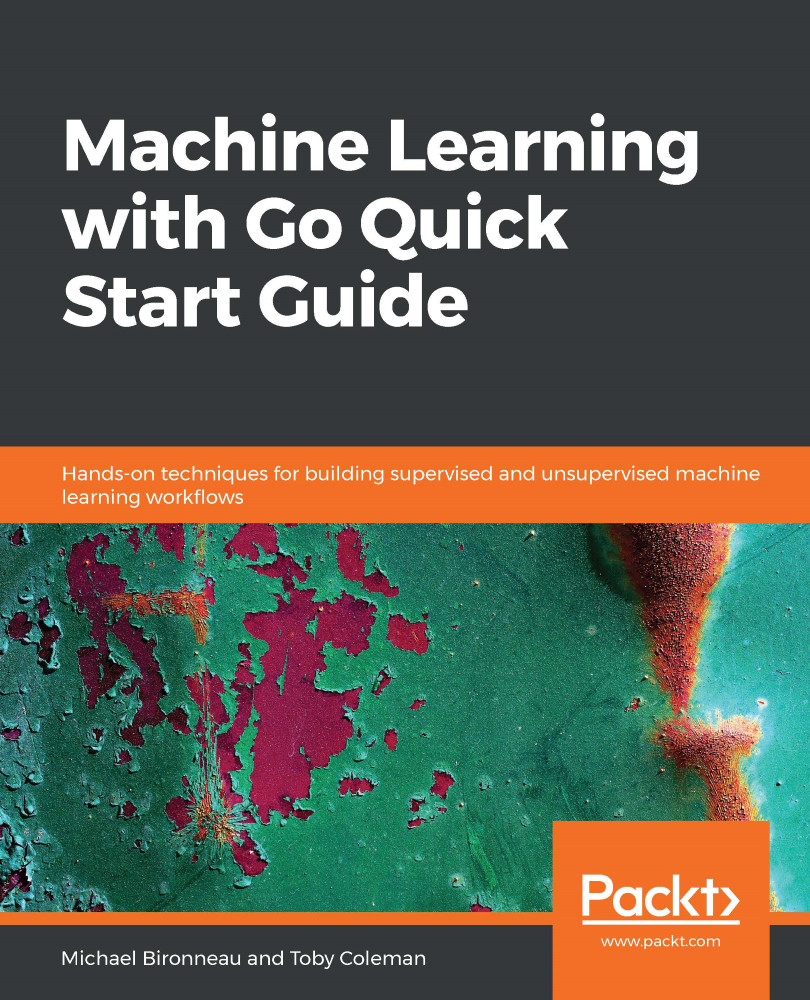
Machine Learning with Go Quick Start Guide

Machine Learning with Go Quick Start Guide

By : Michael Bironneau, Toby Coleman
close
close
Machine Learning with Go Quick Start Guide

Machine Learning with Go Quick Start Guide

By: Michael Bironneau, Toby Coleman

Overview of this book

Machine learning is an essential part of today's data-driven world and is extensively used across industries, including financial forecasting, robotics, and web technology. This book will teach you how to efficiently develop machine learning applications in Go. The book starts with an introduction to machine learning and its development process, explaining the types of problems that it aims to solve and the solutions it offers. It then covers setting up a frictionless Go development environment, including running Go interactively with Jupyter notebooks. Finally, common data processing techniques are introduced. The book then teaches the reader about supervised and unsupervised learning techniques through worked examples that include the implementation of evaluation metrics. These worked examples make use of the prominent open-source libraries GoML and Gonum. The book also teaches readers how to load a pre-trained model and use it to make predictions. It then moves on to the operational side of running machine learning applications: deployment, Continuous Integration, and helpful advice for effective logging and monitoring. At the end of the book, readers will learn how to set up a machine learning project for success, formulating realistic success criteria and accurately translating business requirements into technical ones.
Table of Contents (9 chapters)
close
close

Summary

In this chapter, we compared Go-only and polyglot ML solutions from a practical point of view, contrasting their drawbacks and advantages. We then presented two generic solutions to develop polyglot ML solutions: the os/exec package and JSON-RPC. Finally, we looked at two highly-specialized libraries that come with their own RPC-based integration solutions: TensorFlow and Caffe. You have learned how to decide whether to use a Go-only or polyglot approach to ML in your application, how to implement an RPC-based polyglot ML application, and how to run TensorFlow models from Go.

In the next chapter, we will cover the last step of the ML development life cycle: taking an ML application written in Go to production.

CONTINUE READING
83
Tech Concepts
36
Programming languages
73
Tech Tools
Icon Unlimited access to the largest independent learning library in tech of over 8,000 expert-authored tech books and videos.
Icon Innovative learning tools, including AI book assistants, code context explainers, and text-to-speech.
Icon 50+ new titles added per month and exclusive early access to books as they are being written.
Machine Learning with Go Quick Start Guide
notes
bookmark Notes and Bookmarks search Search in title playlist Add to playlist download Download options font-size Font size

Change the font size

margin-width Margin width

Change margin width

day-mode Day/Sepia/Night Modes

Change background colour

Close icon Search
Country selected

Close icon Your notes and bookmarks

Confirmation

Modal Close icon
claim successful

Buy this book with your credits?

Modal Close icon
Are you sure you want to buy this book with one of your credits?
Close
YES, BUY

Submit Your Feedback

Modal Close icon
Modal Close icon
Modal Close icon