
Sign In Start Free Trial
Account

Add to playlist

Create a Playlist

Modal Close icon
You need to login to use this feature.
  • Book Overview & Buying Practical Data Analysis Using Jupyter Notebook
  • Table Of Contents Toc
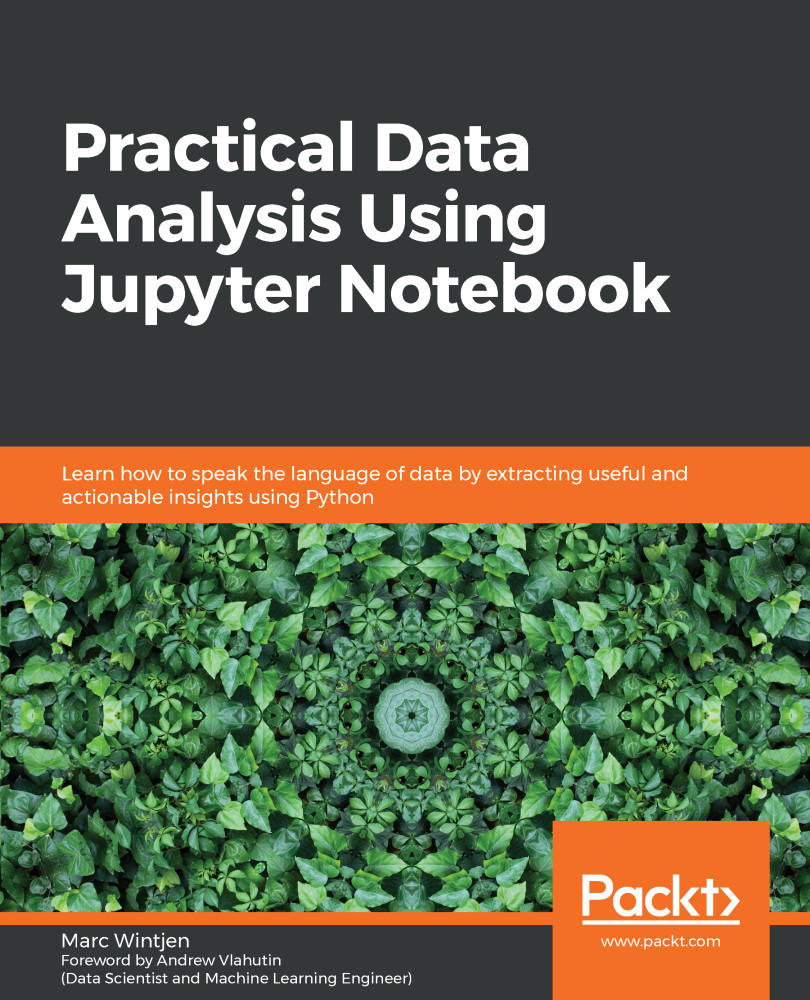
Practical Data Analysis Using Jupyter Notebook

Practical Data Analysis Using Jupyter Notebook

By : Marc Wintjen
3.9 (9)
close
close
Practical Data Analysis Using Jupyter Notebook

Practical Data Analysis Using Jupyter Notebook

3.9 (9)
By: Marc Wintjen

Overview of this book

Data literacy is the ability to read, analyze, work with, and argue using data. Data analysis is the process of cleaning and modeling your data to discover useful information. This book combines these two concepts by sharing proven techniques and hands-on examples so that you can learn how to communicate effectively using data. After introducing you to the basics of data analysis using Jupyter Notebook and Python, the book will take you through the fundamentals of data. Packed with practical examples, this guide will teach you how to clean, wrangle, analyze, and visualize data to gain useful insights, and you'll discover how to answer questions using data with easy-to-follow steps. Later chapters teach you about storytelling with data using charts, such as histograms and scatter plots. As you advance, you'll understand how to work with unstructured data using natural language processing (NLP) techniques to perform sentiment analysis. All the knowledge you gain will help you discover key patterns and trends in data using real-world examples. In addition to this, you will learn how to handle data of varying complexity to perform efficient data analysis using modern Python libraries. By the end of this book, you'll have gained the practical skills you need to analyze data with confidence.
Table of Contents (18 chapters)
close
close
1
Section 1: Data Analysis Essentials
7
Section 2: Solutions for Data Discovery
12
Section 3: Working with Unstructured Big Data
16
Works Cited
Exploring, Cleaning, Refining, and Blending Datasets

In the previous chapter, we learned about the power of data visualizations, and the importance of having good-quality, consistent data defined with dimensions and measures.

Now that we understand why that's important, we are going to focus on the how throughout this chapter by working hands-on with data. Most of the examples provided so far included data that was already prepped (prepared) ahead of time for easier consumption. We are now switching gears by learning the skills that are necessary to be comfortable working with data to increase your data literacy.

A key concept of this chapter is cleaning, filtering, and refining data. In many cases, the reason why you need to perform these actions is the source data does not provide high-quality analytics as is. Throughout my career, high-quality data is not the norm and data gaps are common. As good data...

Visually different images
CONTINUE READING
83
Tech Concepts
36
Programming languages
73
Tech Tools
Icon Unlimited access to the largest independent learning library in tech of over 8,000 expert-authored tech books and videos.
Icon Innovative learning tools, including AI book assistants, code context explainers, and text-to-speech.
Icon 50+ new titles added per month and exclusive early access to books as they are being written.
Practical Data Analysis Using Jupyter Notebook
notes
bookmark Notes and Bookmarks search Search in title playlist Add to playlist download Download options font-size Font size

Change the font size

margin-width Margin width

Change margin width

day-mode Day/Sepia/Night Modes

Change background colour

Close icon Search
Country selected

Close icon Your notes and bookmarks

Confirmation

Modal Close icon
claim successful

Buy this book with your credits?

Modal Close icon
Are you sure you want to buy this book with one of your credits?
Close
YES, BUY

Submit Your Feedback

Modal Close icon
Modal Close icon
Modal Close icon