


-
Book Overview & Buying
-
Table Of Contents

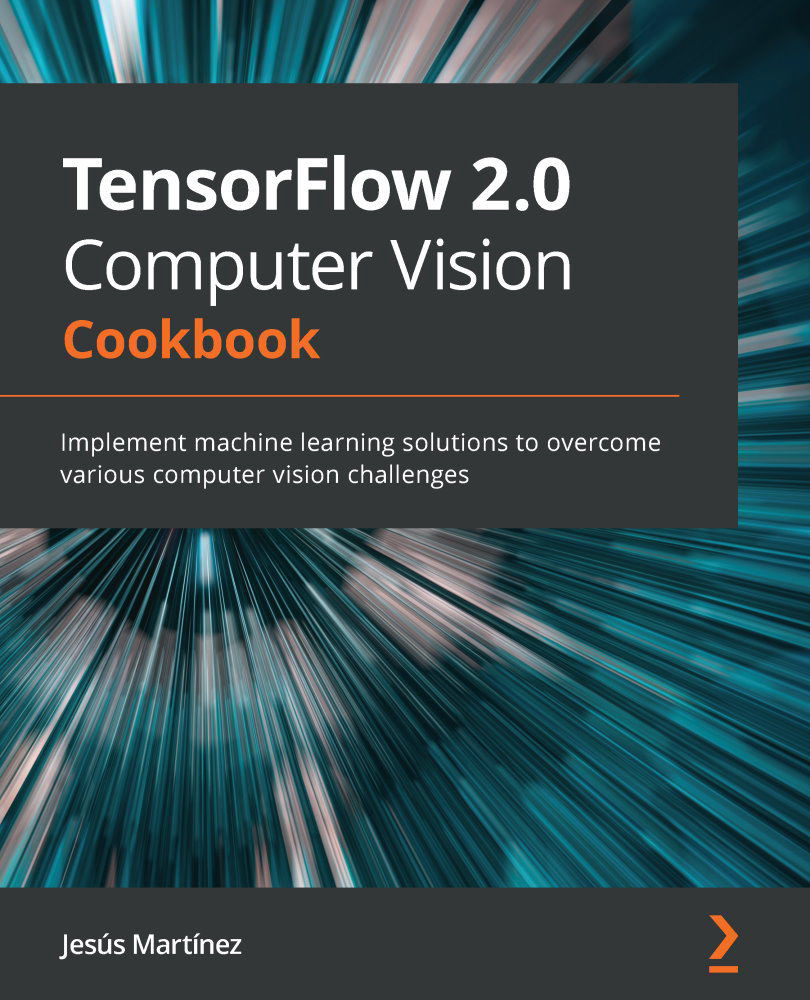
TensorFlow 2.0 Computer Vision Cookbook
By :


TensorFlow 2.0 Computer Vision Cookbook
By:
Overview of this book
Computer vision is a scientific field that enables machines to identify and process digital images and videos. This book focuses on independent recipes to help you perform various computer vision tasks using TensorFlow.
The book begins by taking you through the basics of deep learning for computer vision, along with covering TensorFlow 2.x’s key features, such as the Keras and tf.data.Dataset APIs. You’ll then learn about the ins and outs of common computer vision tasks, such as image classification, transfer learning, image enhancing and styling, and object detection. The book also covers autoencoders in domains such as inverse image search indexes and image denoising, while offering insights into various architectures used in the recipes, such as convolutional neural networks (CNNs), region-based CNNs (R-CNNs), VGGNet, and You Only Look Once (YOLO).
Moving on, you’ll discover tips and tricks to solve any problems faced while building various computer vision applications. Finally, you’ll delve into more advanced topics such as Generative Adversarial Networks (GANs), video processing, and AutoML, concluding with a section focused on techniques to help you boost the performance of your networks.
By the end of this TensorFlow book, you’ll be able to confidently tackle a wide range of computer vision problems using TensorFlow 2.x.
Table of Contents (14 chapters)
Preface


Chapter 1: Getting Started with TensorFlow 2.x for Computer Vision
 Free Chapter
Chapter 2: Performing Image Classification
Chapter 3: Harnessing the Power of Pre-Trained Networks with Transfer Learning
Chapter 4: Enhancing and Styling Images with DeepDream, Neural Style Transfer, and Image Super-Resolution
Chapter 5: Reducing Noise with Autoencoders
Chapter 6: Generative Models and Adversarial Attacks
Chapter 7: Captioning Images with CNNs and RNNs

Chapter 8: Fine-Grained Understanding of Images through Segmentation
Chapter 9: Localizing Elements in Images with Object Detection
Chapter 10: Applying the Power of Deep Learning to Videos
Chapter 11: Streamlining Network Implementation with AutoML
Chapter 12: Boosting Performance
Other Books You May Enjoy


