
Sign In Start Free Trial
Account

Add to playlist

Create a Playlist

Modal Close icon
You need to login to use this feature.
  • Book Overview & Buying Hands-On Graph Analytics with Neo4j
  • Table Of Contents Toc
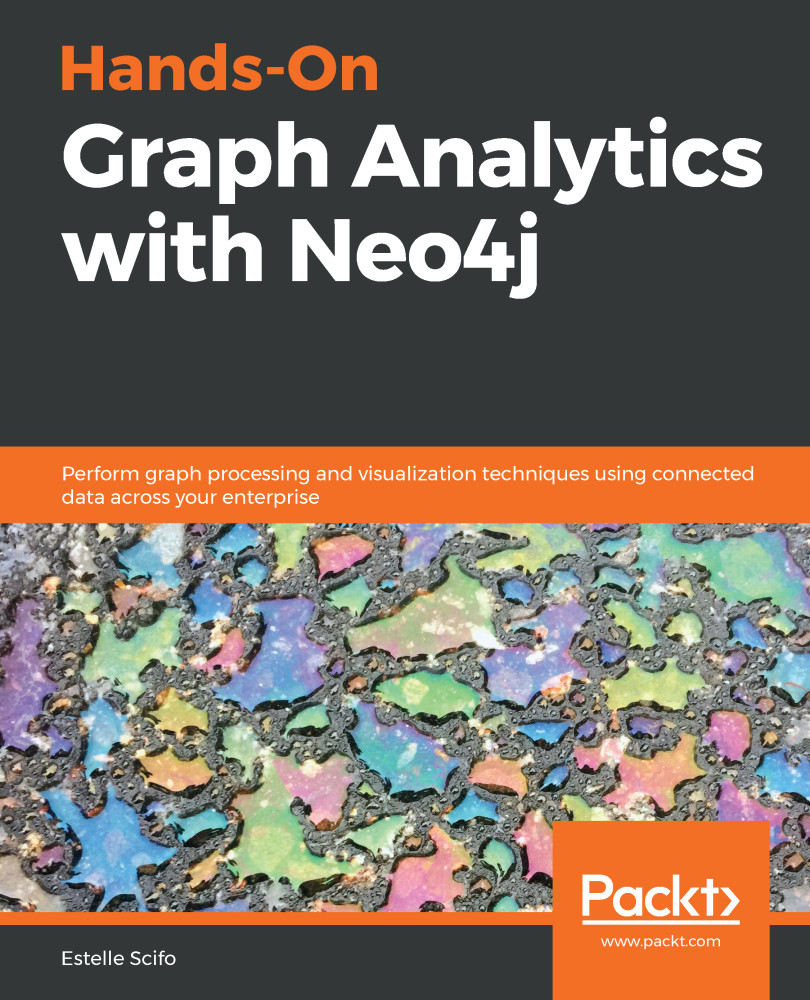
Hands-On Graph Analytics with Neo4j

Hands-On Graph Analytics with Neo4j

By : Scifo
4.6 (9)
close
close
Hands-On Graph Analytics with Neo4j

Hands-On Graph Analytics with Neo4j

4.6 (9)
By: Scifo

Overview of this book

Neo4j is a graph database that includes plugins to run complex graph algorithms. The book starts with an introduction to the basics of graph analytics, the Cypher query language, and graph architecture components, and helps you to understand why enterprises have started to adopt graph analytics within their organizations. You’ll find out how to implement Neo4j algorithms and techniques and explore various graph analytics methods to reveal complex relationships in your data. You’ll be able to implement graph analytics catering to different domains such as fraud detection, graph-based search, recommendation systems, social networking, and data management. You’ll also learn how to store data in graph databases and extract valuable insights from it. As you become well-versed with the techniques, you’ll discover graph machine learning in order to address simple to complex challenges using Neo4j. You will also understand how to use graph data in a machine learning model in order to make predictions based on your data. Finally, you’ll get to grips with structuring a web application for production using Neo4j. By the end of this book, you’ll not only be able to harness the power of graphs to handle a broad range of problem areas, but you’ll also have learned how to use Neo4j efficiently to identify complex relationships in your data.
Table of Contents (18 chapters)
close
close
1
Section 1: Graph Modeling with Neo4j
5
Section 2: Graph Algorithms
10
Section 3: Machine Learning on Graphs
14
Section 4: Neo4j for Production

Understanding GraphQL APIs by example GitHub API v4

While in the previous section we used Python to build a full web application whose backend database is Neo4j, in this section, we will remove the dependency on Python and build an API directly accessible from the Neo4j server.

When building APIs, a very popular framework is Representational State Transfer (REST). Even though this approach is still possible with a graph database (check, for instance, the gREST project), a different approach is becoming more and more popular GraphQL, a query language for API.

In order to understand GraphQL, we will again use the GitHub API. In previous chapters, we used the REST version (v3). However, v4 uses GraphQL, so we should build a few queries. To do so, we can go to https://developer.github.com/v4/explorer/, which is the traditional GraphQL playground. After providing GitHub login credentials, there is a two-part window; the left panel is where we will write the query, while the...

CONTINUE READING
83
Tech Concepts
36
Programming languages
73
Tech Tools
Icon Unlimited access to the largest independent learning library in tech of over 8,000 expert-authored tech books and videos.
Icon Innovative learning tools, including AI book assistants, code context explainers, and text-to-speech.
Icon 50+ new titles added per month and exclusive early access to books as they are being written.
Hands-On Graph Analytics with Neo4j
notes
bookmark Notes and Bookmarks search Search in title playlist Add to playlist download Download options font-size Font size

Change the font size

margin-width Margin width

Change margin width

day-mode Day/Sepia/Night Modes

Change background colour

Close icon Search
Country selected

Close icon Your notes and bookmarks

Confirmation

Modal Close icon
claim successful

Buy this book with your credits?

Modal Close icon
Are you sure you want to buy this book with one of your credits?
Close
YES, BUY

Submit Your Feedback

Modal Close icon
Modal Close icon
Modal Close icon