-
Book Overview & Buying
-
Table Of Contents

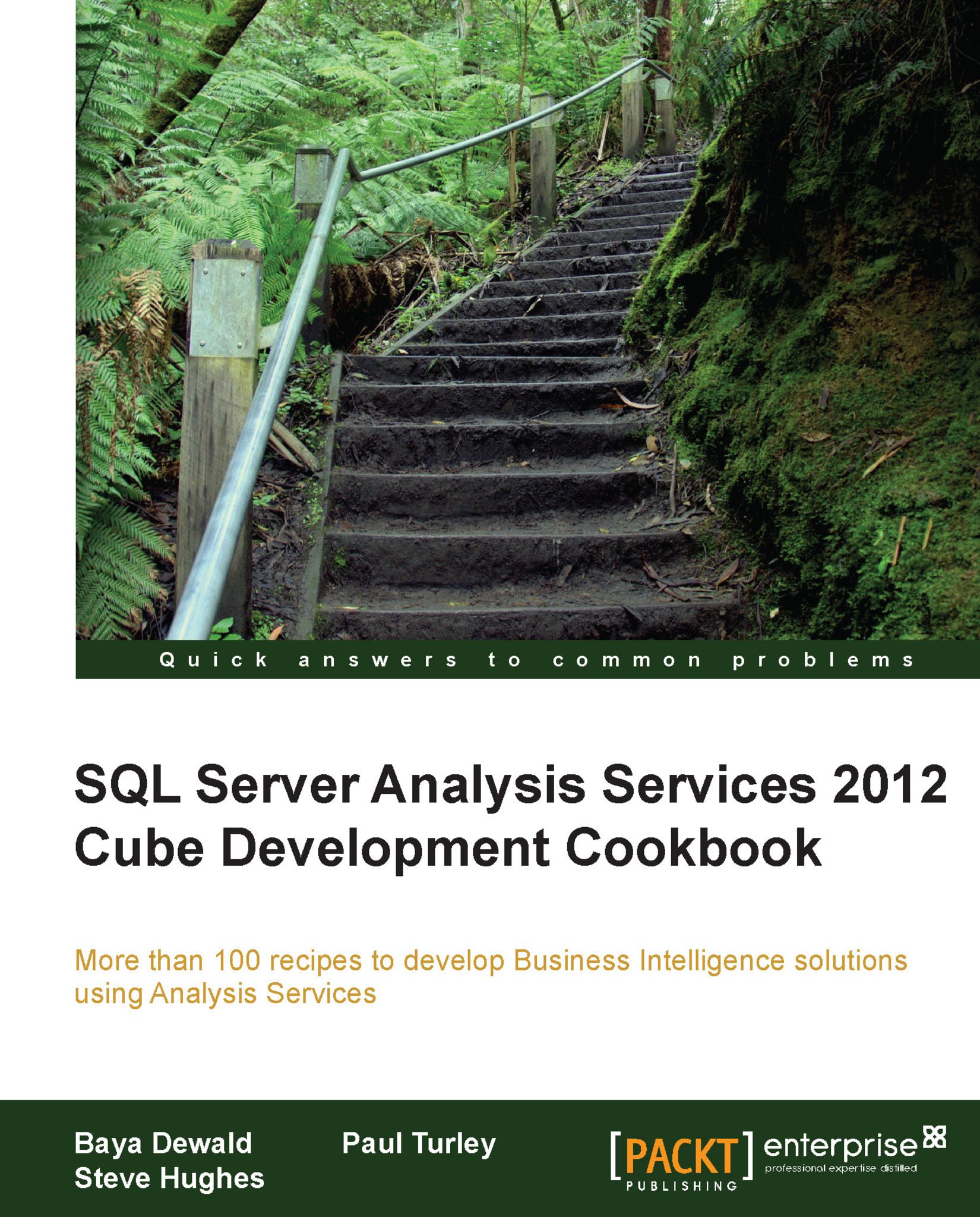
SQL Server Analysis Services 2012 Cube Development Cookbook
By :


SQL Server Analysis Services 2012 Cube Development Cookbook
By:
Overview of this book
Microsoft SQL Server is a relational database management system. As a database, it is a software product whose primary function is to store and retrieve data as requested by other software applications. SQL Server Analysis Services adds OLAP and data mining capabilities for SQL Server databases. OLAP (online analytical processing) is a technique for analyzing business data for effective business intelligence.
This practical guide teaches you how to build business intelligence solutions using Microsoft’s core product – SQL Server Analysis Services. The book covers the traditional multi-dimensional model which has been around for over a decade as well as the tabular model introduced with SQL Server 2012.
Starting with comparing MultiDimensional and tabular models – discussing the values and limitations of each, you will then cover the essential techniques for building dimensions and cubes. Following on from this, you will be introduced to more advanced topics, such as designing partitions and aggregations, implementing security, and synchronizing databases for solutions serving many users.
The book also covers administrative material, such as database backups, server configuration options, and monitoring and tuning performance. We also provide a primer on MultiDimensional eXpressions (MDX) as well as Data Analysis expressions (DAX) languages.
This book provides you with data cube development techniques, and also the ongoing monitoring and tuning for Analysis Services.
Table of Contents (14 chapters)
Preface


 Free Chapter
1. Introduction to Multidimensional Data Model Design
2. Defining Analysis Services Dimensions
3. Creating Analysis Services Cubes
4. Extending and Customizing Cubes
5. Optimizing Dimension and Cube Processing
6. MDX
7. Analysis Services Security
8. Administering and Monitoring Analysis Services
9. Using Tabular Models
10. DAX Calculations and Queries

11. Performance Tuning and Troubleshooting Tabular Models
A. Miscellaneous Analysis Services Topics
Index