Sign In Start Free Trial
Account

Add to playlist

Create a Playlist

Modal Close icon
You need to login to use this feature.
  • Book Overview & Buying Mastering SFML Game Development
  • Table Of Contents Toc
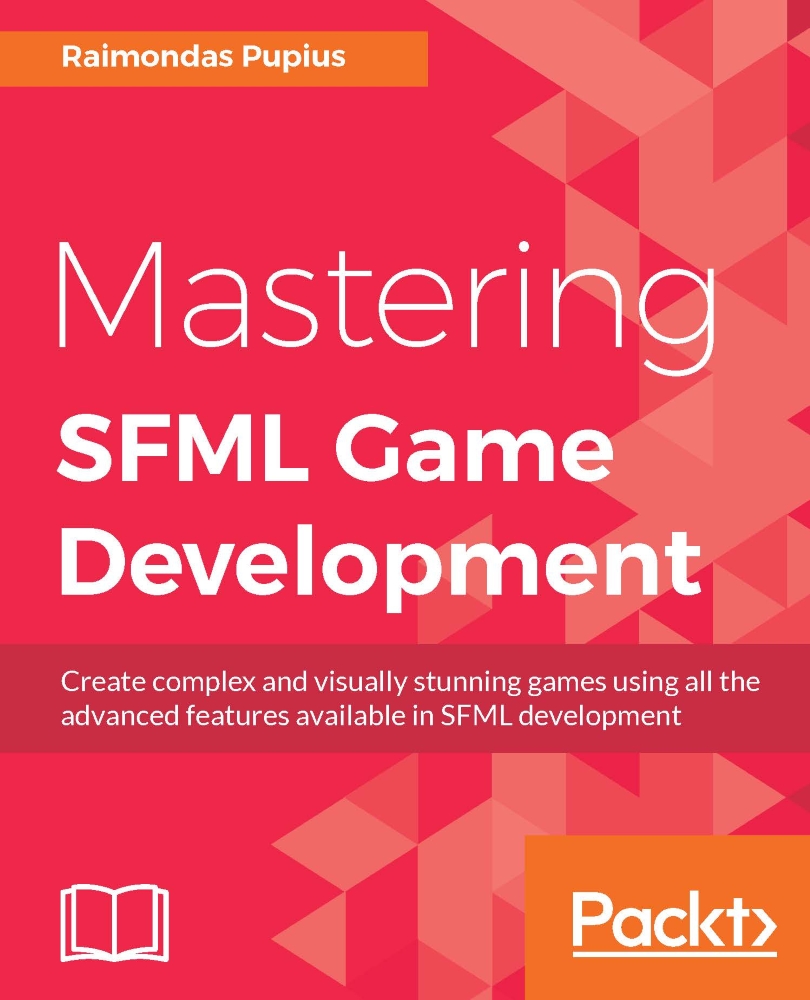
Mastering SFML Game Development

Mastering SFML Game Development

By : Raimondas Pupius
3 (2)
close
close
Mastering SFML Game Development

Mastering SFML Game Development

3 (2)
By: Raimondas Pupius

Overview of this book

SFML is a cross-platform software development library written in C++ with bindings available for many programming languages. It provides a simple interface to the various components of your PC, to ease the development of games and multimedia applications. This book will help you become an expert of SFML by using all of its features to its full potential. It begins by going over some of the foundational code necessary in order to make our RPG project run. By the end of chapter 3, we will have successfully picked up and deployed a fast and efficient particle system that makes the game look much more ‘alive’. Throughout the next couple of chapters, you will be successfully editing the game maps with ease, all thanks to the custom tools we’re going to be building. From this point on, it’s all about making the game look good. After being introduced to the use of shaders and raw OpenGL, you will be guided through implementing dynamic scene lighting, the use of normal and specular maps, and dynamic soft shadows. However, no project is complete without being optimized first. The very last chapter will wrap up our project by making it lightning fast and efficient.
Table of Contents (11 chapters)
close
close

Preface

Designing a game from scratch can be one of the most difficult journeys to embark on. With the amount of work that goes into it, it’s would not be farfetched to compare game development to building a car. It combines many different areas of expertise that would, otherwise, not be overlapping, meaning the mastermind behind it has to, often enough, also act as the Jack of all trades. Not many other types of projects can claim that they found a way to combine advanced lighting calculations, accurate physics simulations, and the inner-workings of a fully fledged, stable, and self-sustaining economy-model into something cohesive. These are just some of those trades one has to pick up, and in the fast-growing world of gaming, new ones are constantly popping into existence. Among all of the noise, some patterns slowly begin to emerge as time passes by. With several different generations having access to gaming now, and a couple of them not knowing the world without it, certain expectations begin to form within the zeitgeist. The breath-taking inventions and technical demos of yesterday have become the common-place features of today, and the beacons of light shining onto tomorrow. Keeping up with these features and not being left behind in the dark is what makes a good game developer today, and that’s where we come in. Although it won’t teach you everything, this book will do a solid job at giving you an edge by not only expanding your repertoire of techniques and ideas, but also setting a clear goal into the future, that’s always going to keep progressing into something bigger and better.

As the first two chapters fly by, you will learn about setting up a basic, yet powerful RPG-style game, built on top of flexible architectures used in today’s games. That same game will then be given extra graphical oomph, as we cover building an efficient particle system, capable of easy expansion and many different graphical options. Subsequently, you will be brought up to speed to the practicalities and benefits of creating custom tools, such as a map editor, for modifying and managing the assets of your game. Usage of SFML’s shaders will also be touched on, right before we embark on a journey of cutting SFML out completely in Chapter 7, One Step Forward, One Level Down – Integrating OpenGL, by using raw OpenGL and rendering something on screen all by ourselves. This is followed by us exploring and implementing advanced lighting techniques, such as normal and specular maps, to really give the game scene a graphical kick with dynamic lights. Of course, there can be no light that doesn’t cast a shadow, which is why Chapter 9, The Speed of Dark – Lighting and Shadows, covers and implements shadow-mapping in 3D, allowing us to have realistic, three-dimensional shadows. This is all topped off by making final optimizations to the game that will not only make it run as fast as possible, but also provide you with all of the tools and skills necessary to keep making improvements into the future.

While this book aims to inspire you to be the Jack of all trades, it will also make you a master of some by enabling your games to look and run as good as they possibly can. There is a long road ahead of us, so make sure you pack your ambition, and hopefully we shall see each other again at the finish line. Good luck!

CONTINUE READING
83
Tech Concepts
36
Programming languages
73
Tech Tools
Icon Unlimited access to the largest independent learning library in tech of over 8,000 expert-authored tech books and videos.
Icon Innovative learning tools, including AI book assistants, code context explainers, and text-to-speech.
Icon 50+ new titles added per month and exclusive early access to books as they are being written.
Mastering SFML Game Development
notes
bookmark Notes and Bookmarks search Search in title playlist Add to playlist download Download options font-size Font size

Change the font size

margin-width Margin width

Change margin width

day-mode Day/Sepia/Night Modes

Change background colour

Close icon Search
Country selected

Close icon Your notes and bookmarks

Confirmation

Modal Close icon
claim successful

Buy this book with your credits?

Modal Close icon
Are you sure you want to buy this book with one of your credits?
Close
YES, BUY

Submit Your Feedback

Modal Close icon
Modal Close icon
Modal Close icon