
Sign In Start Free Trial
Account

Add to playlist

Create a Playlist

Modal Close icon
You need to login to use this feature.
  • Book Overview & Buying Game Development Patterns and Best Practices
  • Table Of Contents Toc
  • Feedback & Rating feedback
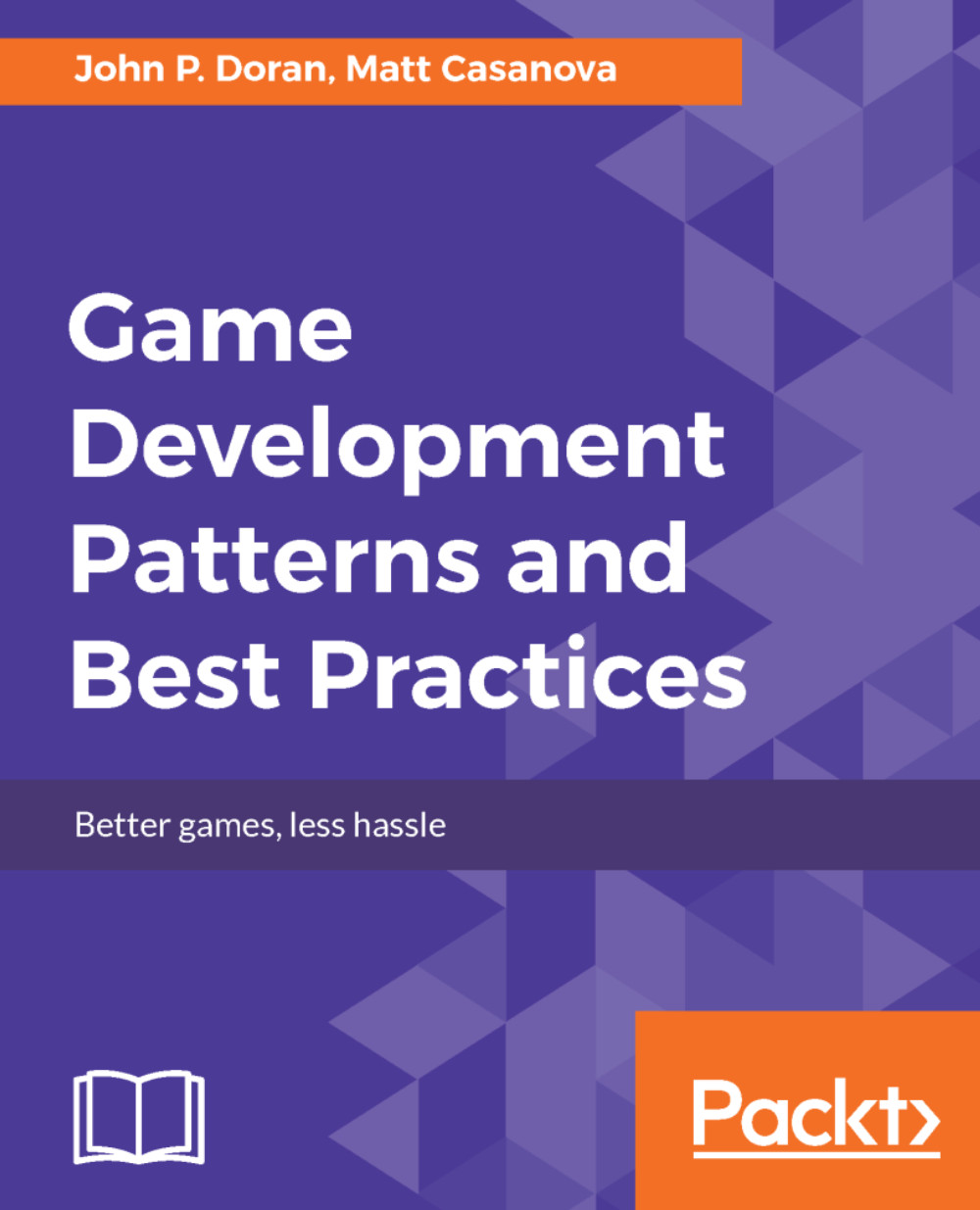
Game Development Patterns and Best Practices

Game Development Patterns and Best Practices

By : John P. Doran, Casanova
5 (1)
close
close
Game Development Patterns and Best Practices

Game Development Patterns and Best Practices

5 (1)
By: John P. Doran, Casanova

Overview of this book

You’ve learned how to program, and you’ve probably created some simple games at some point, but now you want to build larger projects and find out how to resolve your problems. So instead of a coder, you might now want to think like a game developer or software engineer. To organize your code well, you need certain tools to do so, and that’s what this book is all about. You will learn techniques to code quickly and correctly, while ensuring your code is modular and easily understandable. To begin, we will start with the core game programming patterns, but not the usual way. We will take the use case strategy with this book. We will take an AAA standard game and show you the hurdles at multiple stages of development. Similarly, various use cases are used to showcase other patterns such as the adapter pattern, prototype pattern, flyweight pattern, and observer pattern. Lastly, we’ll go over some tips and tricks on how to refactor your code to remove common code smells and make it easier for others to work with you. By the end of the book you will be proficient in using the most popular and frequently used patterns with the best practices.
Table of Contents (13 chapters)
close
close
4
Artificial Intelligence Using the State Pattern

Creating Objects with the Prototype Pattern

We saw in the last chapter how using a Dynamic Factory can help us decouple our high-level modules, such as the M5StageManager or M5ObjectManager from the implementation details of our derived M5Stage or M5Component classes. We did this by pushing those dependencies into derived builder classes that would be used by a Dynamic Factory. This allowed us the freedom to change our derived stage and component classes without needing to modify our higher level modules. C++ template classes made using the Dynamic Factory very easy, since we were not required to create a derived class builder for every stage and component.

However, we are required to create a builder for each M5Object type we want, since they will contain a set of components that are unique to each object. Unfortunately, these builders may require frequent changes as we playtest, balance, and modify our game design...

Visually different images
CONTINUE READING
83
Tech Concepts
36
Programming languages
73
Tech Tools
Icon Unlimited access to the largest independent learning library in tech of over 8,000 expert-authored tech books and videos.
Icon Innovative learning tools, including AI book assistants, code context explainers, and text-to-speech.
Icon 50+ new titles added per month and exclusive early access to books as they are being written.
Game Development Patterns and Best Practices
notes
bookmark Notes and Bookmarks search Search in title playlist Add to playlist download Download options font-size Font size

Change the font size

margin-width Margin width

Change margin width

day-mode Day/Sepia/Night Modes

Change background colour

Close icon Search
Country selected

Close icon Your notes and bookmarks

Confirmation

Modal Close icon
claim successful

Buy this book with your credits?

Modal Close icon
Are you sure you want to buy this book with one of your credits?
Close
YES, BUY

Submit Your Feedback

Modal Close icon
Modal Close icon
Modal Close icon