Sign In Start Free Trial
Account

Add to playlist

Create a Playlist

Modal Close icon
You need to login to use this feature.
  • Book Overview & Buying Unity 2018 By Example
  • Table Of Contents Toc
  • Feedback & Rating feedback
Unity 2018 By Example

Unity 2018 By Example - Second Edition

By : Alan Thorn
3 (2)
close
close
Unity 2018 By Example

Unity 2018 By Example

3 (2)
By: Alan Thorn

Overview of this book

Unity is the most exciting and popular engine used for developing games. With its 2018 release, Unity has become the primary source of both game development and virtual reality content. In Unity 2018 By Example, you’ll learn how to use Unity in order to make amazing games from popular genres - from action shooters to mind-bending puzzle games to adventure and Virtual Reality (VR) games. Even if you have no previous experience of using Unity, this book will help you understand the toolsets it provides in depth. In addition to this, you'll understand how to create time-critical collection games, twin-stick space shooters, platformers, and action-fest games with intelligent enemies. Finally, you'll get to grips with creating VR games with the new toolsets introduced by Unity to help you develop amazing VR experiences. To make things easier, you will be provided with step-by-step tutorials for making five great games in Unity 2018, along with a detailed explanation of all the fundamental concepts. By the end of this book, you’ll have established a strong foundation in making games with Unity 2018.
Table of Contents (14 chapters)
close
close
13
Index

Importing assets


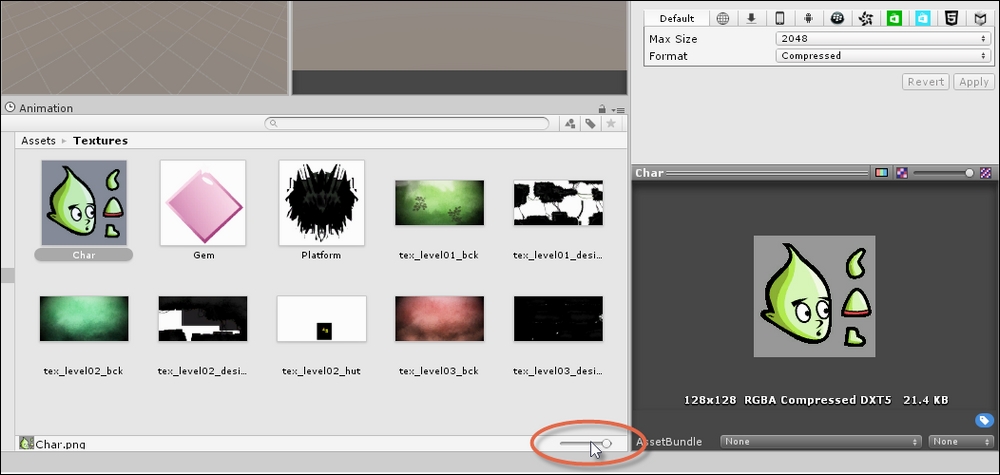
Starting from an empty project created in the previous section, let's now import the texture assets we'll be using, both for the player character and environment. The assets to import are included in the book companion files in the Chapter05/Assets folder. From here, select all textures together in Windows Explorer or Mac Finder, and drag and drop them to the Unity Project panel in a designated Textures folder. (Create one if you haven't already!). This imports all relevant textures to the active Project. See Figure 5.3:

Figure 5.3: Importing texture assets to the Project

Note

Remember that you can always use the Thumbnail Size Slider (at the bottom right corner of the Project panel) to adjust the size of thumbnail previews in order to get an easier view of your texture assets.

By default, Unity assumes that all imported textures will eventually be used as regular textures applied to 3D models in the scene, such as cubes, spheres, and meshes. In most cases, this assumption is...

Visually different images
CONTINUE READING
83
Tech Concepts
36
Programming languages
73
Tech Tools
Icon Unlimited access to the largest independent learning library in tech of over 8,000 expert-authored tech books and videos.
Icon Innovative learning tools, including AI book assistants, code context explainers, and text-to-speech.
Icon 50+ new titles added per month and exclusive early access to books as they are being written.
Unity 2018 By Example
notes
bookmark Notes and Bookmarks search Search in title playlist Add to playlist font-size Font size

Change the font size

margin-width Margin width

Change margin width

day-mode Day/Sepia/Night Modes

Change background colour

Close icon Search
Country selected

Close icon Your notes and bookmarks

Confirmation

Modal Close icon
claim successful

Buy this book with your credits?

Modal Close icon
Are you sure you want to buy this book with one of your credits?
Close
YES, BUY

Submit Your Feedback

Modal Close icon
Modal Close icon
Modal Close icon