
Sign In Start Free Trial
Account

Add to playlist

Create a Playlist

Modal Close icon
You need to login to use this feature.
  • Book Overview & Buying Mastering Internet of Things
  • Table Of Contents Toc
  • Feedback & Rating feedback
Mastering Internet of Things

Mastering Internet of Things

By : Peter Waher
4 (4)
close
close
Mastering Internet of Things

Mastering Internet of Things

4 (4)
By: Peter Waher

Overview of this book

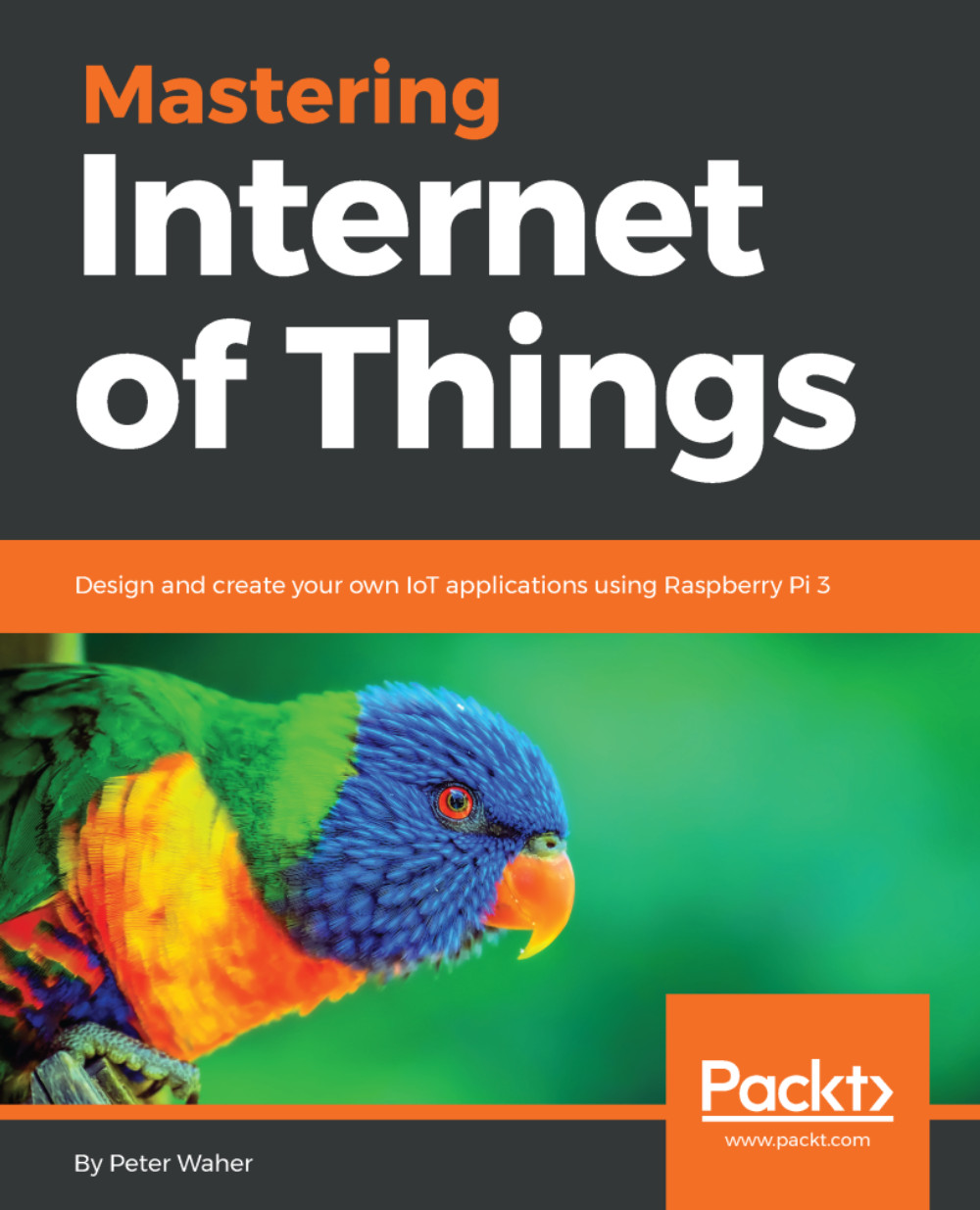
The Internet of Things (IoT) is the fastest growing technology market. Industries are embracing IoT technologies to improve operational expenses, product life, and people's well-being. Mastering Internet of Things starts by presenting IoT fundamentals and the smart city. You will learn the important technologies and protocols that are used for the Internet of Things, their features, corresponding security implications, and practical examples on how to use them. This book focuses on creating applications and services for the Internet of Things. Further, you will learn to create applications and services for the Internet of Things. You will be discover various interesting projects and understand how to publish sensor data, control devices, and react to asynchronous events using the XMPP protocol. The book also introduces chat, to interact with your devices. You will learn how to automate your tasks by using Internet of Things Service Platforms as the base for an application. You will understand the subject of privacy, requirements they should be familiar with, and how to avoid violating any of the important new regulations being introduced. At the end of the book, you will have mastered creating open, interoperable and secure networks of things, protecting the privacy and integrity of your users and their information.
Table of Contents (18 chapters)
close
close

Adding dynamic asynchronous resources

The actuator project (ActuatorHttp in the GitHub repository) also needs a /Momentary resource that returns the current state of the output in XML or JSON. The implementation is similar to that of the sensor, so it's straightforward to do. But we also need a way to control the output. We do that by adding a /Set resource. Since we will call asynchronous methods, we take this opportunity to add this resource as an asynchronous POST resource. This means we must explicitly handle errors and exceptions, as well as explicitly sending the response when it is ready:

this.httpServer.Register("/Set", null, async (req, resp) => 
{ 
   try 
   { 
         // Process resource here 
 
         resp.SendResponse();    // Sends response. 
   } 
   catch (Exception ex) 
   { 
         resp.SendResponse(ex);  // Sends error response....

Visually different images
CONTINUE READING
83
Tech Concepts
36
Programming languages
73
Tech Tools
Icon Unlimited access to the largest independent learning library in tech of over 8,000 expert-authored tech books and videos.
Icon Innovative learning tools, including AI book assistants, code context explainers, and text-to-speech.
Icon 50+ new titles added per month and exclusive early access to books as they are being written.
Mastering Internet of Things
notes
bookmark Notes and Bookmarks search Search in title playlist Add to playlist download Download options font-size Font size

Change the font size

margin-width Margin width

Change margin width

day-mode Day/Sepia/Night Modes

Change background colour

Close icon Search
Country selected

Close icon Your notes and bookmarks

Confirmation

Modal Close icon
claim successful

Buy this book with your credits?

Modal Close icon
Are you sure you want to buy this book with one of your credits?
Close
YES, BUY

Submit Your Feedback

Modal Close icon
Modal Close icon
Modal Close icon