
Sign In Start Free Trial
Account

Add to playlist

Create a Playlist

Modal Close icon
You need to login to use this feature.
  • Book Overview & Buying Mastering ROS for Robotics Programming
  • Table Of Contents Toc
Mastering ROS for Robotics Programming

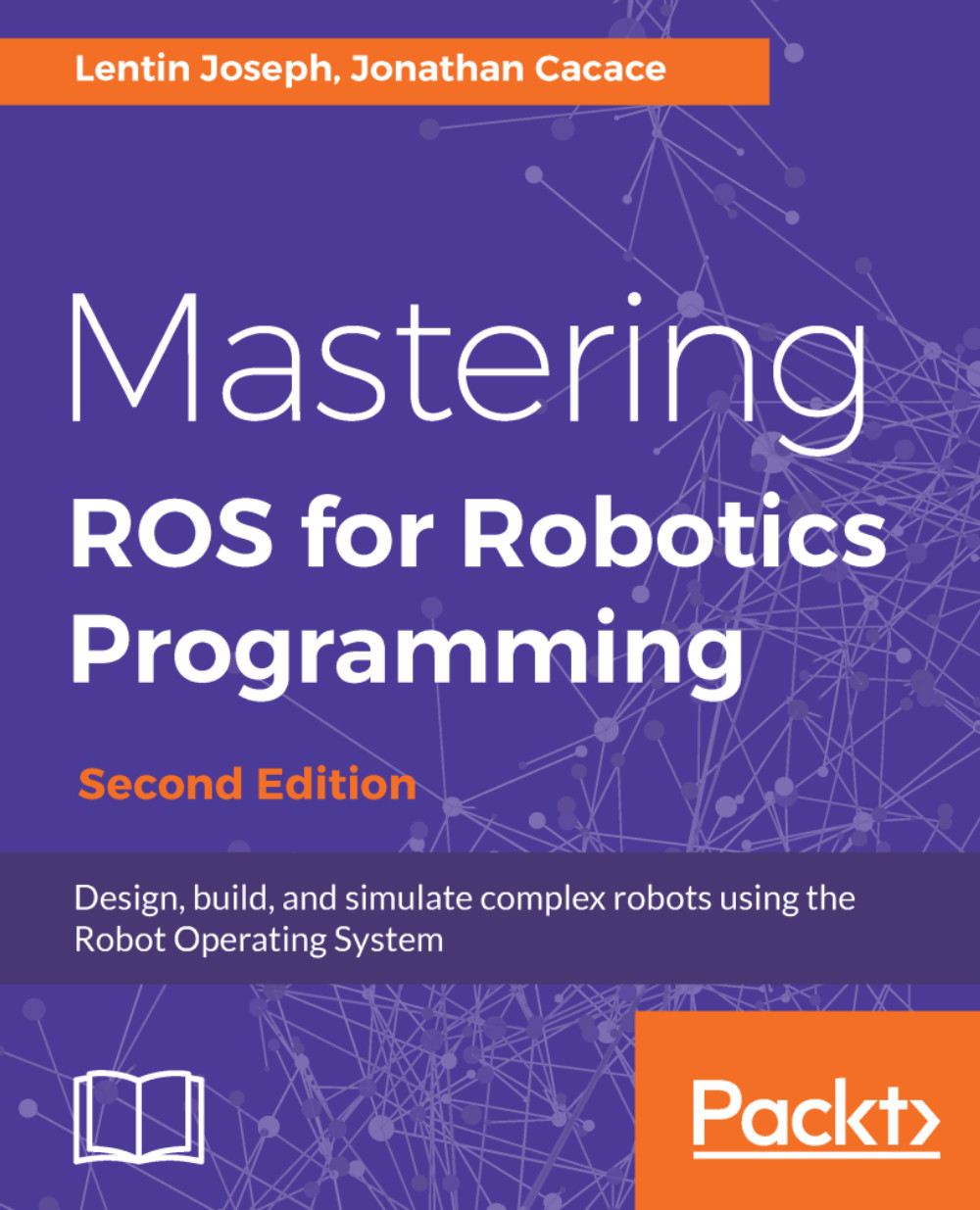
Mastering ROS for Robotics Programming - Second Edition

By : Lentin Joseph, Jonathan Cacace
3 (2)
close
close
Mastering ROS for Robotics Programming

Mastering ROS for Robotics Programming

3 (2)
By: Lentin Joseph, Jonathan Cacace

Overview of this book

In this day and age, robotics has been gaining a lot of traction in various industries where consistency and perfection matter. Automation is achieved via robotic applications and various platforms that support robotics. The Robot Operating System (ROS) is a modular software platform to develop generic robotic applications. This book focuses on the most stable release of ROS (Kinetic Kame), discusses advanced concepts, and effectively teaches you programming using ROS. We begin with aninformative overview of the ROS framework, which will give you a clear idea of how ROS works. During the course of this book, you’ll learn to build models of complex robots, and simulate and interface the robot using the ROS MoveIt! motion planning library and ROS navigation stacks. Learn to leverage several ROS packages to embrace your robot models. After covering robot manipulation and navigation, you’ll get to grips with the interfacing I/O boards, sensors, and actuators of ROS. Vision sensors are a key component of robots, and an entire chapter is dedicated to the vision sensor and image elaboration, its interface in ROS and programming. You’ll also understand the hardware interface and simulation of complex robots to ROS and ROS Industrial. At the end of this book, you’ll discover the best practices to follow when programming using ROS.
Table of Contents (17 chapters)
close
close

Adding custom msg and srv files

In this section, we will look at how to create custom messages and services definitions in the current package. The message definitions are stored in a .msg file and the service definitions are stored in a .srv file. These definitions inform ROS about the type of data and name of data to be transmitted from a ROS node. When a custom message is added, ROS will convert the definitions into equivalent C++ codes, which we can include in our nodes.

We can start with message definitions. Message definitions have to be written in the .msg file and have to be kept in the msg folder, which is inside the package. We are going to create a message file called demo_msg.msg with the following definition:

string greeting 
int32 number 

Until now, we have worked only with standard message definitions. Now, we have created our own definitions and can see how to...

Visually different images
CONTINUE READING
83
Tech Concepts
36
Programming languages
73
Tech Tools
Icon Unlimited access to the largest independent learning library in tech of over 8,000 expert-authored tech books and videos.
Icon Innovative learning tools, including AI book assistants, code context explainers, and text-to-speech.
Icon 50+ new titles added per month and exclusive early access to books as they are being written.
Mastering ROS for Robotics Programming
notes
bookmark Notes and Bookmarks search Search in title playlist Add to playlist font-size Font size

Change the font size

margin-width Margin width

Change margin width

day-mode Day/Sepia/Night Modes

Change background colour

Close icon Search
Country selected

Close icon Your notes and bookmarks

Confirmation

Modal Close icon
claim successful

Buy this book with your credits?

Modal Close icon
Are you sure you want to buy this book with one of your credits?
Close
YES, BUY

Submit Your Feedback

Modal Close icon
Modal Close icon
Modal Close icon