


-
Book Overview & Buying
-
Table Of Contents

R Machine Learning Projects
By :


R Machine Learning Projects
By:
Overview of this book
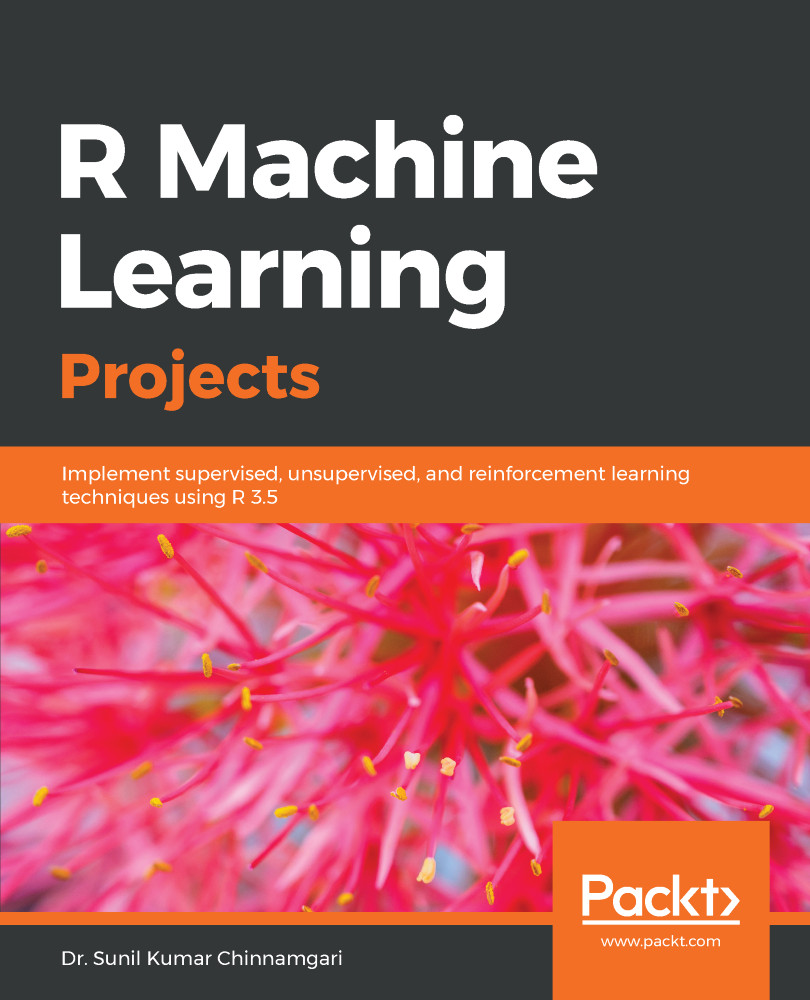
R is one of the most popular languages when it comes to performing computational statistics (statistical computing) easily and exploring the mathematical side of machine learning. With this book, you will leverage the R ecosystem to build efficient machine learning applications that carry out intelligent tasks within your organization.
This book will help you test your knowledge and skills, guiding you on how to build easily through to complex machine learning projects. You will first learn how to build powerful machine learning models with ensembles to predict employee attrition. Next, you’ll implement a joke recommendation engine and learn how to perform sentiment analysis on Amazon reviews. You’ll also explore different clustering techniques to segment customers using wholesale data. In addition to this, the book will get you acquainted with credit card fraud detection using autoencoders, and reinforcement learning to make predictions and win on a casino slot machine.
By the end of the book, you will be equipped to confidently perform complex tasks to build research and commercial projects for automated operations.
Table of Contents (19 chapters)
Preface


Chapter 1: Understanding Object-Oriented Design
Chapter 2: Learning the Four Fundamental Pillars

Chapter 3: Creating SOLID Design Solutions
Chapter 4: Favoring Composition Over Inheritance
Part 2: Basic Design Patterns
Chapter 5: Maintaining Global States with the Singleton Pattern
Chapter 6: Decoupling Objects with the Observer Pattern
Chapter 7: Spawning Game Objects with the Factory Pattern
Chapter 8: Changing Object Behavior with the State Pattern
Chapter 9: Designing Actors with the Command Pattern
Part 3: Advanced Design Patterns
Chapter 10: Implementing AI with the Strategy Pattern
Chapter 11: Creating a Power-Up System with the Decorator Pattern
Chapter 12: Cross-Fading Transitions with the Service Locator Pattern
Chapter 13: Improving Game Feel with the Event Queue Pattern
Index


