
Sign In Start Free Trial
Account

Add to playlist

Create a Playlist

Modal Close icon
You need to login to use this feature.
  • Book Overview & Buying Natural Language Processing and Computational Linguistics
  • Table Of Contents Toc
  • Feedback & Rating feedback
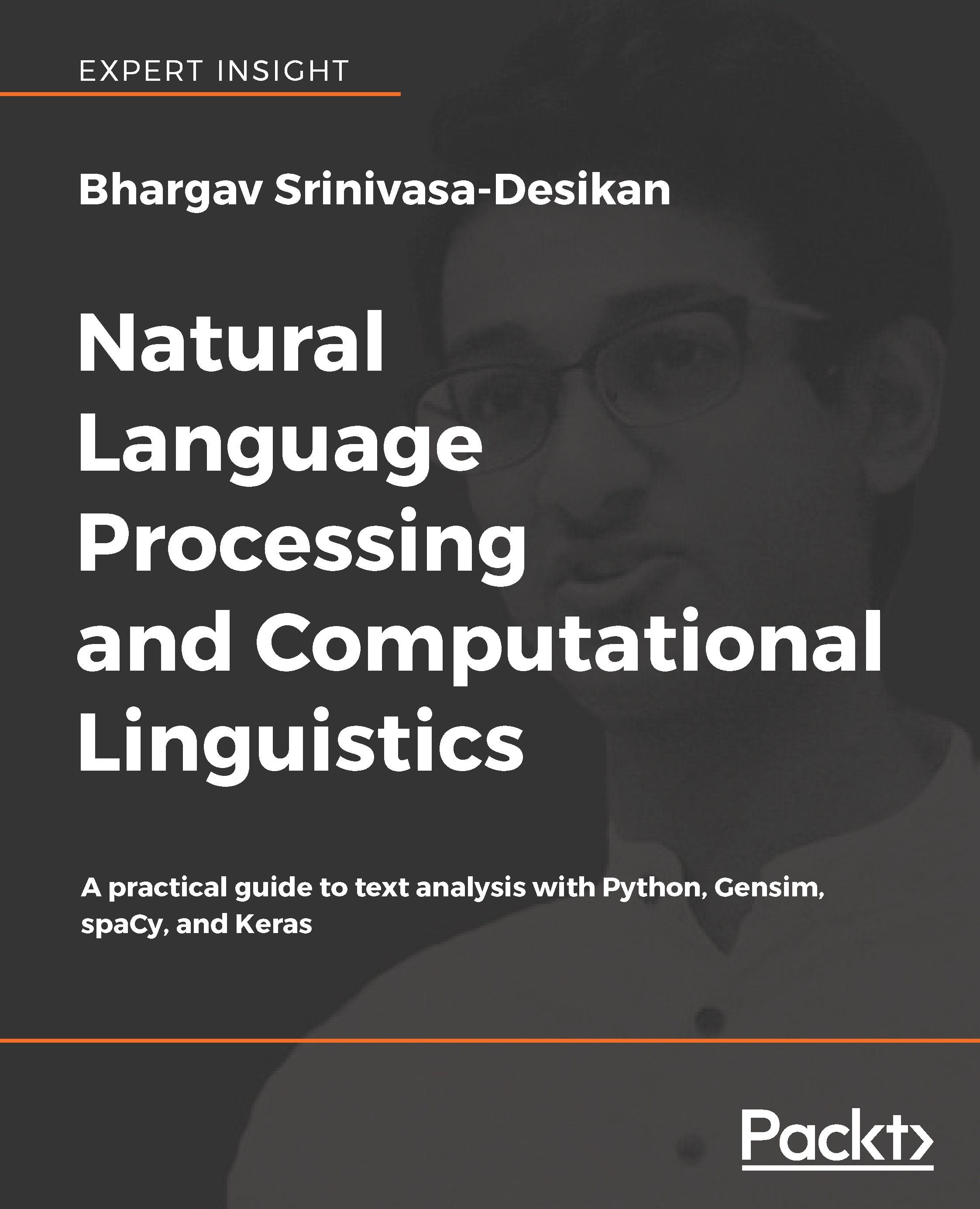
Natural Language Processing and Computational Linguistics

Natural Language Processing and Computational Linguistics

By : Bhargav Srinivasa-Desikan
3.6 (7)
close
close
Natural Language Processing and Computational Linguistics

Natural Language Processing and Computational Linguistics

3.6 (7)
By: Bhargav Srinivasa-Desikan

Overview of this book

Modern text analysis is now very accessible using Python and open source tools, so discover how you can now perform modern text analysis in this era of textual data. This book shows you how to use natural language processing, and computational linguistics algorithms, to make inferences and gain insights about data you have. These algorithms are based on statistical machine learning and artificial intelligence techniques. The tools to work with these algorithms are available to you right now - with Python, and tools like Gensim and spaCy. You'll start by learning about data cleaning, and then how to perform computational linguistics from first concepts. You're then ready to explore the more sophisticated areas of statistical NLP and deep learning using Python, with realistic language and text samples. You'll learn to tag, parse, and model text using the best tools. You'll gain hands-on knowledge of the best frameworks to use, and you'll know when to choose a tool like Gensim for topic models, and when to work with Keras for deep learning. This book balances theory and practical hands-on examples, so you can learn about and conduct your own natural language processing projects and computational linguistics. You'll discover the rich ecosystem of Python tools you have available to conduct NLP - and enter the interesting world of modern text analysis.
Table of Contents (17 chapters)
close
close

Why Python?

In Python, we re text in the form of string [1], which are objects of the str [2] class. They are an immutable sequence of Unicode code points or characters. It is important to make a careful distinction here, though; in Python 3, all strings are by default Unicode, but in Python 2, the str class is limited to ASCII code, and there is a Unicode class to deal with Unicodes.

Unicode is merely an encoding language or a way we handle text. For example, the Unicode value for the letter Z is U+005A. There are many encoding types, and historically in Python, developers were expected to deal with different encodings on their own, with all the low-level action happening in bytes. In fact, the shift in the way Python handles Unicode has led to a lot of discussions [3], criticism [4], and praise [5] within the community. It also remains an important point of contention when we...

Visually different images
CONTINUE READING
83
Tech Concepts
36
Programming languages
73
Tech Tools
Icon Unlimited access to the largest independent learning library in tech of over 8,000 expert-authored tech books and videos.
Icon Innovative learning tools, including AI book assistants, code context explainers, and text-to-speech.
Icon 50+ new titles added per month and exclusive early access to books as they are being written.
Natural Language Processing and Computational Linguistics
notes
bookmark Notes and Bookmarks search Search in title playlist Add to playlist download Download options font-size Font size

Change the font size

margin-width Margin width

Change margin width

day-mode Day/Sepia/Night Modes

Change background colour

Close icon Search
Country selected

Close icon Your notes and bookmarks

Confirmation

Modal Close icon
claim successful

Buy this book with your credits?

Modal Close icon
Are you sure you want to buy this book with one of your credits?
Close
YES, BUY

Submit Your Feedback

Modal Close icon
Modal Close icon
Modal Close icon