Sign In Start Free Trial
Account

Add to playlist

Create a Playlist

Modal Close icon
You need to login to use this feature.
  • Book Overview & Buying Flutter Design Patterns and Best Practices
  • Table Of Contents Toc
Flutter Design Patterns and Best Practices

Flutter Design Patterns and Best Practices

By : Daria Orlova, Esra Kadah, Jaime Blasco
5 (4)
close
close
Flutter Design Patterns and Best Practices

Flutter Design Patterns and Best Practices

5 (4)
By: Daria Orlova, Esra Kadah, Jaime Blasco

Overview of this book

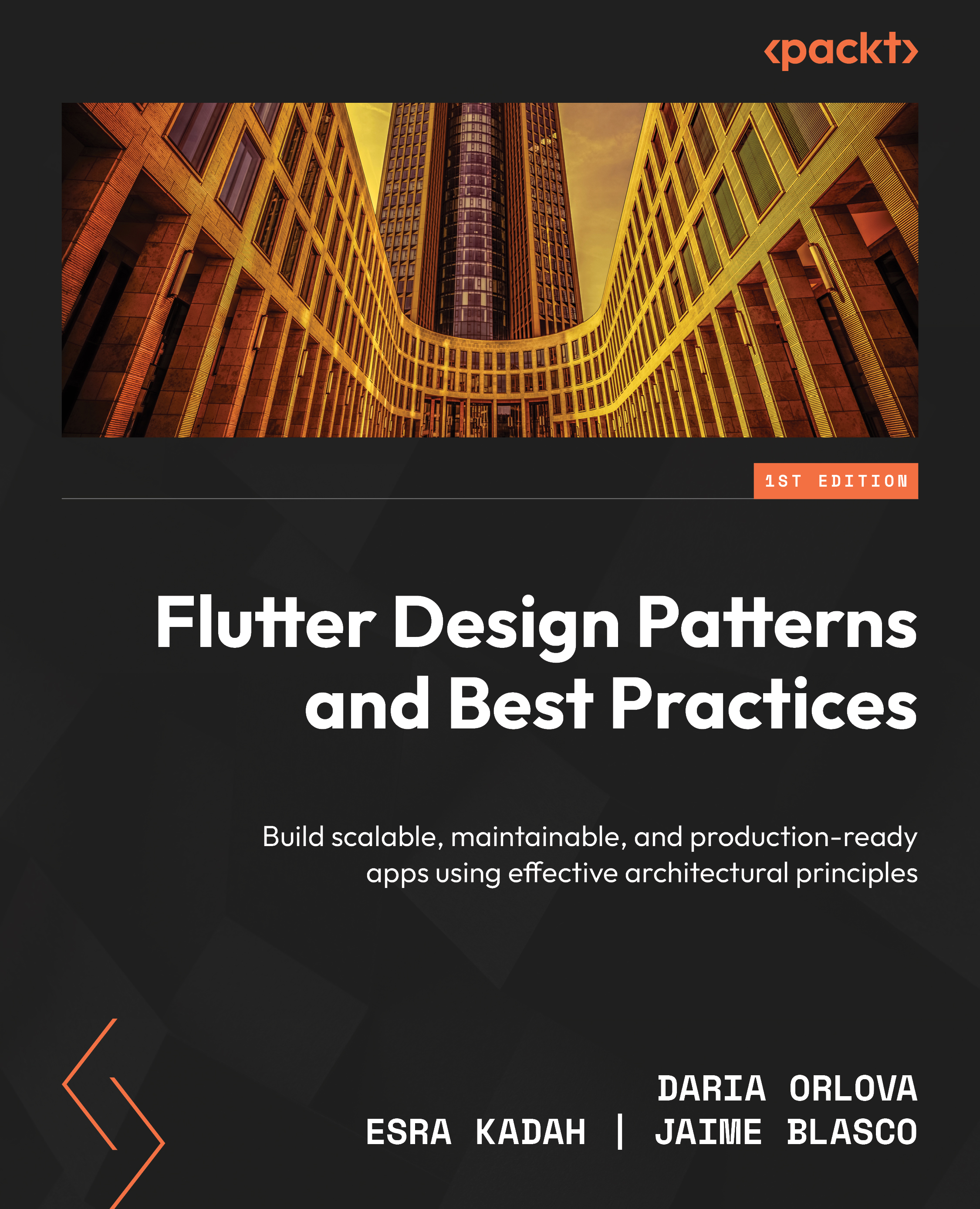
Flutter’s rapid adoption by developers and businesses alike has led to an increased demand for skilled developers who can deliver high-quality Flutter apps. Flutter can be a great tool to develop apps for yourself, but you don’t always need to consider things like scalability or business goals as a hobbyist. When you build apps for a business, however, you must use specific tools to help the business achieve its goals. This requires solutions to be fast, reliable, and delivered on time. This book will help you meet these business requirements. You'll begin by learning how to build responsive UIs that work on all devices. Next, you'll delve into state management, understanding how to select the appropriate solution and gaining hands-on experience with InheritedWidget, ChangeNotifier, and BLoC. Later, you'll move on to high-level practices such as layered architecture, dependency injection, and repository patterns. The book will also show you how to develop features of any complexity, such as multithreading and native layer implementations. You'll also learn how to ensure the quality of your solutions by prioritizing testing. By the end of this book, you'll be able to deliver well-architected Flutter projects that are stable, scalable, and maintainable.
Table of Contents (19 chapters)
close
close
1
Part 1: Building Delightful User Interfaces
4
Part 2: Connecting UI with Business Logic
8
Part 3: Exploring Practical Design Patterns and Architecture Best Practices
14
Part 4: Ensuring App Quality and Stability

Best Practices for Building UIs with Flutter

Flutter is rapidly becoming a go-to framework for creating applications of various scales. Google Trends and Stack Overflow confirm that Flutter has become a more popular search term than React Native for the last several years (see https://trends.google.com/trends/explore?q=%2Fg%2F11f03_rzbg,%2Fg%2F11h03gfxy9&hl=en and https://insights.stackoverflow.com/trends?tags=flutter%2Creact-native). Flutter consistently appears in various development ratings: the top 3 GitHub repositories by number of contributors (https://octoverse.github.com/2022/state-of-open-source), the top 3 most downloaded plugins in JetBrains Marketplace (https://blog.jetbrains.com/platform/2024/01/jetbrains-marketplace-highlights-of-2023-major-updates-community-news/), and second in Google Play Store ratings right after Kotlin (https://appfigures.com/top-sdks/development/apps).

This isn’t a surprise, since Flutter offers a delightful toolkit that allows developers to build smooth and pixel-perfect UIs almost immediately after their first encounter with the framework. Flutter also does a great job of hiding away the details of the rendering process. However, because it is so easy to overlook those details, a lack of understanding of how the framework actually works can lead to performance issues.

This chapter explores the benefits of using Flutter’s declarative UI-building approach, as well as how that approach affects developers. We will discuss methods for optimizing performance and avoiding interference with the framework’s building and rendering processes. We will also examine how this approach works under the hood and provide best practices for creating beautiful and blazing-fast interfaces.

By the end of this chapter, you will understand the concept of the Flutter tree system and how to scope your widget tree for the best performance. This knowledge will provide the foundation necessary for learning architectural design patterns based on the framework’s build system.

In this chapter, we’re going to cover the following main topics:

  • Understanding the difference between declarative and imperative UI design.
  • Everything is a widget! Or is it?
  • Reduce, reuse, recycle!
Visually different images
CONTINUE READING
83
Tech Concepts
36
Programming languages
73
Tech Tools
Icon Unlimited access to the largest independent learning library in tech of over 8,000 expert-authored tech books and videos.
Icon Innovative learning tools, including AI book assistants, code context explainers, and text-to-speech.
Icon 50+ new titles added per month and exclusive early access to books as they are being written.
Flutter Design Patterns and Best Practices
notes
bookmark Notes and Bookmarks search Search in title playlist Add to playlist download Download options font-size Font size

Change the font size

margin-width Margin width

Change margin width

day-mode Day/Sepia/Night Modes

Change background colour

Close icon Search
Country selected

Close icon Your notes and bookmarks

Confirmation

Modal Close icon
claim successful

Buy this book with your credits?

Modal Close icon
Are you sure you want to buy this book with one of your credits?
Close
YES, BUY

Submit Your Feedback

Modal Close icon
Modal Close icon
Modal Close icon