Sign In Start Free Trial
Account

Add to playlist

Create a Playlist

Modal Close icon
You need to login to use this feature.
  • Book Overview & Buying Python Natural Language Processing Cookbook
  • Table Of Contents Toc
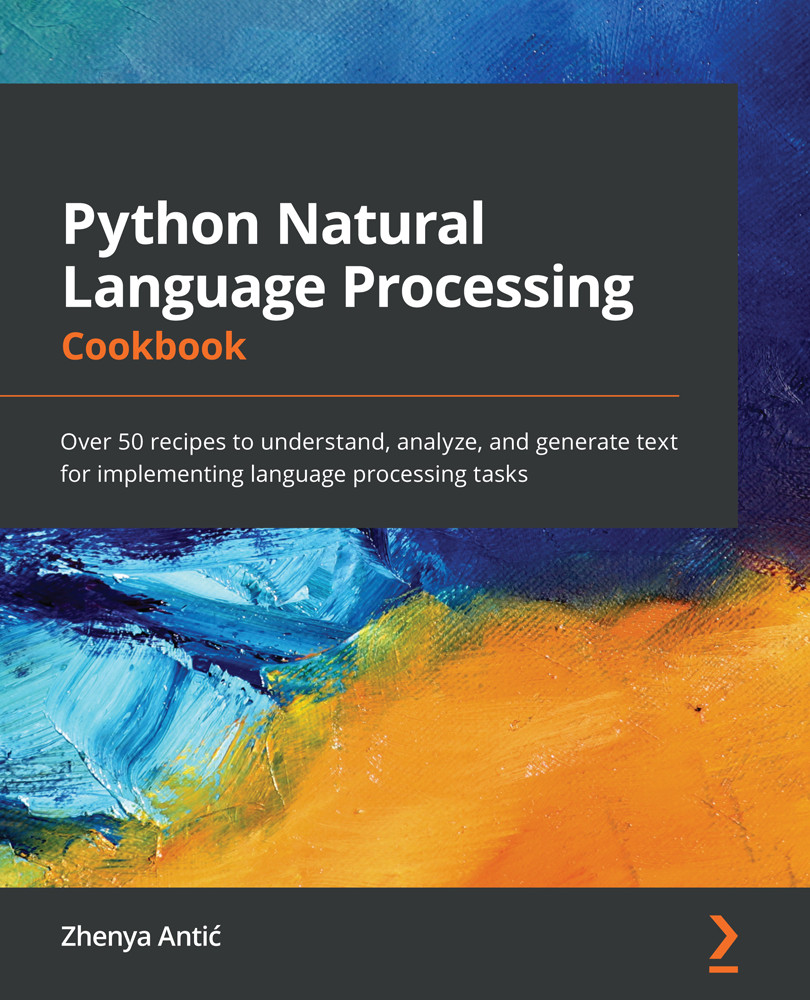
Python Natural Language Processing Cookbook

Python Natural Language Processing Cookbook

By : Zhenya Antić
4.4 (18)
close
close
Python Natural Language Processing Cookbook

Python Natural Language Processing Cookbook

4.4 (18)
By: Zhenya Antić

Overview of this book

Python is the most widely used language for natural language processing (NLP) thanks to its extensive tools and libraries for analyzing text and extracting computer-usable data. This book will take you through a range of techniques for text processing, from basics such as parsing the parts of speech to complex topics such as topic modeling, text classification, and visualization. Starting with an overview of NLP, the book presents recipes for dividing text into sentences, stemming and lemmatization, removing stopwords, and parts of speech tagging to help you to prepare your data. You’ll then learn ways of extracting and representing grammatical information, such as dependency parsing and anaphora resolution, discover different ways of representing the semantics using bag-of-words, TF-IDF, word embeddings, and BERT, and develop skills for text classification using keywords, SVMs, LSTMs, and other techniques. As you advance, you’ll also see how to extract information from text, implement unsupervised and supervised techniques for topic modeling, and perform topic modeling of short texts, such as tweets. Additionally, the book shows you how to develop chatbots using NLTK and Rasa and visualize text data. By the end of this NLP book, you’ll have developed the skills to use a powerful set of tools for text processing.
Table of Contents (10 chapters)
close
close

Using SVMs for supervised text classification

In this recipe, we will build a machine learning classifier that uses the SVM algorithm. By the end of the recipe, you will have a working classifier that you will be able to test on new inputs and evaluate using the same classification_report tools as we used in the previous sections.

Getting ready

We will continue working with the same packages that we already installed in the previous recipes.

How to do it…

We will start with the already familiar steps of dividing data into training and testing sets and creating a vectorizer. We will then train the SVM classifier and evaluate it.

Your steps are as follows:

  1. Import the necessary functions and packages:
    import numpy as np
    import pandas as pd
    import string
    import pickle
    from sklearn import svm
    from sklearn import preprocessing
    from sklearn.metrics import classification_report
    from sklearn.model_selection import train_test_split
    from sklearn.feature_extraction...
CONTINUE READING
83
Tech Concepts
36
Programming languages
73
Tech Tools
Icon Unlimited access to the largest independent learning library in tech of over 8,000 expert-authored tech books and videos.
Icon Innovative learning tools, including AI book assistants, code context explainers, and text-to-speech.
Icon 50+ new titles added per month and exclusive early access to books as they are being written.
Python Natural Language Processing Cookbook
notes
bookmark Notes and Bookmarks search Search in title playlist Add to playlist download Download options font-size Font size

Change the font size

margin-width Margin width

Change margin width

day-mode Day/Sepia/Night Modes

Change background colour

Close icon Search
Country selected

Close icon Your notes and bookmarks

Confirmation

Modal Close icon
claim successful

Buy this book with your credits?

Modal Close icon
Are you sure you want to buy this book with one of your credits?
Close
YES, BUY

Submit Your Feedback

Modal Close icon
Modal Close icon
Modal Close icon