


-
Book Overview & Buying
-
Table Of Contents

AI Agents in Practice
By :


AI Agents in Practice
By:
Overview of this book
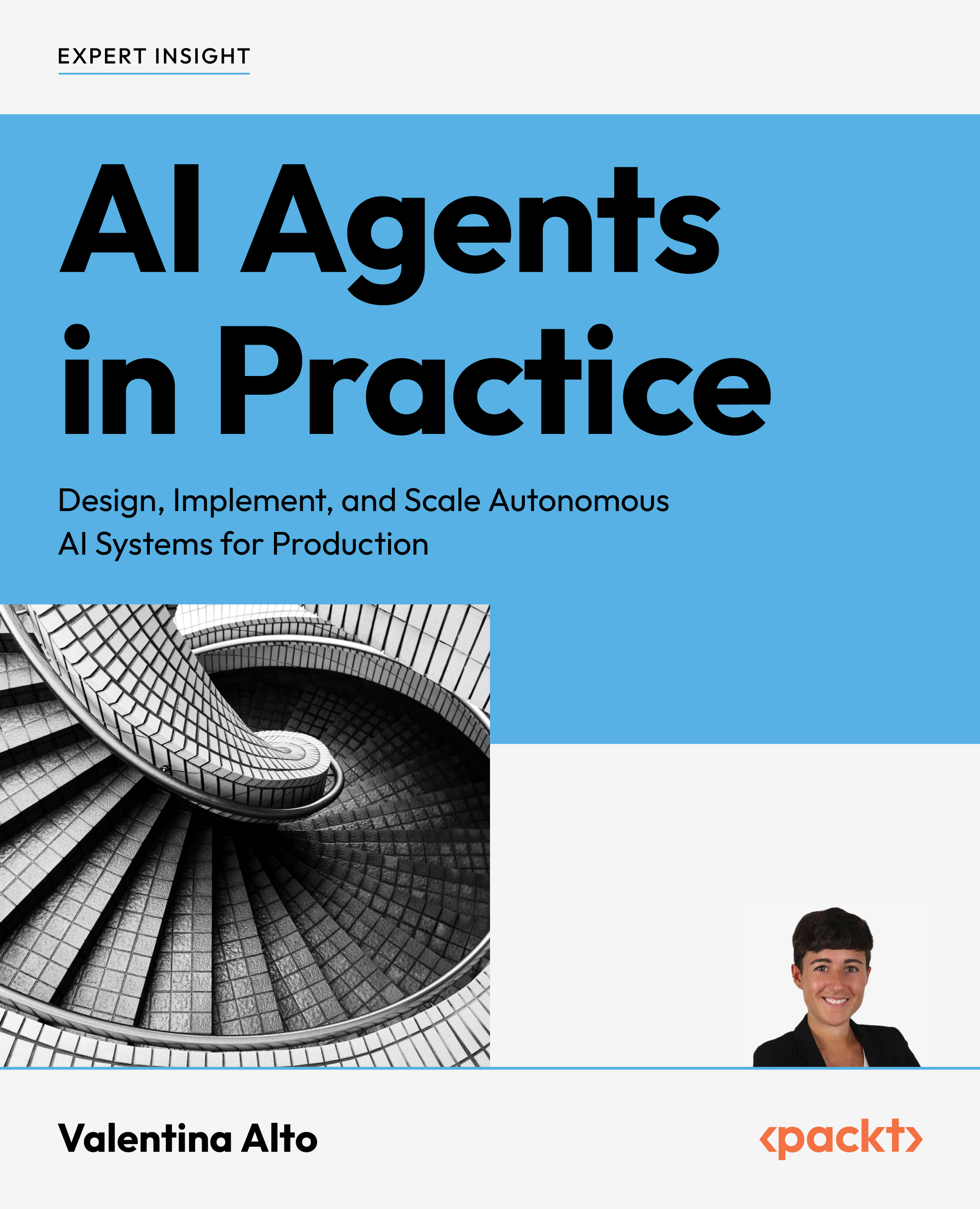
As AI agents evolve to take on complex tasks and operate autonomously, you need to learn how to build these next-generation systems. Author Valentina Alto brings practical, industry-grounded expertise in AI Agents in Practice to help you go beyond simple chatbots and create AI agents that plan, reason, collaborate, and solve real-world problems using large language models (LLMs) and the latest open-source frameworks.
In this book, you'll get a comparative tour of leading AI agent frameworks such as LangChain and LangGraph, covering each tool's strengths, ideal use cases, and how to apply them in real-world projects. Through step-by-step examples, you’ll learn how to construct single-agent and multi-agent architectures using proven design patterns to orchestrate AI agents working together. Case studies across industries will show you how AI agents drive value in real-world scenarios, while guidance on responsible AI will help you implement ethical guardrails from day one. The chapters also set the stage with a brief history of AI agents, from early rule-based systems to today's LLM-driven autonomous agents, so you understand how we got here and where the field is headed.
By the end of this book, you'll have the practical skills, design insights, and ethical foresight to build and deploy AI agents that truly make an impact.
Table of Contents (15 chapters)
Preface


 Free Chapter
Part 1: Foundations of AI Workflows and the Rise of AI Agents
Evolution of GenAI Workflows
The Rise of AI Agents
Part 2: Designing, Building, and Scaling AI Agents
The Need for an AI Orchestrator

The Need for Memory and Context Management
The Need for Tools and External Integrations
Building Your First AI Agent with LangChain
Multi-Agent Applications
Part 3: Road to an Open, Agentic Ecosystem
Orchestrating Intelligence: Blueprint for Next-Gen Agent Protocols
Navigating Ethical Challenges in Real-World AI
Other Books You May Enjoy
Index


