Sign In Start Free Trial
Account

Add to playlist

Create a Playlist

Modal Close icon
You need to login to use this feature.
  • Book Overview & Buying Entity Framework Tutorial (Update)
  • Table Of Contents Toc
  • Feedback & Rating feedback
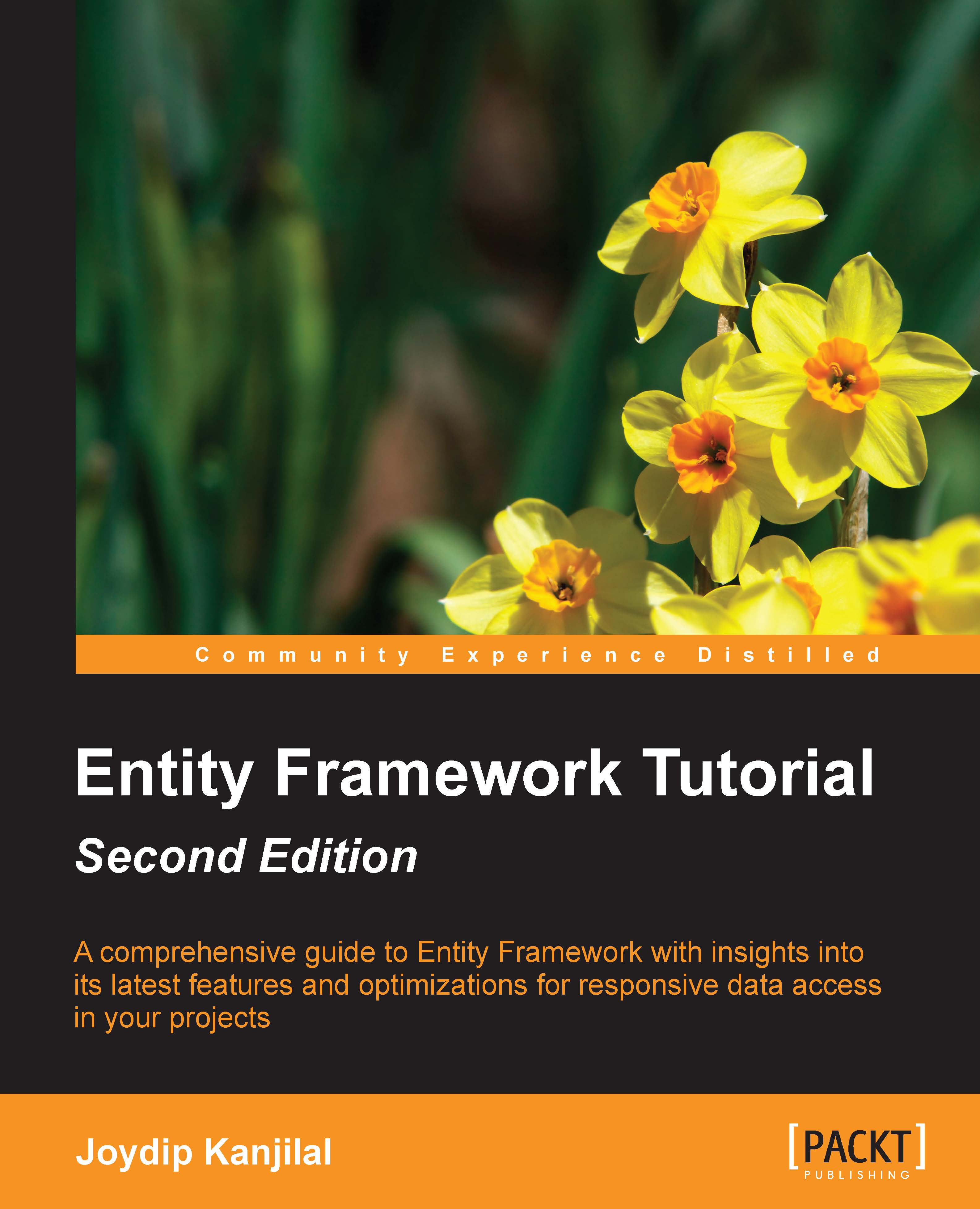
Entity Framework Tutorial (Update)

Entity Framework Tutorial (Update) - Second Edition

By : Joydip Kanjilal
2 (4)
close
close
Entity Framework Tutorial (Update)

Entity Framework Tutorial (Update)

2 (4)
By: Joydip Kanjilal

Overview of this book

The ADO.NET Entity Framework from Microsoft is a new ADO.NET development framework that provides a level of abstraction for data access strategies and solves the impedance mismatch issues that exist between different data models This book explores Microsoft’s Entity Framework and explains how it can used to build enterprise level applications. It will also teach you how you can work with RESTful Services and Google’s Protocol Buffers with Entity Framework and WCF. You will explore how to use Entity Framework with ASP.NET Web API and also how to consume the data exposed by Entity Framework from client applications of varying types, i.e., ASP.NET MVC, WPF and Silverlight. You will familiarize yourself with the new features and improvements introduced in Entity Framework including enhanced POCO support, template-based code generation, tooling consolidation and connection resiliency. By the end of the book, you will be able to successfully extend the new functionalities of Entity framework into your project.
Table of Contents (11 chapters)
close
close
10
Index

Working with the ADO.NET Entity Client


The ADO.NET Entity Client is a data provider that provides a gateway to execute entity level queries using Entity Framework. You can use it to query against your conceptual model of data. Entity Client uses its own language called E-SQL, a storage independent language, to communicate with the conceptual model. You can execute the same E-SQL query against any data store. In other words, it is provider independent, and you need not make changes to your query if the underlying data store changes. Therefore, you can use the same E-SQL syntax to communicate to the conceptual model, regardless of the data store in use.

The E-SQL queries are converted to a command tree that is in turn passed to the storage-specific provider to generate native SQL statements. As an example, if you are using SQL Server as the database, the E-SQL queries that you are using will be converted to a command tree that will be passed to the ADO.NET provider for the SQL Server. This...

Visually different images
CONTINUE READING
83
Tech Concepts
36
Programming languages
73
Tech Tools
Icon Unlimited access to the largest independent learning library in tech of over 8,000 expert-authored tech books and videos.
Icon Innovative learning tools, including AI book assistants, code context explainers, and text-to-speech.
Icon 50+ new titles added per month and exclusive early access to books as they are being written.
Entity Framework Tutorial (Update)
notes
bookmark Notes and Bookmarks search Search in title playlist Add to playlist font-size Font size

Change the font size

margin-width Margin width

Change margin width

day-mode Day/Sepia/Night Modes

Change background colour

Close icon Search
Country selected

Close icon Your notes and bookmarks

Confirmation

Modal Close icon
claim successful

Buy this book with your credits?

Modal Close icon
Are you sure you want to buy this book with one of your credits?
Close
YES, BUY

Submit Your Feedback

Modal Close icon
Modal Close icon
Modal Close icon