Sign In Start Free Trial
Account

Add to playlist

Create a Playlist

Modal Close icon
You need to login to use this feature.
  • Book Overview & Buying Mastering RStudio: Develop, Communicate, and Collaborate with R
  • Table Of Contents Toc
  • Feedback & Rating feedback
Mastering RStudio: Develop, Communicate, and Collaborate with R

Mastering RStudio: Develop, Communicate, and Collaborate with R

By : Julian Hillebrand, Nierhoff
4.6 (5)
close
close
Mastering RStudio: Develop, Communicate, and Collaborate with R

Mastering RStudio: Develop, Communicate, and Collaborate with R

4.6 (5)
By: Julian Hillebrand, Nierhoff

Overview of this book

RStudio helps you to manage small to large projects by giving you a multi-functional integrated development environment, combined with the power and flexibility of the R programming language, which is becoming the bridge language of data science for developers and analyst worldwide. Mastering the use of RStudio will help you to solve real-world data problems. This book begins by guiding you through the installation of RStudio and explaining the user interface step by step. From there, the next logical step is to use this knowledge to improve your data analysis workflow. We will do this by building up our toolbox to create interactive reports and graphs or even web applications with Shiny. To collaborate with others, we will explore how to use Git and GitHub and how to build your own packages to ensure top quality results. Finally, we put it all together in an interactive dashboard written with R.
Table of Contents (12 chapters)
close
close
11
Index

Using branches


A big advantage of Git is that we can not only use it really well for smaller projects, on which just a few people work, but also for much bigger software projects on which several hundred developers work. And so, Git provides a lot of different tools to manage all kinds of different situations.

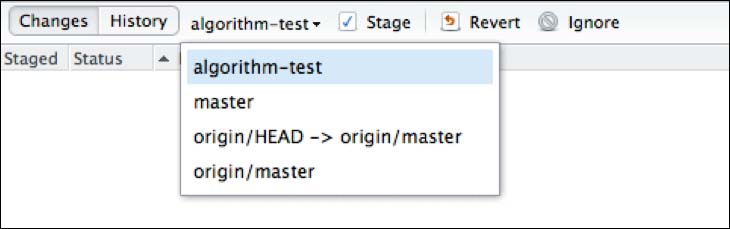
One of the most important functions is called Branches. They give us the ability to try out something experimental or split our commits. The default branch is master. So, you actually have already been using branches, as this branch was where you committed all your changes to.

We can create our own branches with the checkout function:

git checkout –b <branch name>

After we create our new branch, we can see it in the Git pane in RStudio. So, we can actually choose in what branch we want to commit our staged changes.

To actually to use the push and pull functions with this branch, we need to tell RStudio that there is a remote equivalent connected to this local branch. We can do this...

Visually different images
CONTINUE READING
83
Tech Concepts
36
Programming languages
73
Tech Tools
Icon Unlimited access to the largest independent learning library in tech of over 8,000 expert-authored tech books and videos.
Icon Innovative learning tools, including AI book assistants, code context explainers, and text-to-speech.
Icon 50+ new titles added per month and exclusive early access to books as they are being written.
Mastering RStudio: Develop, Communicate, and Collaborate with R
notes
bookmark Notes and Bookmarks search Search in title playlist Add to playlist font-size Font size

Change the font size

margin-width Margin width

Change margin width

day-mode Day/Sepia/Night Modes

Change background colour

Close icon Search
Country selected

Close icon Your notes and bookmarks

Confirmation

Modal Close icon
claim successful

Buy this book with your credits?

Modal Close icon
Are you sure you want to buy this book with one of your credits?
Close
YES, BUY

Submit Your Feedback

Modal Close icon
Modal Close icon
Modal Close icon