Sign In Start Free Trial
Account

Add to playlist

Create a Playlist

Modal Close icon
You need to login to use this feature.
  • Book Overview & Buying FuelPHP Application Development Blueprints
  • Table Of Contents Toc
  • Feedback & Rating feedback
FuelPHP Application Development Blueprints

FuelPHP Application Development Blueprints

By : Sebastien Drouyer
4.4 (5)
close
close
FuelPHP Application Development Blueprints

FuelPHP Application Development Blueprints

4.4 (5)
By: Sebastien Drouyer

Overview of this book

This book is for intermediary to seasoned web developers who want to learn how to use the FuelPHP framework and build complex projects using it. You should be familiar with PHP, HTML, CSS, and JavaScript, but no prior knowledge about MVC frameworks is required.
Table of Contents (8 chapters)
close
close
7
Index

Development process of a FuelPHP application

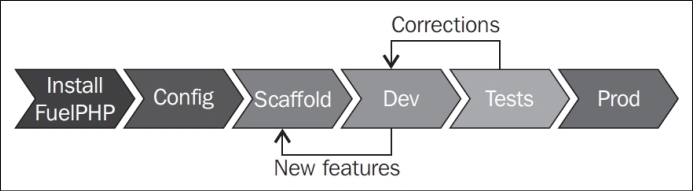
The development process of a FuelPHP application generally contains the steps shown in the following image:

Development process of a FuelPHP application
  • Install FuelPHP: Since we are using this framework, this first step is quite obvious.
  • Config (configuration): At the beginning, you will generally need to specify how to connect to the database and which package you will use. Later on, you might also need to create and use your own configuration files to improve the maintainability of your application.
  • Scaffold: The oil command line of FuelPHP allows you to easily generate code files ready to be used. This step is not necessary, but we will often use this functionality in this book because it really speeds up the implementation of your application.
  • Dev (development): This is where you, as a developer, step in. You customize the generated code to get exactly what you want. When you want to add new features (for instance a new model), you go back to the scaffolding step.
  • Tests: Functional and unit testing are important if you want large applications to stay maintainable. When bugs are discovered, you go back to the development step in order to fix them. Unlike the other steps, we won't approach this subject in this chapter for the sake of its conciseness. It will be addressed in Chapter 5, Building Your Own RESTful API.
  • Prod (production): Having a project working locally is nice, but the final objective is generally to publish it online. We will give you some directions about this step at the end of this chapter, but we won't get too much into the details, given the diversity of available hosting services.

Just to be clear, this is a very general guideline, and of course the order of the steps is not rigid. For instance, developers using the test-driven development process could merge the fourth and fifth steps, or a preproduction step could be added. The development process should only depend on each developer and institution's standards.

Visually different images
CONTINUE READING
83
Tech Concepts
36
Programming languages
73
Tech Tools
Icon Unlimited access to the largest independent learning library in tech of over 8,000 expert-authored tech books and videos.
Icon Innovative learning tools, including AI book assistants, code context explainers, and text-to-speech.
Icon 50+ new titles added per month and exclusive early access to books as they are being written.
FuelPHP Application Development Blueprints
notes
bookmark Notes and Bookmarks search Search in title playlist Add to playlist font-size Font size

Change the font size

margin-width Margin width

Change margin width

day-mode Day/Sepia/Night Modes

Change background colour

Close icon Search
Country selected

Close icon Your notes and bookmarks

Confirmation

Modal Close icon
claim successful

Buy this book with your credits?

Modal Close icon
Are you sure you want to buy this book with one of your credits?
Close
YES, BUY

Submit Your Feedback

Modal Close icon
Modal Close icon
Modal Close icon