Sign In Start Free Trial
Account

Add to playlist

Create a Playlist

Modal Close icon
You need to login to use this feature.
  • Book Overview & Buying Mastering F#
  • Table Of Contents Toc
Mastering F#

Mastering F#

By : García-Caro Núñez, Fahad
2.5 (2)
close
close
Mastering F#

Mastering F#

2.5 (2)
By: García-Caro Núñez, Fahad

Overview of this book

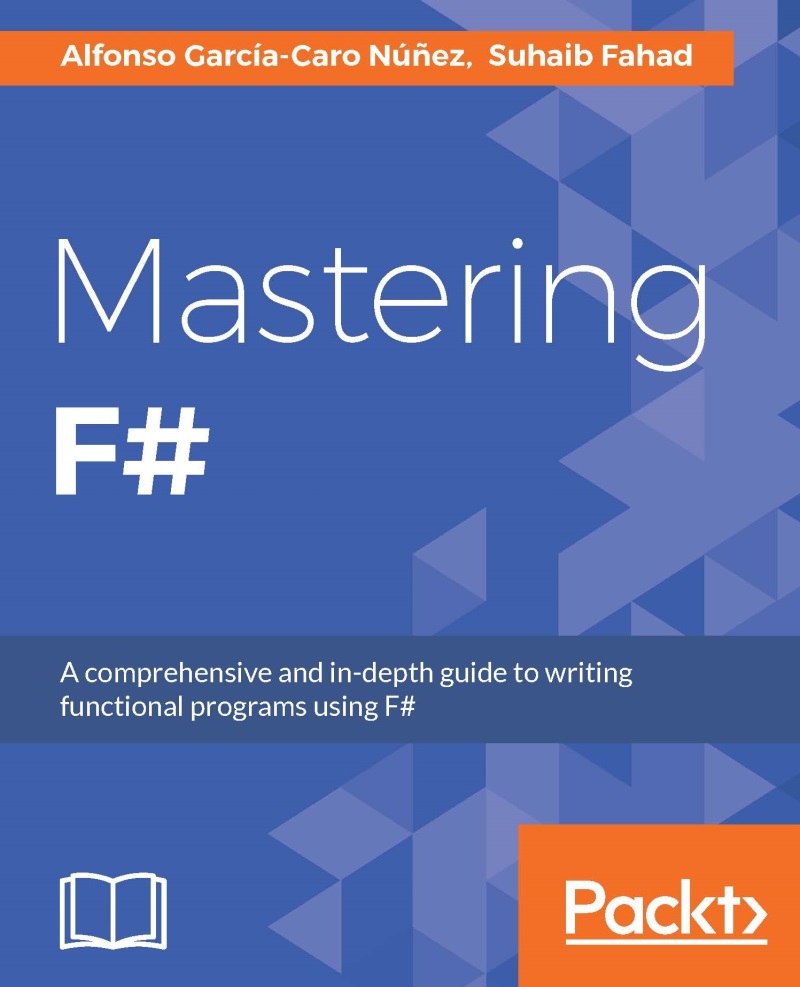
F# is a multi-paradigm programming language that encompasses object-oriented, imperative, and functional programming language properties. Now adopted in a wide range of application areas and is supported both by industry-leading companies who provide professional tools and by an active open community, F# is rapidly gaining popularity as it emerges in digital music advertising, creating music-focused ads for Spotify, Pandora, Shazam, and anywhere on the web. This book will guide you through the basics and will then help you master F#. The book starts by explaining how to use F# with Visual Studio, file ordering, and the differences between F# and C# in terms of usage. It moves on to explain the functional core of F# such as data types, type declarations, immutability, strong type interference, pattern matching, records, F# data structures, sequence expressions, and lazy evaluation. Next, the book takes you through imperative and asynchronous programming, F# type providers, applications, and testing in F#. Finally, we look into using F# with distributed programming and using F# as a suitable language for data science. In short, this book will help you learn F# for real-world applications and increase your productivity with functional programming.
Table of Contents (11 chapters)
close
close

Actor Model

The concept of the actor programming model is very simple-our program components can be decoupled by replacing direct function calls with asynchronous messages. Different implementations of the Actor Model add other features around this idea, but at minimum, the decoupled components (the actors) include a message queue, which is thread-safe and acts as a buffer if messages come faster than the actor can process them. This is how the F# MailboxProcessor works.

MailboxProcessor

The MailboxProcessor class in the FSharp.Core library is used to build concurrent actors. It has some limitations, such as not being able to do interprocess communication or to persist messages in the queue in case our application crashes. But it is a very good way to easily include actors in our F# program without any additional dependencies.

As an exercise, we are going to build a dummy chat application, which includes a couple of bot users generating random messages and a human user, you. Let...

CONTINUE READING
83
Tech Concepts
36
Programming languages
73
Tech Tools
Icon Unlimited access to the largest independent learning library in tech of over 8,000 expert-authored tech books and videos.
Icon Innovative learning tools, including AI book assistants, code context explainers, and text-to-speech.
Icon 50+ new titles added per month and exclusive early access to books as they are being written.
Mastering F#
notes
bookmark Notes and Bookmarks search Search in title playlist Add to playlist font-size Font size

Change the font size

margin-width Margin width

Change margin width

day-mode Day/Sepia/Night Modes

Change background colour

Close icon Search
Country selected

Close icon Your notes and bookmarks

Confirmation

Modal Close icon
claim successful

Buy this book with your credits?

Modal Close icon
Are you sure you want to buy this book with one of your credits?
Close
YES, BUY

Submit Your Feedback

Modal Close icon
Modal Close icon
Modal Close icon