Sign In Start Free Trial
Account

Add to playlist

Create a Playlist

Modal Close icon
You need to login to use this feature.
  • Book Overview & Buying Clojure for Java Developers
  • Table Of Contents Toc
Clojure for Java Developers

Clojure for Java Developers

close
close
Clojure for Java Developers

Clojure for Java Developers

Overview of this book

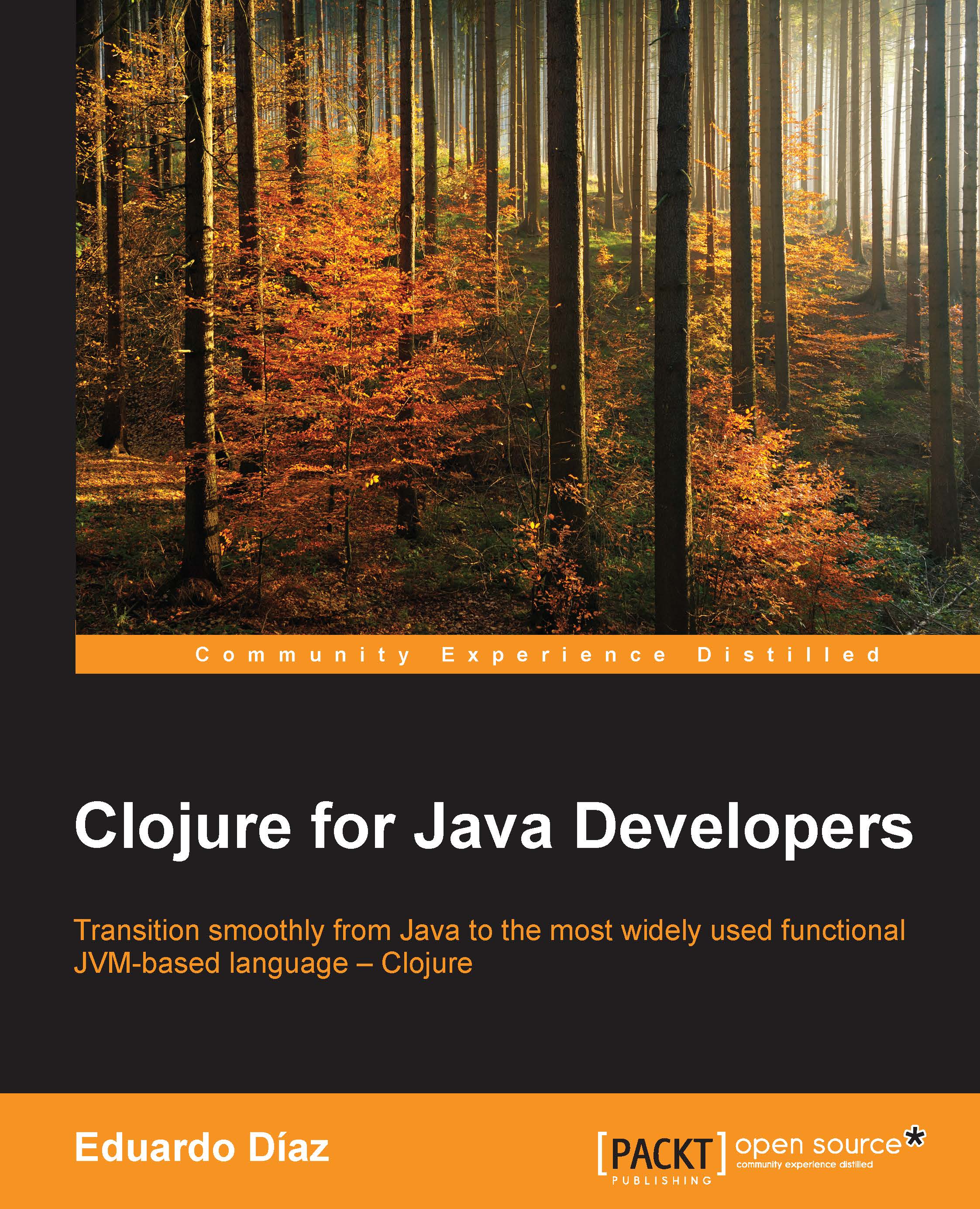
We have reached a point where machines are not getting much faster, software projects need to be delivered quickly, and high quality in software is more demanding as ever. We need to explore new ways of writing software that helps achieve those goals. Clojure offers a new possibility of writing high quality, multi-core software faster than ever, without having to leave your current platform. Clojure for Java developers aims at unleashing the true potential of the Clojure language to use it in your projects. The book begins with the installation and setup of the Clojure environment before moving on to explore the language in-depth. Get acquainted with its various features such as functional programming, concurrency, etc. with the help of example projects. Additionally, you will also, learn how the tooling works, and how it interacts with the Java environment. By the end of this book, you will have a firm grip on Clojure and its features, and use them effectively to write more robust programs.
Table of Contents (9 chapters)
close
close
8
Index

Persistent collections


One of the most important features in Clojure is that collections are persistent. That does not mean that they are persistent to disk, it means that you can have several historical versions of a collection with the guarantee that updating or looking for something in any of those versions is going to have the same effort (complexity). You get all this with very little extra memory.

How? It is actually pretty simple. Clojure shares a common structure between several different data structures. If you add a single element to a data structure, Clojure shares the common part between the two structures and keeps track of the differences.

Let's see what we mean with an example:

(def sample-coll [:one :two :three])
(def second-sample-coll (conj sample-coll :four))
(def third-sample-coll (replace {:one 1} sample-coll))

sample-coll ;; [:one :two :three]
second-sample-coll ;; [:one :two :three :four]
third-sample-coll ;; [1 :two :three :four]

As you can see, when you conj a new item...

CONTINUE READING
83
Tech Concepts
36
Programming languages
73
Tech Tools
Icon Unlimited access to the largest independent learning library in tech of over 8,000 expert-authored tech books and videos.
Icon Innovative learning tools, including AI book assistants, code context explainers, and text-to-speech.
Icon 50+ new titles added per month and exclusive early access to books as they are being written.
Clojure for Java Developers
notes
bookmark Notes and Bookmarks search Search in title playlist Add to playlist font-size Font size

Change the font size

margin-width Margin width

Change margin width

day-mode Day/Sepia/Night Modes

Change background colour

Close icon Search
Country selected

Close icon Your notes and bookmarks

Confirmation

Modal Close icon
claim successful

Buy this book with your credits?

Modal Close icon
Are you sure you want to buy this book with one of your credits?
Close
YES, BUY

Submit Your Feedback

Modal Close icon
Modal Close icon
Modal Close icon